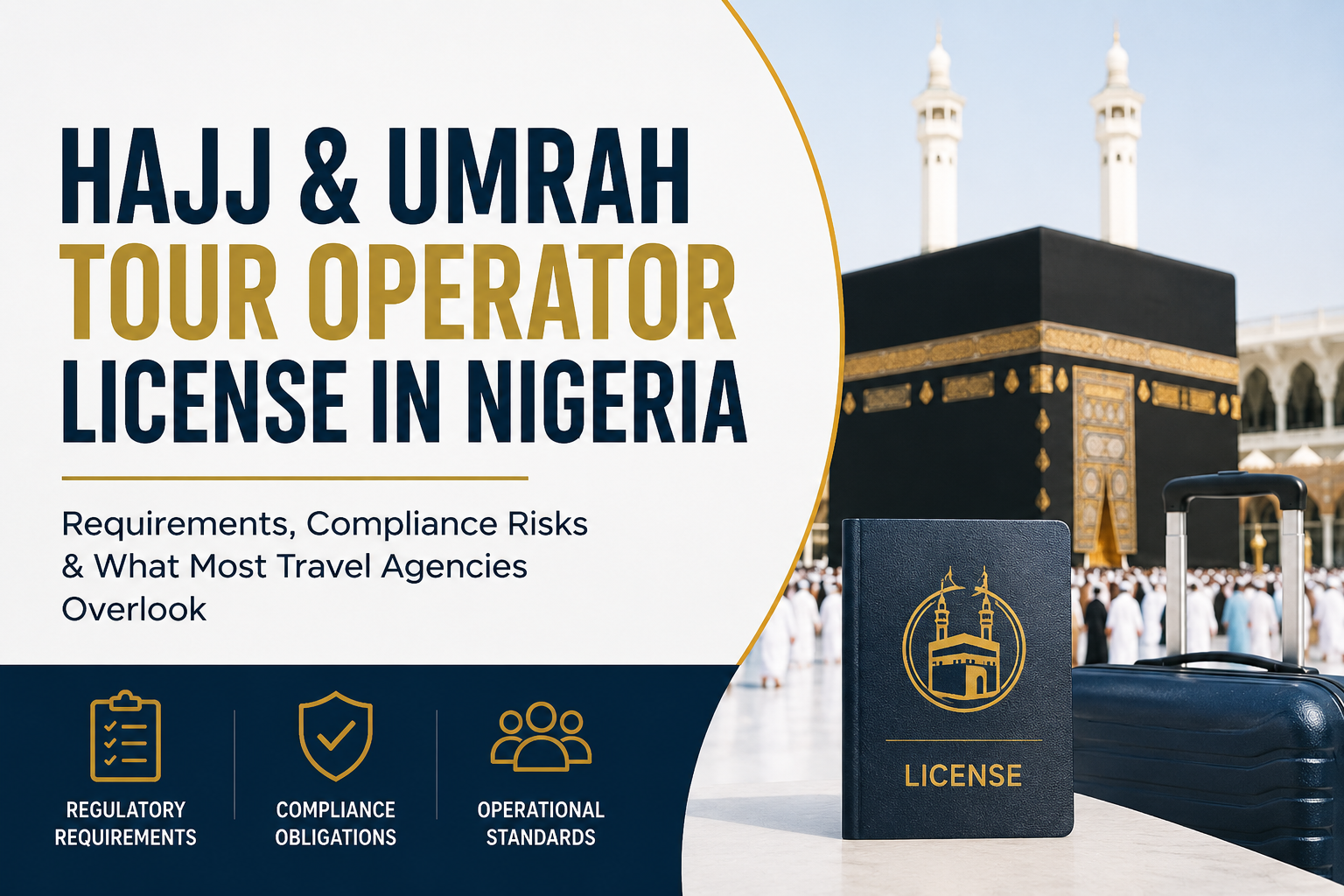
Religious tourism is one of the most sensitive and highly regulated sectors in Nigeria’s travel industry. Yet, many intending operators still assume that organising Hajj or Umrah pilgrimages is simply an extension of ordinary travel agency services.
It is not.
Obtaining a Hajj and Umrah Tour Operator License in Nigeria involves a complex regulatory framework administered by the National Hajj Commission of Nigeria (NAHCON), with strict compliance obligations that extend beyond incorporation documents and basic travel operations.
From aviation accreditation and financial thresholds to operational history and ongoing regulatory monitoring, the licensing process is designed to screen out inexperienced or underprepared operators before they are entrusted with pilgrims.
This article provides a comprehensive overview of the Hajj and Umrah Tour Operator licensing framework in Nigeria, including the regulatory requirements, hidden compliance issues, common misconceptions, and why many businesses underestimate the complexity of entering the pilgrimage industry.
Understanding the Hajj and Umrah Tour Operator License
A Hajj and Umrah Tour Operator License is an approval issued by the National Hajj Commission of Nigeria (NAHCON) authorising qualified travel agencies to organise and coordinate pilgrimage services for Nigerian pilgrims travelling to the Kingdom of Saudi Arabia for Hajj or Umrah.
Unlike a conventional tourism license, this approval is sector-specific and subject to strict operational oversight.
Licensed operators are typically expected to coordinate:
- Pilgrim registration and documentation
- Visa processing
- International flight arrangements
- Accommodation logistics
- Feeding and welfare services
- Ground transportation
- Religious guidance support
- Saudi Arabia operational coordination
- Pilgrim complaint management
Because of the international, religious, and welfare-sensitive nature of pilgrimage operations, NAHCON applies significantly higher compliance standards than those applicable to ordinary travel agencies.
The Regulatory Authority Responsible for Licensing
The National Hajj Commission of Nigeria (NAHCON) is the primary regulatory body responsible for:
- Licensing private Hajj and Umrah operators
- Monitoring pilgrimage operations
- Coordinating pilgrim welfare standards
- Conducting verification exercises
- Publishing approved operator lists
- Enforcing compliance and sanctions
- Liaising with Saudi Arabian authorities on pilgrimage matters
The Commission periodically warns intending pilgrims against dealing with unlicensed operators, underscoring the seriousness attached to regulatory compliance within the sector.
Why Many Travel Agencies Misunderstand the Licensing Process
One of the biggest misconceptions in the industry is the assumption that obtaining a Hajj or Umrah license is merely a documentation exercise.
In reality, the licensing process evaluates whether an applicant possesses the operational, financial, and technical capacity to manage pilgrimage logistics responsibly.
This distinction is critical.
Pilgrimage operations involve:
- International coordination
- Aviation compliance
- Religious welfare obligations
- Large-scale logistics management
- Public accountability
- Continuous regulatory monitoring
For this reason, NAHCON licensing guidelines contain requirements that many first-time applicants are not prepared for.
Key Eligibility Requirements for Hajj and Umrah Tour Operator License in Nigeria
The requirements applicable to Hajj and Umrah licensing are derived from NAHCON operational guidelines and licensing conditions.
Below are some of the most important regulatory expectations.
1. Incorporation of the Applicant Company
The applicant must be a duly incorporated company registered with the Corporate Affairs Commission (CAC).
However, incorporation alone is not sufficient.
Regulators typically assess whether the company structure, operational objectives, and business profile align with pilgrimage operations.
Issues such as poorly drafted business objects, inadequate corporate structure, or inconsistencies in company records may create avoidable compliance concerns during review.
2. Minimum Share Capital Requirement
One of the most significant barriers to entry is the financial threshold imposed on intending operators.
NAHCON licensing guidelines reference a minimum share capital requirement of:
₦30,000,000
for eligible travel agencies.
This requirement alone demonstrates that pilgrimage operations are not designed for informal or undercapitalised businesses.
Importantly, many applicants fail to appreciate the difference between:
- Authorised share capital
- Paid-up capital
- Operational liquidity
- Demonstrable financial capacity
Regulators often look beyond figures stated in incorporation documents.
3. IATA Accreditation Requirements
Another major compliance hurdle is aviation accreditation.
According to NAHCON guidelines, applicant companies are expected to possess:
- Valid IATA approval
- IATA-accredited personnel
This requirement significantly elevates the complexity of the licensing process because IATA accreditation itself involves separate operational and financial eligibility standards.
Many intending operators underestimate this aspect until they discover that ordinary travel agency registration does not automatically satisfy aviation compliance expectations.
4. Operational History and Industry Experience
One of the most overlooked aspects of the licensing framework is the emphasis on operational history.
Certain licensing conditions reference:
- Consecutive years of Umrah operations
- Previous Hajj licensing experience
- Evidence of license utilisation
- Satisfactory operational performance
This indicates that the regulator places substantial weight on industry experience and prior compliance history.
For new entrants, this is often where the process becomes more technically nuanced than anticipated.
5. Regulatory and Background Compliance
NAHCON guidelines also provide that applicant companies, directors, shareholders, representatives, and associated persons must not possess adverse criminal or regulatory records in Nigeria or Saudi Arabia.
This requirement reflects the international sensitivity of pilgrimage operations and the importance of maintaining integrity within the industry.
Depending on the circumstances, regulators may review:
- Previous compliance history
- Pilgrim complaints
- Regulatory sanctions
- Operational disputes
- Aviation-related violations
- International compliance concerns
The Hidden Compliance Burden Most Applicants Discover Too Late
Many businesses focus exclusively on obtaining approval while paying little attention to ongoing operational compliance.
This is a serious mistake.
The real regulatory burden often begins after licensing.
Licensed operators are expected to maintain standards relating to:
- Pilgrim welfare
- Accommodation quality
- Transportation coordination
- Visa management
- Flight logistics
- Complaint resolution
- Financial accountability
- Saudi operational procedures
Failure in any of these areas may expose operators to:
- Regulatory sanctions
- Suspension
- Delisting
- Loss of pilgrim allocation
- Reputational damage
- Public complaints
NAHCON has repeatedly conducted verification and assessment exercises for licensed operators as part of its oversight responsibilities.
Documentation Commonly Associated With the Licensing Process
Although documentation requirements may vary depending on the applicable licensing cycle, applicants are commonly expected to provide:
- CAC incorporation documents(which includes: Certificate of incorporation, CAC Form 7,2 or 1.1 and Memorandum and Articles of Association
- Tax clearance certificates
- VAT registration evidence
- Audited financial statements
- IATA approval documentation
- Staff accreditation records
- Corporate office evidence
- Operational history documentation
- Previous license utilisation evidence
- Compliance undertakings
However, one important point must be emphasised:
Possessing documents does not automatically establish regulatory compliance.
Regulators evaluate credibility, operational readiness, consistency, and the overall capacity of the applicant to manage pilgrimage operations responsibly.
Why Many Hajj and Umrah Operators Eventually Face Regulatory Issues
Pilgrimage operations involve unusually high reputational exposure.
Unlike ordinary tourism disputes, operational failures affecting pilgrims often attract immediate public scrutiny.
Common industry challenges include:
- Flight disruptions
- Accommodation disputes
- Visa complications
- Stranded pilgrims
- Welfare complaints
- Unauthorised charges
- Poor coordination in Saudi Arabia
This explains why NAHCON consistently cautions pilgrims against engaging unlicensed or non-compliant operators.
In this industry, even relatively small operational failures can escalate into major reputational crises.
The International Dimension of Hajj and Umrah Operations
Another reality many applicants fail to appreciate is that Nigerian licensing alone is not sufficient for successful pilgrimage operations.
Hajj and Umrah services intersect extensively with Saudi Arabian regulatory systems and approved service structures.
Operators may still encounter challenges relating to:
- Saudi-approved service providers
- Accommodation arrangements
- Pilgrim quotas
- Transportation systems
- Visa processing procedures
- Religious travel coordination
Consequently, operational preparedness requires far more than local incorporation and regulatory filing.
Common Misconceptions About Hajj and Umrah Licensing
“Any Travel Agency Can Organise Hajj Operations”
Incorrect.
Only operators licensed or approved by NAHCON are authorised to organise pilgrimage services.
“CAC Registration Is Enough”
False.
Corporate incorporation is merely the starting point. Financial, aviation, operational, and compliance requirements also apply.
“Umrah Operations Are Informal”
Incorrect.
Umrah operations remain regulated and subject to compliance monitoring and operational expectations.
“Licensing Guarantees Automatic Renewal”
Not necessarily.
Operational performance and compliance history may significantly influence future licensing outcomes.
“Small Compliance Errors Do Not Matter”
In pilgrimage operations, small mistakes can quickly become public controversies with regulatory implications.
Why Regulatory Interpretation Matters
One of the least understood aspects of the licensing process is regulatory interpretation.
Many provisions within licensing guidelines appear straightforward until implementation begins.
For example:
- What qualifies as satisfactory operational performance?
- What level of evidence proves effective license utilisation?
- What operational deficiencies may become disqualifying?
- How are compliance concerns assessed during review?
These are the areas where many inexperienced applicants encounter difficulties.
And unfortunately, those mistakes often become expensive to correct.
Frequently Asked Questions (FAQs)
Who issues the Hajj and Umrah Tour Operator License in Nigeria?
The license is issued by the National Hajj Commission of Nigeria (NAHCON).
What is the minimum share capital requirement?
Official guidelines reference a minimum share capital requirement of ₦30 million for eligible operators.
Is IATA accreditation mandatory?
Yes. NAHCON guidelines reference valid IATA accreditation and qualified personnel as part of the licensing conditions.
Can a newly incorporated company apply immediately?
The practical answer depends on the applicable licensing cycle and operational requirements in force at the time of application.
Certain guidelines reference operational history and evidence of prior performance.
Does NAHCON publish lists of approved operators?
Yes. The Commission periodically publishes lists of licensed tour operators.
Can an operator lose its license?
Yes. Regulatory breaches, operational failures, or non-compliance may expose operators to sanctions or licensing consequences.
Is Saudi Arabia compliance relevant to Nigerian operators?
Absolutely.
Pilgrimage operations involve coordination with Saudi Arabian service systems and regulatory procedures.
Final Thoughts
The phrase “Hajj and Umrah Tour Operator License” may sound straightforward on the surface, but the underlying regulatory framework is significantly more demanding than many businesses anticipate.
This is not merely a tourism permit.
It is a highly regulated operational authorisation involving:
- Financial scrutiny
- Aviation compliance
- International coordination
- Pilgrim welfare obligations
- Operational monitoring
- Ongoing regulatory oversight
For serious operators, success in this sector requires more than filing documents.
It requires proper corporate structuring, regulatory preparedness, operational systems, and a deep understanding of compliance expectations within both Nigerian and Saudi pilgrimage frameworks.
Businesses that underestimate the complexity of the process often discover too late that pilgrimage regulation is one of the few sectors where operational mistakes can simultaneously become legal, reputational, financial, and public relations problems.
And in an industry built on trust, credibility is everything.

