
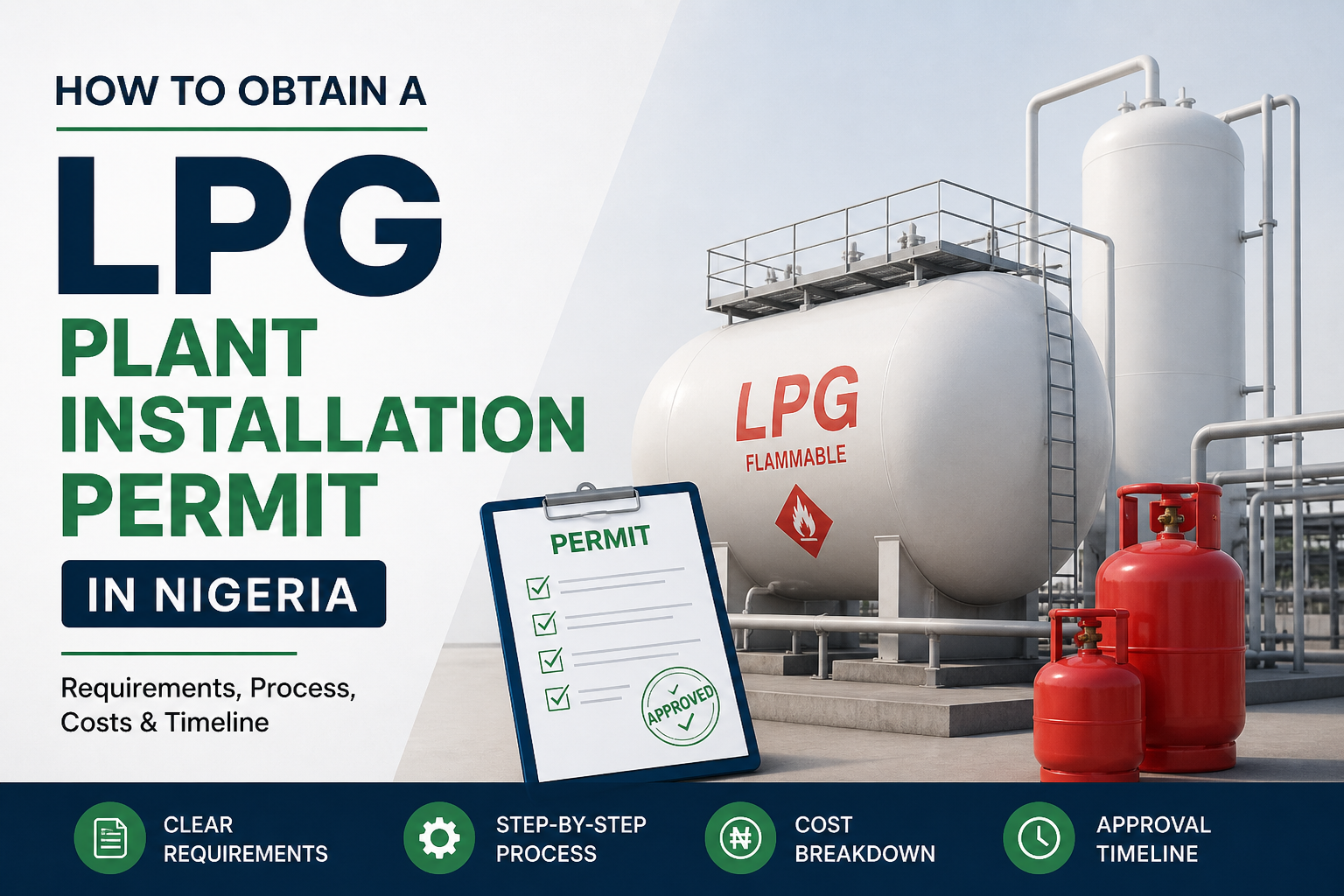
Starting a Liquefied Petroleum Gas (LPG) plant in Nigeria is one of the most profitable downstream oil and gas investments, but it is also one of the most highly regulated. If you are planning to set up a cooking gas plant, understanding how to obtain a LPG plant installation permit in Nigeria is critical to avoiding delays, penalties, or outright shutdown.
This guide provides everything you need, from official requirements, step-by-step procedures, costs, documents, timelines, and FAQs, based strictly on regulatory frameworks and guidance issued by the Nigerian Midstream and Downstream Petroleum Regulatory Authority (NMDPRA), formerly DPR.
Table of Contents
- Overview of LPG Licensing in Nigeria
- Legal Framework & Regulatory Authority
- Types of LPG Licenses & Permits
- Step-by-Step Process to Obtain LPG Plant Installation Permit
- Requirements & Documents (Official Checklist)
- Technical & Safety Standards
- Cost Breakdown (Government Fees & Professional Costs)
- Timeline for Approval
- Inspection & Compliance Process
- Common Mistakes to Avoid
- FAQs (People Also Ask)
- Misconceptions About LPG Plant Licensing
- Final Thoughts
1. Overview of LPG Licensing in Nigeria
LPG plant installation in Nigeria is governed under the Petroleum Industry regulatory regime. You cannot legally construct, install, or operate a gas plant without regulatory approval.
The licensing process is structured into phases, each requiring separate approvals before proceeding to the next.
According to official regulatory procedures, the process involves:
- Site approval
- Approval to construct/install
- Final operating license
These are processed electronically via the NMDPRA licensing portal.
2. Legal Framework & Regulatory Authority
The primary regulator is:
Nigerian Midstream and Downstream Petroleum Regulatory Authority
Established under the Petroleum Industry Act (2021), NMDPRA oversees all midstream and downstream petroleum activities, including LPG plant licensing.
Previously handled by DPR, the responsibility now lies fully with NMDPRA.
3. Types of LPG Licenses & Permits
To fully establish an LPG plant, you must obtain the following permits sequentially:
| License Type | Description |
|---|---|
| Site Suitability Approval | Confirms location is safe and compliant |
| Approval to Install (ATI) | Permission to construct the plant |
| License to Operate (LTO) | Final permit to commence operations |
| Legacy License (optional) | For existing manual licenses |
These stages are explicitly listed on the official licensing workflow.
4. Step-by-Step Process to Obtain LPG Plant Installation Permit
Step 1: Register on the NMDPRA Portal
- Visit the official LPG licensing portal
- Create an account on the Central Electronic Licensing System (CELPS)
- Provide company details and verify email
Step 2: Apply for Site Suitability
Submit:
- Proposed location details
- Layout plan
- Land documents
The regulator evaluates:
- Safety distance
- Environmental impact
- Proximity to buildings
Step 3: Environmental & Safety Assessment
You must obtain:
- Environmental Impact Assessment (EIA)
- Fire Service clearance
- Safety plan
This ensures compliance with environmental and safety regulations.
Step 4: Apply for Approval to Install (ATI)
Submit:
- Engineering design drawings
- Tank specifications
- Equipment details
- Safety systems
Important:
No LPG plant can be constructed without this approval.
Step 5: Construction & Inspection
After ATI approval:
- Construct according to approved design
- Install tanks, piping, and safety systems
Regulators will:
- Conduct site inspections
- Verify compliance
Step 6: Apply for License to Operate (LTO)
Once construction is complete:
- Submit completion report
- Request final inspection
If successful, you will be issued an LPG operating license.
5. Requirements & Documents (Official Checklist)
Below is a complete checklist based on regulatory guidance:
Corporate Documents
- Certificate of Incorporation (CAC)
- Tax Clearance Certificate
- Company profile
Land & Location Documents
- Land title (C of O or lease agreement)
- Survey plan
- Town planning approval
Technical Documents
- Engineering design drawings
- Tank test reports
- Equipment specifications
Safety & Environmental Documents
- Environmental Impact Assessment
- Fire Service approval
- Emergency response plan
Financial Documents
- Proof of funding
- Project cost estimate
These align with regulatory expectations for licensing approval.
6. Technical & Safety Standards
LPG plants must meet strict engineering and safety standards:
Storage Requirements
- Pressure vessels rated for LPG storage
- Corrosion-resistant materials
- Pressure relief valves
Safety Distances
- Minimum distance from buildings and ignition sources
- Typically between 3–10 meters depending on capacity
Emergency Systems
- Fire suppression systems
- Gas leak detection
- Emergency shutdown systems
7. Cost Breakdown (Nigeria LPG Permit Cost)
Government Fees (Estimated)
| Permit | Official Fee |
|---|---|
| Application Fee | ₦10,000 |
| License to Operate | ₦150,000 |
| Inspection Fees | Varies |
| Renewal Fees | Annual |
Professional & Setup Costs
| Item | Estimated Cost |
|---|---|
| Consultancy | ₦500,000 – ₦3M |
| EIA Report | ₦300,000 – ₦2M |
| Fire Certification | ₦100,000 – ₦500,000 |
| Engineering Design | ₦1M – ₦5M |
Capital Investment (Plant Setup)
| Plant Size | Cost |
|---|---|
| Mini Plant | ₦15M – ₦40M |
| Medium Plant | ₦50M – ₦150M |
| Large Plant | ₦200M+ |
8. Timeline for Approval
| Stage | Duration |
|---|---|
| Site Approval | 2–4 weeks |
| ATI Approval | 1–3 months |
| Construction | 2–6 months |
| Final License | 2–4 weeks |
Total Estimated Time: 3–9 months
9. Inspection & Compliance Process
Regulators will conduct:
- Pre-construction inspection
- Mid-construction inspection
- Final commissioning inspection
They evaluate:
- Safety systems
- Equipment quality
- Compliance with approved design
Failure may result in:
- Rejection
- Delays
- Additional costs
10. Common Mistakes to Avoid
- Starting construction without ATI approval
- Using substandard equipment
- Ignoring safety distances
- Submitting incomplete documents
- Not using certified consultants
11. Frequently Asked Questions (People Also Ask)
1. How much does it cost to get LPG plant license in Nigeria?
Government fees are relatively low (₦10,000–₦150,000), but total costs including consultancy and compliance can exceed ₦1M–₦5M.
2. How long does it take to get LPG plant permit?
Typically 3–9 months, depending on documentation and approval speed.
3. Can I build a gas plant without approval?
No. Construction without approval is illegal and may lead to closure.
4. What agency issues LPG license in Nigeria?
The Nigerian Midstream and Downstream Petroleum Regulatory Authority.
5. Is EIA mandatory?
Yes, for most LPG plant projects.
12. Common Misconceptions
“Only big companies need licenses”
False. Even mini LPG plants must be licensed.
“You can build first and regularise later”
Wrong. Approval must come before construction.
“License is one-time”
Incorrect. Licenses require periodic renewal.
13. Final Thoughts
Obtaining a LPG (Cooking Gas) Plant Installation Permit in Nigeria is a structured but achievable process if you follow regulatory guidelines strictly.
The key to success lies in:
- Proper documentation
- Compliance with safety standards
- Following the correct licensing stages
With Nigeria’s growing demand for LPG, this sector presents massive investment potential, but only for those who operate within the law.

