
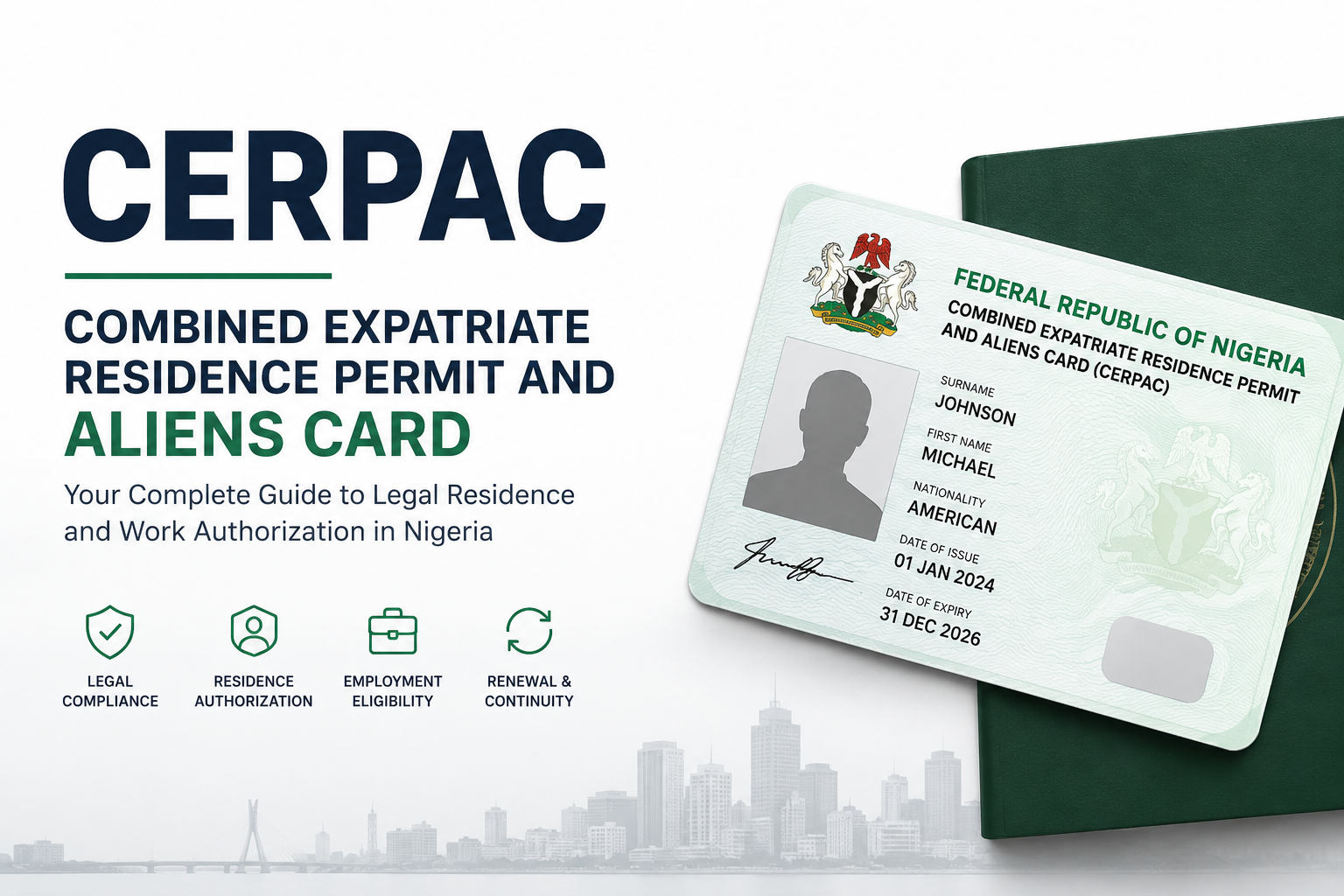
Nigeria’s immigration environment has changed significantly in recent years. What many foreign nationals still assume is a “simple residence permit process” has evolved into a tightly regulated compliance framework administered by the Nigeria Immigration Service under the authority of the Federal Ministry of Interior.
For expatriates, foreign investors, multinational employers, technical consultants, NGOs, and even foreign students, one document sits at the centre of lawful long-term stay in Nigeria: the Combined Expatriate Residence Permit and Aliens Card (CERPAC).
On paper, the process may appear straightforward. In practice, however, a poorly handled CERPAC application can trigger compliance exposure, immigration sanctions, delayed onboarding, audit complications, entry restrictions, renewal difficulties, and in some cases, revocation issues tied to Nigerian immigration law.
That is where many applicants make costly assumptions.
The official position of the Nigeria Immigration Service is clear: foreign nationals residing or employed in Nigeria beyond the permitted threshold must regularise their immigration status appropriately.
This guide examines what the CERPAC really is, who needs it, how the process works under current Nigerian immigration regulations, and why businesses increasingly treat immigration compliance as a strategic legal function rather than an administrative formality.
What Is the Combined Expatriate Residence Permit and Aliens Card (CERPAC)?
The Combined Expatriate Residence Permit and Aliens Card (CERPAC) is an official residence authorisation issued to eligible foreign nationals residing or working in Nigeria.
According to the official CERPAC page of the Nigeria Immigration Service, the permit serves as:
- Proof of lawful residence;
- A foreign national identification document;
- Evidence of approved residency status in Nigeria.
The Nigeria Immigration Service further states that CERPAC is generally intended for foreign nationals residing in Nigeria for one year or longer.
In simple terms, a foreign national may enter Nigeria with a visa, but continued lawful residence and work authorisation typically require CERPAC regularisation.
That distinction is where many immigration compliance failures begin.
Why CERPAC Is More Important Than Many Foreign Nationals Realise
One of the biggest misconceptions among expatriates entering Nigeria is believing that:
- A visa alone is sufficient;
- Entry clearance automatically authorises employment;
- Immigration compliance ends after arrival;
- CERPAC is merely an “ID card.”
None of these assumptions accurately reflects the current regulatory position.
The Nigeria Immigration Service expressly links CERPAC to lawful residence and employment authorisation under the Immigration Act 2015 and Immigration Regulations 2017.
This means immigration compliance is not isolated from:
- expatriate quota administration,
- employment authorisation,
- corporate immigration obligations,
- renewal timelines,
- reporting duties,
- and immigration monitoring systems.
Increasingly, immigration compliance in Nigeria is becoming digitised, traceable, and interconnected.
The era of “informal regularisation later” is disappearing rapidly.
The Legal Framework Behind CERPAC
Many online discussions oversimplify CERPAC as a routine immigration card. Officially, however, the framework derives from Nigerian immigration legislation.
The Nigeria Immigration Service CERPAC guidance references:
- Sections 37, 38, and 39 of the Immigration Act 2015;
- Sections 11–14 of the Immigration Regulations 2017.
These provisions empower Nigerian immigration authorities to regulate:
- foreign residence,
- residency permits,
- employment authorisation,
- and revocation matters.
What many companies underestimate is that immigration issues can extend beyond the expatriate personally. Regulatory exposure may also affect:
- sponsoring employers,
- corporate immigration records,
- expatriate quota utilisation,
- future applications,
- and institutional credibility with immigration authorities.
That is precisely why sophisticated organisations treat immigration documentation with the same seriousness as tax, licensing, and regulatory compliance.
Who Needs CERPAC in Nigeria?
Based on official guidance from the Nigeria Immigration Service, the following categories may require CERPAC:
1. Foreign Employees
This is the most common category.
Foreign nationals employed by Nigerian companies or multinational entities operating in Nigeria are generally expected to obtain valid residence authorisation.
This category is closely tied to:
- expatriate quota approvals,
- designated positions,
- sponsoring entities,
- and employment regularisation.
A mismatch between employment structure and immigration records can create serious complications during renewals or audits.
2. Foreign Business Owners and Investors
Foreign nationals establishing or owning businesses in Nigeria may also qualify for residency authorisation through CERPAC structures.
However, investor-related immigration matters frequently involve additional corporate compliance layers beyond the immigration application itself.
This is where many “DIY applications” begin to fail.
3. Foreign Students
The official NIS guidance expressly references foreign students studying in Nigeria.
What is often overlooked is that student-related residence permissions still require consistency across:
- admission documentation,
- institutional records,
- passport status,
- and immigration timelines.
4. Dependents
Dependents of expatriates residing lawfully in Nigeria may also qualify under dependent residency structures.
Yet dependent applications are frequently delayed because applicants underestimate documentary consistency requirements.
5. Retirees
The NIS also recognises retirees aged 65 and above intending to reside in Nigeria.
Retirement-related residence processing can involve additional scrutiny concerning lawful basis for residence and supporting documentation.
What Many Applicants Fail to Understand About Nigerian Immigration Compliance
A recurring problem in immigration matters is that applicants focus only on “documents to upload.”
Experienced immigration professionals focus on something else entirely:
- immigration alignment,
- legal basis,
- application sequencing,
- sponsorship structure,
- compliance continuity,
- and regulatory defensibility.
That distinction matters.
For example:
- A valid visa does not automatically cure quota inconsistencies.
- An employment letter alone may not resolve residency classification issues.
- Incorrect timing can create future renewal exposure.
- Inconsistent filings may trigger scrutiny later.
By the time applicants realise these issues exist, the matter is often already complicated.
The Official CERPAC Application Process
The Nigeria Immigration Service states that applications are processed online through the official portal.
The official portal is available here:
Nigerian Immigration e‑CERPAC Portal
According to official NIS guidance, the process generally involves:
- Online application submission;
- Upload of required supporting documentation;
- Payment of applicable fees;
- Immigration processing and verification;
- Biometric enrollment;
- Issuance procedures.
However, that summary does not reflect the operational complexity behind successful processing.
In reality, immigration applications frequently depend on:
- the applicant’s immigration history,
- visa category,
- sponsoring structure,
- company status,
- quota position,
- compliance history,
- and timing.
This is precisely why seemingly “simple” applications sometimes experience prolonged delays.
Nigeria’s Shift to Digital e-CERPAC Processing
Nigeria’s immigration system is becoming increasingly digitised.
The Nigeria Immigration Service e‑CERPAC announcement confirms that the e-CERPAC system now enables processing before arrival into Nigeria in certain circumstances.
Additionally, the NIS announced a fully digital CERPAC application transition effective August 2025.
This shift is significant for several reasons:
- Immigration records are becoming more centralised;
- Manual workaround practices are being reduced;
- Data consistency matters more than before;
- Immigration discrepancies are easier to detect;
- Compliance expectations are rising.
Foreign companies operating in Nigeria should pay close attention to this transition.
The modernisation of immigration systems typically increases enforcement efficiency.
Common CERPAC Mistakes That Create Serious Problems
Assuming Immigration Compliance Can Be “Fixed Later”
This is perhaps the most dangerous misconception.
Some expatriates enter Nigeria believing regularisation can always be resolved afterward without consequence.
The reality is that delayed compliance may affect:
- renewal eligibility,
- travel continuity,
- corporate sponsorship records,
- future visa applications,
- and immigration credibility.
Using Incorrect Visa Pathways
Certain immigration complications begin before the expatriate even arrives in Nigeria.
Where entry classification does not align with intended activities, downstream compliance complications often follow.
This is one of the most common causes of avoidable immigration stress.
Ignoring Expatriate Quota Dependencies
For foreign employees, CERPAC processing may interact with expatriate quota structures.
Many employers underestimate the importance of:
- quota validity,
- position designation,
- renewal timing,
- and utilisation compliance.
This becomes particularly risky during immigration inspections or corporate restructuring.
Submitting Inconsistent Documentation
Inconsistencies across:
- names,
- dates,
- employment records,
- passport details,
- and corporate filings
can create avoidable processing delays.
Small discrepancies sometimes trigger disproportionately large complications.
Assuming Every CERPAC Category Works the Same Way
Different categories involve different compliance considerations.
A student pathway differs significantly from:
- employment regularisation,
- investor residency,
- dependent residency,
- or retirement-related residence authorisation.
Generic internet advice often ignores these distinctions entirely.
The Hidden Compliance Risks Most Companies Discover Too Late
Large organisations increasingly understand that immigration issues are not isolated administrative matters.
Poor immigration management can affect:
- expatriate onboarding,
- operational continuity,
- regulatory reputation,
- cross-border mobility,
- and even investor confidence.
Where immigration records become inconsistent, remediation can be substantially more difficult than proper initial structuring.
This is especially true where:
- multiple expatriates are involved,
- historical records are incomplete,
- quota allocations are changing,
- or previous filings contain discrepancies.
How Long Does CERPAC Last?
The official NIS position indicates that CERPAC is generally issued for specified durations and remains subject to renewal.
However, validity periods may depend on:
- immigration category,
- expatriate quota structure,
- sponsoring entity status,
- and compliance position.
This is another area where many applicants mistakenly assume “one-size-fits-all” timelines apply universally.
They do not.
Is CERPAC the Same as a Nigerian Visa?
No.
This is one of the most misunderstood areas of Nigerian immigration law.
A visa primarily facilitates entry into Nigeria.
CERPAC, on the other hand, relates to lawful residence and, where applicable, employment authorisation within Nigeria.
Confusing these two concepts can create serious compliance exposure.
The Growing Importance of Immigration Audit Readiness
Nigeria’s immigration administration is becoming increasingly structured and technology-driven.
As systems digitise, immigration compliance becomes easier to verify.
This means organisations should begin thinking beyond:
- “application approval”
and start thinking about:
- audit defensibility,
- compliance continuity,
- record synchronisation,
- and renewal sustainability.
That shift changes everything.
Why Sophisticated Companies Rarely Handle Immigration Reactively
Companies that manage expatriate mobility professionally understand something important:
Immigration compliance is not merely about obtaining a card.
It is about ensuring:
- every stage aligns legally,
- the documentation structure is defensible,
- timelines are protected,
- and future renewals are not jeopardised by present shortcuts.
Reactive immigration handling usually becomes more expensive later.
Frequently Asked Questions About CERPAC in Nigeria
What does CERPAC stand for?
CERPAC means Combined Expatriate Residence Permit and Aliens Card.
It is an immigration document issued by the Nigeria Immigration Service to eligible foreign nationals residing in Nigeria.
Is CERPAC mandatory in Nigeria?
For many foreign nationals residing or working in Nigeria beyond permitted thresholds, yes.
The Nigeria Immigration Service states that CERPAC is required for foreigners residing or employed in Nigeria.
Can a foreigner work in Nigeria without CERPAC?
Lawful employment authorisation for expatriates in Nigeria typically requires proper immigration regularisation.
Attempting employment without appropriate immigration status may create compliance risks for both the expatriate and the sponsoring company.
How much is CERPAC in Nigeria?
The official NIS guidance references fees including:
- USD 2,000 for employed foreigners,
- USD 600 for students,
- and gratis arrangements for certain foreigners married to Nigerian citizens.
However, fee structures and applicable charges may vary depending on category and processing framework.
Is CERPAC the same as expatriate quota?
No.
These are related but distinct concepts.
Expatriate quota concerns authorisation for companies to employ expatriates in designated positions, while CERPAC relates to the expatriate’s residence authorisation and legal stay.
Confusing the two is a common corporate compliance mistake.
Can CERPAC be renewed?
Yes.
The NIS recognises renewal structures for qualifying foreign nationals.
However, renewals are not merely administrative repetitions of prior approvals. Historical compliance issues can affect future processing.
What happens if a foreigner overstays or fails to regularise status properly?
Immigration non-compliance may expose individuals and sponsoring organisations to:
- penalties,
- regulatory scrutiny,
- processing delays,
- travel complications,
- and other enforcement consequences.
Can dependents obtain CERPAC?
Yes.
Dependents of qualifying expatriates may qualify under relevant immigration categories recognised by the Nigeria Immigration Service.
Is the CERPAC process now digital?
Yes.
Nigeria has introduced e-CERPAC and a broader digital immigration processing framework.
Common Misconceptions About CERPAC
“My company invited me, so I’m automatically covered.”
Not necessarily.
Corporate invitation does not replace immigration compliance obligations.
“I entered Nigeria legally, so I can start working immediately.”
Lawful entry and lawful employment authorisation are not always the same thing.
“CERPAC is just an ID card.”
Incorrect.
It is a residence authorisation instrument tied to immigration compliance under Nigerian law.
“Anyone can process it online without complications.”
The portal may be online.
Compliance interpretation is not.
“Once approved, there’s nothing else to worry about.”
Immigration compliance is continuous, especially for long-term expatriate structures.
Final Thoughts: Why CERPAC Compliance Should Never Be Taken Lightly
The modern Nigerian immigration system is evolving rapidly.
Digitalisation, centralised immigration records, and stricter compliance expectations are changing how expatriate residence authorisation is administered.
For foreign nationals, investors, and employers, the real risk is not simply rejection of an application.
The larger danger is building an immigration structure that appears compliant initially but later creates:
- renewal complications,
- audit exposure,
- operational disruption,
- or regulatory vulnerabilities.
That is why experienced organisations no longer treat CERPAC processing as a clerical exercise.
They treat it as a legal and regulatory compliance function.
And increasingly, that distinction is becoming the difference between smooth immigration continuity and expensive corrective action later.
For official immigration guidance, applicants may consult the:

