
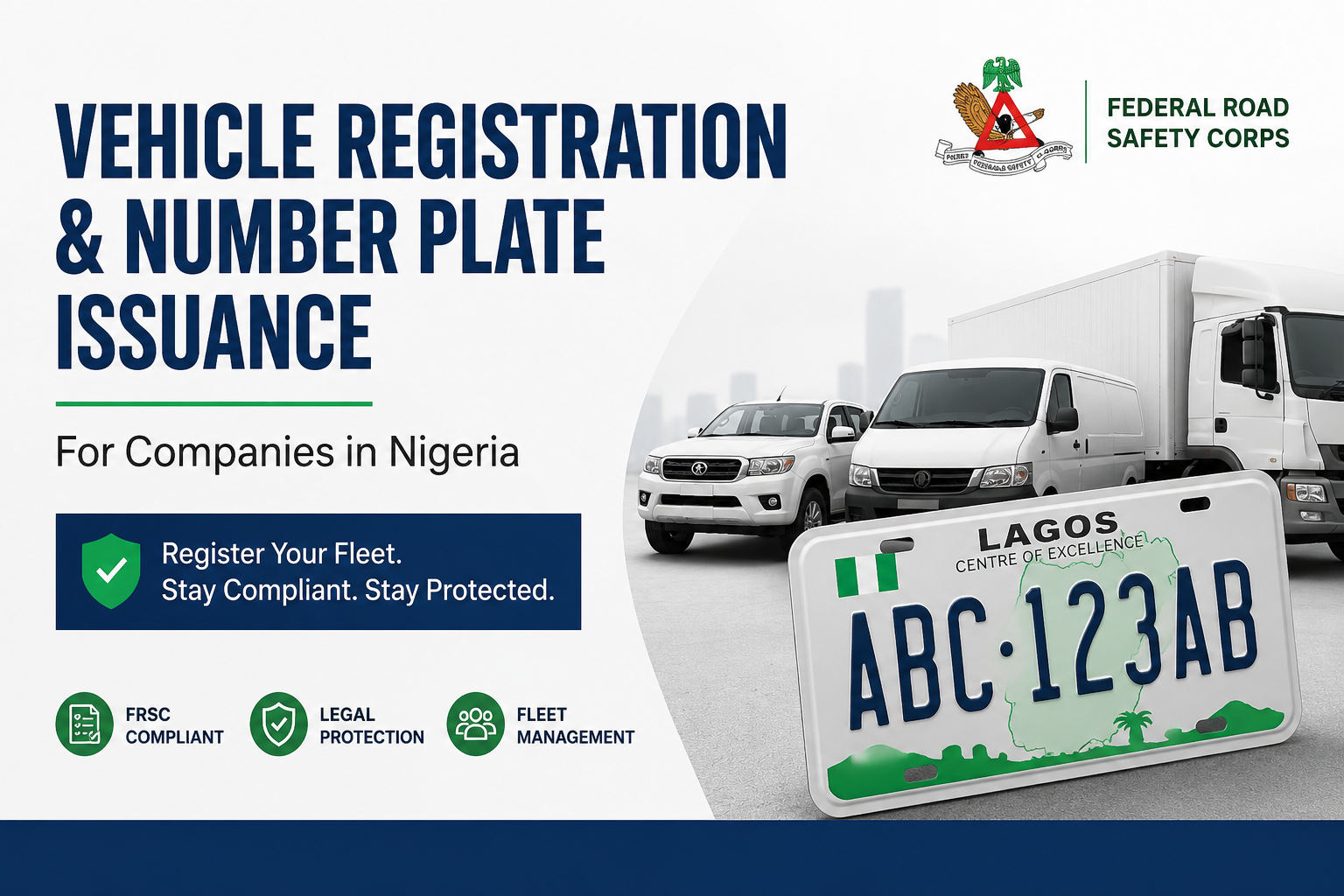
Vehicle registration and number plate issuance in Nigeria is a mandatory legal requirement for every company operating commercial, logistics, transport, oil and gas, construction, ride-hailing, haulage, leasing, or corporate fleet vehicles. The process is regulated primarily by the Federal Road Safety Corps through the National Vehicle Identification Scheme (NVIS), alongside state vehicle licensing authorities.
For companies operating fleets, compliance with FRSC vehicle registration guidelines is not optional. Unregistered vehicles expose businesses to enforcement actions, impoundment, fines, insurance disputes, criminal investigations, and operational disruptions.
This comprehensive guide explains everything companies need to know about vehicle registration and number plate issuance in Nigeria, including:
- Legal framework
- Eligibility
- Fleet registration requirements
- Vehicle categories
- Required documents
- Government fees
- Step-by-step application process
- Number plate categories
- Registration timelines
- Corporate fleet compliance obligations
- Frequently asked questions
- Common misconceptions
The guide is based primarily on information published by the FRSC NVIS portal and official FRSC publications.
What is Vehicle Registration in Nigeria?
Vehicle registration is the official process through which a vehicle is recorded in Nigeria’s national motor vehicle database and assigned:
- A unique registration number
- Vehicle particulars
- Ownership details
- Number plates
- Registration certificate
- Vehicle identification records
Upon successful registration, the vehicle becomes legally authorised for road use in Nigeria.
The process is managed digitally through the FRSC National Vehicle Identification Scheme (NVIS).
What is Number Plate Issuance?
Number plate issuance refers to the allocation and production of official government-approved vehicle identification plates for registered vehicles.
Each number plate is linked to:
- Vehicle ownership
- Vehicle category
- State of registration
- Vehicle identification data
- Security records
FRSC introduced the enhanced number plate system to improve:
- Vehicle traceability
- Road safety
- Security intelligence
- Crime prevention
- Digital verification systems
Companies operating fleets must ensure all vehicles display valid and traceable number plates.
Legal Basis for Vehicle Registration in Nigeria
Vehicle registration and number plate issuance are regulated under:
- The FRSC Establishment Act
- National Road Traffic Regulations
- National Vehicle Identification Scheme (NVIS)
- State Vehicle Administration Laws
The FRSC operates the NVIS platform for vehicle registration services nationwide.
Why Companies Must Register Their Fleet
Corporate fleet registration is essential for:
| Benefit | Why It Matters |
|---|---|
| Legal Compliance | Prevents sanctions and seizures |
| Insurance Validity | Insurance claims may fail without valid registration |
| Fleet Tracking | Supports centralised fleet management |
| Corporate Accountability | Links vehicles to registered entities |
| Road Safety Compliance | Ensures operational legality |
| Security Verification | Helps law enforcement identify vehicles |
| Commercial Operations | Required for haulage and logistics permits |
| Asset Documentation | Supports audits and financing |
Types of Vehicles Companies Can Register
Companies may register:
- Staff vehicles
- Corporate pool vehicles
- Commercial transport vehicles
- Logistics trucks
- Tankers
- Delivery vans
- Haulage trucks
- Construction vehicles
- Utility vehicles
- Fleet buses
- Ride-hailing vehicles
- Leasing vehicles
Categories of Number Plates in Nigeria
Nigeria has several vehicle number plate categories.
1. Standard Private Vehicle Number Plates
Used for:
- Corporate executive vehicles
- Staff vehicles
- General business operations
Current official fee:
- ₦30,000
2. Commercial Vehicle Number Plates
Used for:
- Logistics companies
- Transport operators
- Delivery businesses
- Haulage companies
Current official fee:
- ₦30,000
3. Articulated Vehicle Number Plates
Applicable to:
- Trailers
- Heavy-duty trucks
- Tankers
Official fee:
- ₦90,000
4. Dealer Number Plates
Used by:
- Automobile dealers
- Vehicle distributors
Official fee:
- ₦100,000
5. Fancy Number Plates
Customised or premium plates.
Official fee:
- ₦400,000
6. Government Vehicle Plates
Used by:
- Federal MDAs
- State agencies
- Government-owned corporations
Official fees:
- Standard: ₦80,000
- Fancy: ₦120,000
How Companies Can Obtain Vehicle Registration and Number Plate Issuance in Nigeria
Step 1: Incorporate the Company
Before registering fleet vehicles, the company must be legally registered with the Corporate Affairs Commission.
Required corporate documents include:
- Certificate of Incorporation
- CAC Status Report
- Company Tax Identification Number (TIN)
Step 2: Obtain Vehicle Ownership Documents
The company must possess valid ownership evidence such as:
- Vehicle invoice
- Customs duty payment documents
- Bill of lading
- Proof of importation
- Manufacturer certificate
- Purchase receipt
Imported vehicles require Customs clearance documentation.
Step 3: Obtain Motor Insurance
Before registration, the vehicle must have:
- Valid third-party insurance
or - Comprehensive insurance
Insurance details are entered during NVIS registration.
Step 4: Access the FRSC NVIS Portal
Vehicle registration applications are processed via the FRSC National Vehicle Identification Scheme portal.
Official FRSC NVIS Portal:
FRSC NVIS Portal
Vehicle registration page:
Vehicle Registration Portal
Step 5: Complete Vehicle Registration Details
The applicant enters:
- Vehicle category
- Vehicle sub-category
- Vehicle make
- Colour
- Fuel type
- Year of manufacture
- Model
- Engine number
- Chassis number
- Engine capacity
- Insurance details
- Odometer reading
These fields appear directly on the NVIS registration platform.
Vehicle Information Required During Registration
| Required Information | Description |
|---|---|
| Vehicle Make | Toyota, Lexus, Mercedes, etc. |
| Vehicle Model | Corolla, Hilux, Prado, etc. |
| Engine Number | Unique engine identifier |
| Chassis Number | VIN/chassis details |
| Fuel Type | Petrol, diesel, gas |
| Colour | Official vehicle color |
| Vehicle Category | Commercial/private |
| Insurance Policy Number | Mandatory insurance data |
| Odometer Reading | Mileage record |
| Engine Capacity | Vehicle classification |
Step 6: Pay Prescribed Government Fees
Applicants must pay:
- Number plate fees
- Vehicle registration fees
- Vehicle license fees
- Roadworthiness fees (commercial vehicles)
- Administrative charges
Payment is made through approved channels integrated with the FRSC system.
Official Number Plate Fees in Nigeria
| Number Plate Type | Official Fee |
|---|---|
| Standard Private Plate | ₦30,000 |
| Standard Commercial Plate | ₦30,000 |
| Articulated Vehicle Plate | ₦90,000 |
| Dealer Plate | ₦100,000 |
| Fancy Plate | ₦400,000 |
| Motorcycle Plate | ₦12,000 |
Estimated Total Vehicle Registration Costs for Companies
Total registration costs vary by:
- Vehicle category
- State
- Engine capacity
- Vehicle usage
Typical ranges include:
| Vehicle Type | Estimated Total Registration Cost |
|---|---|
| Standard Saloon Vehicle | ₦75,000 – ₦140,000 |
| SUV | ₦90,000 – ₦180,000 |
| Commercial Vehicle | ₦100,000 – ₦250,000 |
| Articulated Truck | ₦200,000+ |
Step 7: Vehicle Inspection and Verification
Depending on the state and vehicle category, authorities may conduct:
- Physical inspection
- Chassis verification
- Roadworthiness inspection
- Documentation verification
Commercial vehicles usually require roadworthiness certification.
Step 8: Issuance of Number Plates and Registration Documents
After successful processing, the company receives:
- Number plates
- Proof of ownership
- Vehicle license
- Registration certificate
- Plate allocation details
Documents Issued After Vehicle Registration
| Document | Purpose |
|---|---|
| Number Plate | Vehicle identification |
| Proof of Ownership | Ownership verification |
| Vehicle License | Annual licensing |
| Roadworthiness Certificate | Commercial road use |
| Insurance Certificate | Legal insurance compliance |
| Hackney Permit | Commercial passenger transport |
Fleet Registration for Companies in Nigeria
Large organisations can register multiple vehicles under a fleet structure.
Industries commonly requiring fleet registration include:
- Oil and gas
- Telecommunications
- Logistics
- Construction
- Courier services
- Banking
- Security companies
- Government contractors
Fleet registration allows:
- Easier compliance management
- Centralised documentation
- Improved monitoring
- Simplified renewals
Corporate Fleet Registration Requirements
Companies typically need:
| Requirement | Purpose |
|---|---|
| CAC Documents | Corporate verification |
| Tax Identification Number | Tax compliance |
| Vehicle Ownership Documents | Ownership verification |
| Insurance Certificate | Mandatory insurance |
| Customs Papers | Imported vehicle clearance |
| Roadworthiness Certificate | Commercial vehicle compliance |
| Driver Information | Operational records |
How Long Does Vehicle Registration Take in Nigeria?
Processing timelines depend on:
- State
- Vehicle category
- Plate availability
- Verification requirements
Typical timelines:
- Same day to 72 hours for standard registrations
- Longer periods where plate shortages occur
Some reports indicate registration papers may be processed within 24–48 hours where documentation is complete.
Vehicle Revalidation in Nigeria
Vehicle owners must periodically renew:
- Vehicle license
- Roadworthiness
- Insurance
- Other operational permits
FRSC also offers vehicle revalidation services through NVIS.
Vehicle Registration Verification
FRSC allows verification of number plates through its online verification system.
Official portal:
Verify Vehicle Number Plate
This helps companies:
- Verify purchased vehicles
- Confirm authenticity
- Avoid cloned plates
- Conduct due diligence
Common Compliance Obligations for Companies
Corporate fleet operators must ensure:
- Valid annual renewals
- Updated insurance
- Proper plate display
- Roadworthiness compliance
- Driver licensing compliance
- Proper ownership records
Failure may lead to:
- Vehicle impoundment
- Fines
- Enforcement actions
- Insurance claim denials
Common Mistakes Companies Make During Vehicle Registration
1. Using Incomplete Customs Documents
Imported vehicles without proper customs papers may be rejected.
2. Incorrect Chassis Numbers
Mismatched VIN details can trigger investigations.
3. Using Fake Number Plates
Unauthorised plates are illegal and may result in prosecution.
4. Failure to Renew Vehicle Documents
Expired licenses expose vehicles to enforcement.
5. Registering Commercial Vehicles as Private Vehicles
Commercial operations require proper classification.
Advantages of Proper Fleet Registration
| Advantage | Impact |
|---|---|
| Reduced Legal Risk | Avoid sanctions |
| Improved Fleet Tracking | Easier management |
| Better Insurance Protection | Claims validity |
| Regulatory Compliance | Smooth operations |
| Security Protection | Theft recovery assistance |
| Corporate Credibility | Professional operations |
Digitalisation of Vehicle Registration in Nigeria
The FRSC NVIS platform introduced:
- Digital registration systems
- Plate verification
- Centralised databases
- Online services
- Improved security architecture
This has significantly improved:
- Traceability
- Data management
- Security verification
- Fraud prevention
Frequently Asked Questions (FAQs)
Can companies register multiple vehicles at once in Nigeria?
Yes. Companies can register entire fleets under corporate ownership structures subject to FRSC and state licensing requirements.
How much is a standard number plate in Nigeria?
The official fee for standard private and commercial number plates is ₦30,000.
Is vehicle registration compulsory in Nigeria?
Yes. Every vehicle operating on Nigerian roads must be legally registered.
Can I verify a Nigerian number plate online?
Yes. FRSC provides online verification through the NVIS platform.
What documents are required for vehicle registration?
Common documents include:
- Customs papers
- Insurance certificate
- Ownership evidence
- Company incorporation documents
- Vehicle particulars
How long does vehicle registration take?
Typically between 24 hours and several days depending on verification and plate availability.
Can companies obtain customized number plates?
Yes. Fancy number plates are available subject to payment of applicable fees.
Are commercial vehicles required to obtain roadworthiness certificates?
Yes. Commercial vehicles generally require valid roadworthiness certification.
Can a company transfer ownership of a registered vehicle?
Yes. Through the official change of ownership process managed by licensing authorities.
What happens if a company uses fake number plates?
Using fake or unauthorised plates is illegal and may result in:
- Vehicle seizure
- Criminal prosecution
- Regulatory sanctions
Common Misconceptions About Vehicle Registration in Nigeria
Misconception 1: FRSC Alone Handles All Vehicle Registration
Reality:
Vehicle registration involves:
- FRSC
- State licensing authorities
- Insurance providers
- Vehicle inspection authorities
Misconception 2: Fleet Vehicles Do Not Need Annual Renewals
Reality:
Fleet vehicles require periodic renewals and compliance updates.
Misconception 3: Corporate Vehicles Can Use Any Plate Category
Reality:
Vehicle usage determines the proper category.
Commercial operations require commercial registration.
Misconception 4: Vehicle Registration is the Same Nationwide
Reality:
While FRSC plate fees are nationally standardised, state licensing charges differ.
Misconception 5: Number Plates Are Issued Instantly Everywhere
Reality:
Availability may depend on:
- State logistics
- Plate production
- Verification timelines
- Administrative processing
Best Practices for Corporate Fleet Compliance
Companies should:
- Maintain centralised fleet records
- Conduct periodic renewals
- Verify all number plates
- Maintain valid insurance
- Track expiration dates
- Conduct compliance audits
- Use authorised registration channels
Final Thoughts
Vehicle registration and number plate issuance in Nigeria are critical legal and operational requirements for every company managing vehicles or fleet operations. Through the FRSC National Vehicle Identification Scheme (NVIS), businesses can lawfully register vehicles, obtain valid number plates, maintain regulatory compliance, and protect their fleet assets.
Companies operating logistics fleets, commercial transportation services, oil and gas vehicles, construction equipment, staff buses, delivery vans, or executive vehicles should prioritise full compliance with FRSC guidelines to avoid penalties and operational disruptions.
As Nigeria continues to modernise vehicle identification systems through digital registration platforms and centralised databases, proper fleet registration is becoming increasingly important for corporate governance, security compliance, and business continuity.
For official registration services, verification, and vehicle management, companies should use the official FRSC NVIS platform and comply strictly with applicable state licensing requirements.
Official FRSC Website:
Federal Road Safety Corps (FRSC)
Official NVIS Portal:
National Vehicle Identification Scheme (NVIS)

