
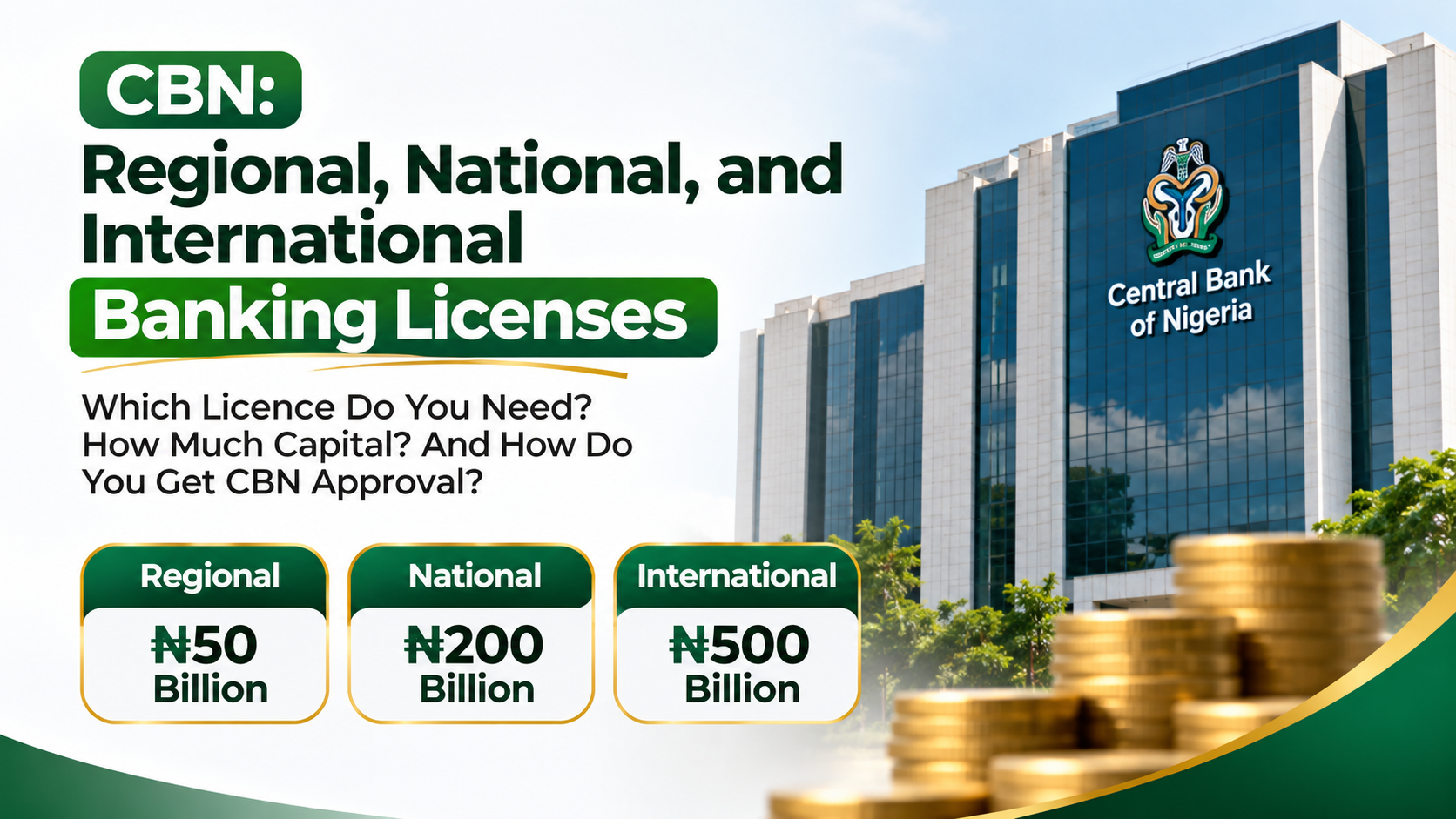
Starting a bank in Nigeria is not just about having money, registering a company and finding a suitable office. It is about understanding the regulatory category you want to operate in, meeting the Central Bank of Nigeria’s capital requirements and satisfying the conditions for obtaining a banking license.
One mistake I have seen businesses make in regulated sectors is to start the process before understanding what the regulator actually expects.
Some promoters have the money but do not have the right corporate structure. Others have registered their companies, appointed directors and even secured office accommodation before discovering that their proposed business model does not fit the license they intend to obtain.
That is an expensive way to learn.
If you intend to establish a commercial bank in Nigeria, this article will help you understand the difference between a Regional, National and International Banking License, the minimum capital requirements, the geographical scope of operations, the major regulatory conditions and the practical steps involved in obtaining a license from the Central Bank of Nigeria (CBN).
I will also explain some of the issues promoters should consider before committing their funds.
Let us get into it.
1. What Is a CBN Banking License?
A CBN banking license is a regulatory authorisation issued by the Central Bank of Nigeria permitting an institution to carry on banking business in Nigeria within the scope of its approved license.
In simple terms, you cannot wake up tomorrow, register a company with the Corporate Affairs Commission (CAC), rent an office, employ staff and start accepting deposits from the public as a bank.
You need the appropriate regulatory approval.
The CBN regulates banking activities under the Banks and Other Financial Institutions Act (BOFIA) 2020, together with applicable CBN regulations, guidelines and licensing requirements.
This is important because not every financial institution is a bank.
A microfinance bank, mortgage bank, payment service bank and commercial bank operate under different regulatory frameworks. Their permitted activities, capital requirements and operating conditions are not the same.
For this article, our focus is on the three geographical categories of commercial banking licenses recognised by the CBN:
-
Regional Banking License.
-
National Banking License.
-
International Banking License.
These categories determine the geographical scope within which a commercial bank is permitted to operate.
And this brings us to the question many prospective investors ask.
2. Understanding the Three Categories of CBN Commercial Banking Licenses
The CBN does not issue these three licenses simply to give banks different names. Each category comes with a defined geographical operating scope and a different minimum capital requirement.
Let us look at them individually.
A. Regional Banking License
A Regional Banking License is designed for a commercial bank that intends to operate within a defined geographical area of Nigeria rather than across the entire country.
Under the CBN’s commercial banking licensing framework, a regional commercial bank may operate in a minimum of six and a maximum of twelve contiguous states, within not more than two geopolitical zones. The Federal Capital Territory is also included in its permitted operating scope.
For example, an investor who intends to establish a commercial bank serving businesses and individuals in the South-East and parts of the South-South may consider a regional banking license, provided the proposed states satisfy the CBN’s geographical requirements.
The idea is straightforward.
You do not necessarily need to establish a nationwide banking network if your business strategy is to serve a defined region.
However, do not confuse a regional banking license with a microfinance banking license. They are two different regulatory authorisations.
A regional commercial bank is still a commercial bank. It operates under the applicable commercial banking regulatory framework.
B. National Banking License
A National Banking License is for promoters who intend to establish a commercial bank with operations across Nigeria.
Unlike the regional category, a national commercial bank is permitted to carry on banking business in every state of the Federation.
This category is suitable for investors with a broader banking strategy.
For instance, if your intention is to establish a bank with branches in Abuja, Lagos, Port Harcourt, Enugu, Kano, Kaduna, Uyo and other commercial centres across the country, the national category is the relevant starting point.
But there is something I always advise prospective investors.
Do not pursue a national banking license simply because it sounds bigger or more prestigious.
A nationwide banking operation comes with substantial responsibilities. You must consider branch infrastructure, technology, cybersecurity, personnel, liquidity, risk management, internal controls and the cost of maintaining operations across different locations.
The license is only one part of the investment.
C. International Banking License
This is the highest geographical category among the three commercial banking authorisations.
An International Banking License permits a commercial bank to operate throughout Nigeria and provides the regulatory basis for establishing and maintaining offshore banking operations in jurisdictions of its choice, subject to CBN approval and compliance with the regulatory requirements of the host country.
This is the category investors should consider where the proposed business model involves a substantial international banking strategy.
For example, a bank may intend to serve Nigerian businesses involved in international trade, facilitate cross-border financial transactions and establish banking operations in other jurisdictions.
However, obtaining an international banking license does not automatically authorise a bank to open branches anywhere in the world.
The bank must still obtain the necessary approvals and satisfy the regulatory requirements of the relevant foreign jurisdiction.
It is important to understand this distinction before making investment projections.
3. Comparison of Regional, National and International Banking Licences
For clarity, here is a breakdown of the three categories.
| Particulars | Regional | National | International |
|---|---|---|---|
| Minimum capital | #50 billion | #200 billion | #500 billion |
| Geographical coverage | 6–12 contiguous states, within a maximum of 2 geopolitical zones, plus FCT | All states in Nigeria | All states in Nigeria |
| Offshore banking operations | Not authorised under this category | Not authorised under this category | Permitted, subject to approvals |
| Business scope | Commercial banking | Commercial banking | Commercial banking |
| Regulatory authority | CBN | CBN | CBN |
Important: These are minimum capital requirements for new commercial banking license applications under the CBN’s revised framework. They should not be confused with the different capital treatment applicable to existing banks under the recapitalisation programme. The applicable requirements should be confirmed with the CBN before commencing an application.
4. What Exactly Does the CBN Mean by Minimum Capital?
This is where many prospective investors need proper guidance.
When the CBN says a Regional Commercial Bank requires #50 billion, it does not mean you can simply show a bank statement indicating that you have access to #50 billion.
There is a difference between having money, having investors who have promised to provide money and having qualifying paid-up capital that the regulator can recognise.
The CBN is interested in the actual capitalisation of the proposed bank.
For new banking license applications, the CBN’s recapitalisation FAQ states that the new minimum capital requirement must be met. It distinguishes this from the treatment of existing banks, for which paid-in capital comprises paid-up capital and share premium.
In practical terms, promoters should be prepared to demonstrate:
-
The source of the proposed capital.
-
The identity of the shareholders and beneficial owners.
-
Evidence of the actual contribution of shareholders.
-
The financial capacity of the investors.
-
The legitimacy of the funds being introduced.
-
Compliance with applicable anti-money laundering and counter-terrorist financing requirements.
Let me emphasise something.
If you have five investors who have agreed to contribute #10 billion each towards a regional bank, that agreement alone does not establish that the bank has met the CBN’s minimum capital requirement.
The funds must be properly raised, documented and presented in the manner prescribed by the CBN.
Do not build your application around verbal investment commitments.
Get the investment structure right from the beginning.
5. What Are the Requirements for Obtaining a CBN Commercial Banking License?
Now, this is where the actual work begins.
Having the required capital is important. But it is not the only thing the CBN will consider.
The regulator wants to know who is behind the proposed bank, where the money is coming from, how the institution intends to operate and whether the promoters have the capacity to manage a financial institution.
Under Section 3 of the Banks and Other Financial Institutions Act (BOFIA) 2020, an application for a banking license must be supported by relevant information and documentation.
Some of the key requirements include the following:
A. Promoters and Shareholders
The proposed bank must have clearly identified promoters and shareholders.
The CBN will be interested in their identities, backgrounds, financial capacity and sources of wealth.
You cannot simply introduce investors into the shareholding structure without proper documentation.
Each significant investor should be prepared to explain the source of their proposed capital contribution.
B. Proposed Directors and Management
The proposed directors and principal officers must satisfy the applicable fit-and-proper requirements.
Their professional experience, integrity, financial standing and suitability will be considered.
The CBN is not just looking for people who have money to invest.
It wants people who can responsibly supervise and manage a bank.
C. Feasibility Report and Business Plan
This is one of the most important documents in the application.
A properly prepared feasibility report should explain:
-
The objectives of the proposed bank.
-
The justification for establishing the bank.
-
The proposed banking services.
-
The target market and geographical coverage.
-
The ownership and shareholding structure.
-
The proposed organisational structure.
-
The financial projections for at least five years.
-
The bank’s business strategy.
-
The risk management framework.
-
The proposed technology and operational infrastructure.
-
The projected profitability and financial sustainability.
Let me make a practical observation here.
A feasibility report should not be prepared just to satisfy a regulatory checklist.
It must demonstrate that the promoters understand the banking business they intend to enter.
A bank that cannot demonstrate a realistic business model will have difficulty convincing the regulator that it is ready to operate.
D. Corporate Documents
The promoters should prepare the relevant proposed constitutional and corporate documents, including:
-
Proposed Memorandum and Articles of Association.
-
Proposed shareholding structure.
-
Details of shareholders and beneficial owners.
-
Particulars of proposed directors.
-
Relevant corporate documents of corporate shareholders.
-
Board and shareholder resolutions, where applicable.
The company’s objects and constitutional provisions must be consistent with the proposed banking business and applicable CBN requirements.
E. Source of Funds
This deserves special attention.
The CBN will want to understand how the proposed capital was generated.
Where there are several investors, the contribution of each investor should be properly documented.
The regulator may require supporting financial records and other evidence to establish the legitimacy of the funds.
Do not assume that because an investor has a large business, their proposed investment will automatically be accepted.
The source of funds must be credible and verifiable.
F. Operational Infrastructure
The proposed bank must demonstrate its ability to operate as a financial institution.
This includes:
-
Suitable head office premises.
-
Banking technology and infrastructure.
-
Core banking application.
-
Cybersecurity arrangements.
-
Internal control systems.
-
Risk management policies.
-
Anti-money laundering and counter-terrorist financing policies.
-
Customer identification and due diligence procedures.
-
Qualified personnel.
-
Adequate security arrangements.
A bank is not an ordinary trading company. The regulatory expectations are considerably higher.
The CBN must be satisfied that the proposed institution can protect depositors’ funds and operate within the applicable regulatory framework.
6. Step-by-Step Process for Obtaining a CBN Commercial Banking License
From a regulatory compliance perspective, I advise promoters to approach this process in stages.
Do not rush to incorporate a company, employ staff or commit funds to office accommodation before understanding the licensing sequence.
The general process involves the following steps.
Step 1: Determine the Appropriate Banking License
The first step is to determine whether the proposed bank will operate regionally, nationally or internationally.
This decision should be based on the proposed business model, geographical coverage and available capital.
It is important to get this right from the beginning.
Step 2: Establish the Promoters’ Structure
Identify the proposed shareholders, investors and promoters.
Determine their respective shareholding percentages and capital contributions.
Where corporate entities are involved, their ownership and beneficial ownership structures should also be properly documented.
At this stage, conduct appropriate due diligence on the proposed investors.
Step 3: Prepare the Feasibility Report and Business Plan
Prepare a comprehensive feasibility report showing the proposed bank’s business model, financial projections, management structure, governance arrangements and operational strategy.
The report must reflect the actual intentions and financial capacity of the promoters.
Step 4: Submit an Application to the CBN
The promoters must submit a formal application to the CBN Governor, accompanied by the prescribed documents and applicable non-refundable application fee.
The application must satisfy the requirements applicable to the proposed license category.
The CBN may request additional information, explanations or supporting documents during its assessment.
Step 5: Obtain Approval-in-Principle (AIP)
Where the CBN is satisfied with the application, it may grant an Approval-in-Principle.
This is an important stage.
However, an Approval-in-Principle is not the same as a final banking license.
It does not authorise the promoters to commence commercial banking operations.
Step 6: Incorporate the Bank with CAC
Following the relevant CBN approval, the promoters proceed with incorporation at the Corporate Affairs Commission in accordance with the conditions attached to the Approval-in-Principle.
The incorporation documents must reflect the approved ownership and corporate structure.
This is one reason I discourage promoters from treating the CAC registration as the first and most important part of the project.
For a proposed bank, regulatory approval and corporate incorporation must be properly sequenced.
Step 7: Establish the Operational Infrastructure
The promoters must put the necessary operational arrangements in place.
This includes:
-
Securing the approved head office premises.
-
Installing the required banking technology.
-
Establishing internal control and risk management systems.
-
Developing AML/CFT compliance policies.
-
Recruiting qualified management and operational personnel.
-
Putting appropriate cybersecurity and data protection measures in place.
-
Establishing the required governance structures.
Step 8: Apply for Final Banking License
After satisfying the conditions attached to the AIP, the promoters submit an application for the final banking license.
The application should be supported by the required CAC documents, evidence of compliance with the approved capital requirements and other operational documents requested by the CBN.
Step 9: CBN Inspection and Final Approval
The CBN may conduct an inspection to verify that the proposed bank has the necessary infrastructure, personnel, technology and operational controls.
Where the regulator is satisfied, it may issue the final banking license subject to applicable conditions.
Step 10: Fulfil Pre-Commencement Requirements
Even after obtaining a final license, promoters must ensure that all applicable pre-commencement conditions have been satisfied.
These may include the relevant deposit insurance arrangements, clearing and settlement arrangements, operational readiness and other regulatory approvals.
The bank must not commence business until the CBN has authorised it to do so.
The application requirements are guided by BOFIA 2020 and the applicable CBN licensing framework. The CBN may also request additional information depending on the circumstances of the application.
7. How Long Does It Take to Obtain a CBN Commercial Banking License?
This is one question I would rather answer honestly than give a prospective investor a timeline that sounds attractive but may not be realistic.
Obtaining a commercial banking license is not a two-week or one-month regulatory exercise.
The duration depends on several factors, including:
-
Completeness of the application.
-
Availability and verification of the required capital.
-
The ownership structure.
-
The background checks on promoters and directors.
-
The quality of the feasibility report.
-
The readiness of the proposed bank’s infrastructure.
-
The time taken to satisfy the CBN’s additional requirements.
The process can take several months and may take considerably longer where there are outstanding regulatory issues.
My advice is that investors should approach this as a major financial and regulatory project rather than an ordinary company registration exercise.
A realistic implementation plan should be prepared before significant financial commitments are made.
8. What Are the Common Mistakes Investors Make When Applying for a Banking License?
Having worked in regulatory compliance for years, one thing I have come to appreciate is that regulatory problems are often created long before an application reaches the regulator.
Sometimes, the problem is not that the business is unqualified.
The problem is that the promoters did not structure the application properly from the beginning.
Here are some mistakes I would advise prospective banking investors to avoid.
| Common mistake | Why it is a problem | What should be done |
|---|---|---|
| Choosing the wrong license category | The proposed business may not fit the geographical or operational scope of the license | Determine the appropriate category before commencing the application |
| Using unverified investors | The CBN may question the credibility of the proposed capital | Conduct investor due diligence |
| Poor source-of-funds documentation | The regulator must be satisfied that the capital is legitimate | Maintain proper financial and documentary evidence |
| Weak feasibility report | It may fail to demonstrate the commercial viability of the bank | Prepare a comprehensive, realistic business plan |
| Poor shareholding structure | Ownership and beneficial ownership may be unclear | Properly document the proposed ownership structure |
| Premature CAC incorporation | It may conflict with the applicable licensing sequence | Follow the CBN approval process |
| Inadequate management experience | Proposed directors and principal officers must satisfy regulatory expectations | Identify suitable and qualified professionals |
| Ignoring operational compliance | The bank may not satisfy pre-licensing inspection requirements | Develop operational and compliance frameworks early |
There is one particular mistake I want to emphasise.
Do not raise billions of naira from investors before you have properly understood the regulatory conditions attached to the proposed banking license.
Capital is not cheap in Nigeria.
You do not want to mobilise funds, create shareholder disputes and spend money on professional services only to discover that your proposed ownership or business structure requires significant restructuring.
Get the regulatory strategy right first.
9. Can a Foreign Investor Establish a Commercial Bank in Nigeria?
Yes. Foreign investors may participate in the establishment of a Nigerian commercial bank, subject to applicable Nigerian laws and CBN regulatory requirements.
However, foreign participation does not exempt the proposed institution from the normal banking licensing requirements.
The proposed foreign shareholders must satisfy the applicable due diligence and fit-and-proper requirements.
Their investment funds must also be properly documented.
Where foreign corporate entities are involved, the relevant corporate records and ownership information will be required.
The promoters should also consider the applicable requirements relating to foreign investment, company incorporation, beneficial ownership disclosure, tax compliance and foreign exchange transactions.
For international banking operations, the CBN’s approval is particularly important.
A Nigerian international commercial banking license does not replace the need for authorisation in the foreign country where the bank intends to establish operations.
10. Is a Commercial Banking License the Same as a Microfinance Banking License?
Absolutely not.
I make this distinction because I have encountered investors who use the terms interchangeably.
They are different licenses with different capital requirements, permitted activities and regulatory expectations.
A commercial bank can undertake a broader range of commercial banking activities under its authorisation.
A microfinance bank operates under a separate regulatory framework designed to provide financial services within the scope of its approved category.
The capital requirements are also substantially different.
If your intention is to provide microfinance services to individuals, traders, small businesses and underserved communities, you may not need to pursue a commercial banking license.
However, if your business model involves establishing a full commercial bank, then the relevant commercial banking authorisation must be considered.
Choosing the wrong license can cost you time and money.
11. What Happens if You Cannot Meet the Minimum Capital Requirement?
Not every investor who wants to establish a bank can raise #50 billion, #200 billion or #500 billion.
And that is understandable.
But it does not mean you should abandon your interest in the financial services industry.
There are other regulated financial institution categories with different capital requirements and operating scopes.
Depending on your proposed business model, you may consider:
-
Microfinance Bank.
-
Payment Service Bank.
-
Finance Company.
-
Mortgage Bank.
-
Merchant Bank.
-
Other CBN-regulated financial institutions.
Each category has its own licensing requirements.
Do not select an alternative simply because its capital requirement is lower. Select it because the permitted activities align with what you actually intend to do.
For example, if your intention is to provide digital payment services, pursuing a commercial banking license may not be the most appropriate starting point.
If your intention is to provide small loans and financial services to underserved communities, a microfinance banking license may be worth considering.
The business model should determine the license, not the other way around.
12. How ICA Can Assist You in Obtaining a CBN Banking License
At ICA-Ibe, Chido & Associates, we understand that establishing a regulated financial institution requires more than filling out application forms and submitting documents.
It requires proper legal structuring, regulatory interpretation, documentation and a clear understanding of what the regulator expects.
As a legal and regulatory compliance consulting firm, we provide professional support to investors and promoters seeking to establish regulated businesses in Nigeria.
Our support for prospective commercial banking promoters can cover:
A. Regulatory Advisory
We advise on the appropriate banking license category based on the proposed business model, geographical coverage and investment capacity.
B. Corporate Structuring
We assist with the proposed ownership structure, shareholder arrangements, corporate documentation and other legal requirements.
C. Feasibility Report and Business Plan
We coordinate the preparation of the relevant regulatory and business documentation required for the application.
D. CBN Licensing Documentation
We assist with the preparation, review and submission of the relevant licensing documents and supporting information.
E. Regulatory Liaison
We provide professional support in managing regulatory correspondence, responding to queries and following up on the application.
F. Post-Approval Compliance Support
We assist with the applicable corporate, regulatory and operational compliance requirements necessary for the proposed institution to progress towards commencement of business.
Our objective is to help promoters approach the licensing process with a proper regulatory strategy and avoid preventable mistakes.
We do not approach banking license applications as ordinary registration jobs.
The financial commitment is too significant for that.
If you are considering establishing a Regional, National or International Commercial Bank in Nigeria, ICA can assist you in assessing the regulatory requirements and developing a structured licensing roadmap.
13. Frequently Asked Questions (FAQs)
1. How much does it cost to obtain a CBN Regional Banking License in Nigeria?
The minimum regulatory capital requirement for a new Regional Commercial Bank is #50 billion.
This is separate from the applicable CBN application and licensing fees, professional fees, incorporation expenses, technology infrastructure, office accommodation, staffing and other operational costs.
The total project cost will depend on the proposed bank’s structure and operational requirements.
2. What is the minimum capital requirement for a National Commercial Bank in Nigeria?
The minimum capital requirement is #200 billion.
3. What is the minimum capital requirement for an International Commercial Bank in Nigeria?
The minimum capital requirement is #500 billion.
4. Can I establish a Regional Commercial Bank with #20 billion?
No. #20 billion does not meet the current minimum capital requirement for a new Regional Commercial Bank.
You would need to meet the prescribed #50 billion requirement.
5. Can a Regional Commercial Bank operate in Abuja?
Yes. The CBN’s geographical framework includes the Federal Capital Territory within the permitted operating scope of a Regional Commercial Bank.
6. How many states can a Regional Commercial Bank operate in?
A Regional Commercial Bank may operate in a minimum of six and a maximum of twelve contiguous states, within not more than two geopolitical zones, in addition to the FCT.
7. Can a National Commercial Bank operate outside Nigeria?
A National Commercial Bank is authorised to operate across Nigeria. However, its national authorisation does not automatically confer the right to establish offshore banking operations.
8. Does an International Banking License allow a bank to operate in other countries?
It provides the regulatory basis for offshore banking operations, subject to the CBN’s approval and compliance with the host country’s laws and licensing requirements.
9. Can foreigners own a commercial bank in Nigeria?
Foreign investors may participate in establishing a commercial bank in Nigeria, subject to applicable investment, corporate and CBN regulatory requirements.
10. Must I register the proposed bank with CAC before applying to the CBN?
The promoters should follow the CBN’s prescribed licensing sequence. The proposed bank’s incorporation is generally undertaken after obtaining the relevant Approval-in-Principle, subject to the applicable CBN requirements.
11. Does obtaining an Approval-in-Principle mean I can start banking operations?
No. An Approval-in-Principle is not a final banking license. The promoters must satisfy the applicable conditions and obtain the final license before commencing banking business.
12. Can an existing Microfinance Bank upgrade to a Commercial Bank?
An existing financial institution may explore a change of license category where permitted by the CBN. However, this is subject to the applicable conversion requirements, regulatory approval, capital requirements and other conditions. It is not an automatic upgrade.
13. Can I use borrowed funds to meet the minimum capital requirement?
The source and structure of the proposed capital must satisfy the CBN’s requirements. Do not assume that borrowed funds will automatically qualify. The financing arrangement and source of funds must be disclosed and assessed against the applicable regulatory conditions.
14. Is the minimum capital requirement the same as the total cost of establishing a bank?
No. The minimum capital requirement is the regulatory capital threshold. Establishing and operating a bank involves additional expenditure on infrastructure, technology, personnel, professional services, security and other operational requirements.
15. Is the #500 billion requirement applicable to every bank in Nigeria?
No. It applies to commercial banks with international authorisation. National and regional commercial banks have different minimum capital requirements. Merchant banks, non-interest banks and microfinance banks are also subject to separate capital requirements.
14. Final Advice: Do Not Start a Banking Project Without a Regulatory Roadmap
Establishing a bank in Nigeria is a serious investment.
It is not a project you should approach based on assumptions, verbal promises or information gathered from people who have never handled a banking license application.
The CBN has a responsibility to protect depositors, maintain financial stability and ensure that only institutions with the necessary financial and operational capacity are permitted to carry on banking business.
That is why the licensing requirements are demanding.
My advice to prospective investors is simple.
Before you mobilise funds, determine the appropriate license category. Understand the capital requirement. Verify your investors. Structure the proposed ownership correctly. Prepare a realistic feasibility report and establish a clear regulatory roadmap.
Do not wait until the CBN raises an objection before discovering that something was wrong with your original structure.
At ICA, we believe that good regulatory compliance begins before an application is submitted.
It begins with getting the foundation right.
