Need a PDF copy of this guide?
Download the professionally formatted PDF version of this article for offline reading, sharing with colleagues, or future reference.
📄 Download PDF: Product Certification in Nigeria
If you manufacture products in Nigeria, there is something you need to understand before you spend money on packaging, marketing, distribution or chasing big customers.
Product certification is not just about putting a government-looking logo on your product.
It is about proving that your product consistently meets the applicable Nigerian Industrial Standard.
In this article, I will explain what NIS certification is, who needs it, how the process works, what SON actually looks at, the common mistakes businesses make, and how to approach the process without wasting money or time.
I have dealt with regulatory compliance long enough to know one thing.
The biggest problem is usually not the application.
The problem is that many businesses apply for certification when the business itself is not yet ready for certification.
And that is where the frustration begins.
What is NIS Certification?
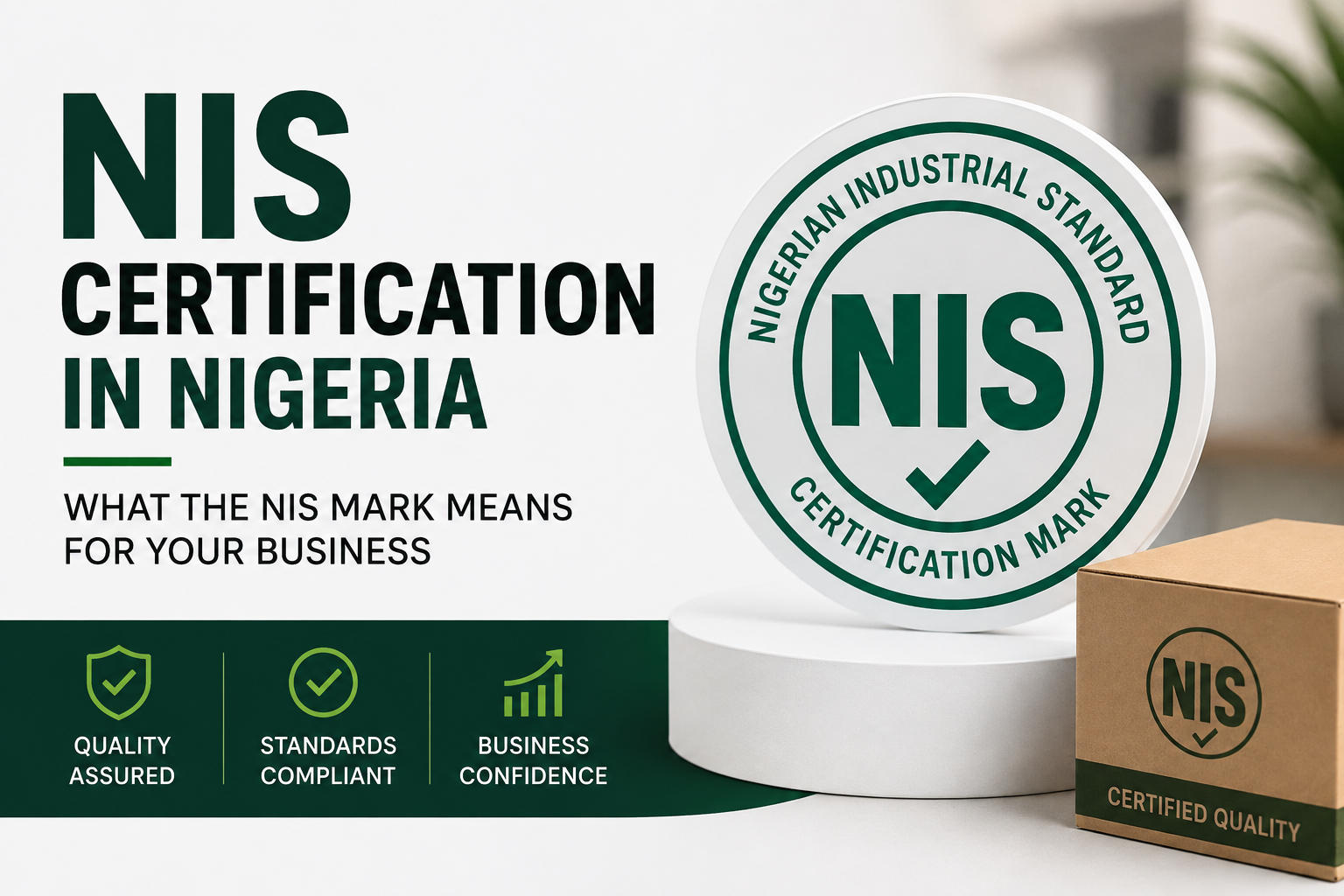
NIS means Nigerian Industrial Standard.
The NIS Certification Mark is a voluntary product certification scheme operated by the Standards Organisation of Nigeria (SON).
SON describes it as a scheme designed to recognise products that demonstrate consistent compliance with the requirements of the relevant Nigerian Industrial Standards at the point of production and in the market.
In simple English:
You are asking SON to independently verify that your product meets the applicable Nigerian standard and, if it does, recognise that compliance through the NIS Mark.
That is important.
Because there is a difference between:
“My product is good.”
and
“An independent regulator has assessed my product against an applicable standard.”
The second carries much more weight.
But There Is Something Many Business Owners Get Wrong
NIS certification should not be confused with every other SON requirement.
This is where many consultants and business owners get mixed up.
SON operates different conformity assessment and certification schemes.
For locally manufactured products, MANCAP is a mandatory conformity assessment programme, while the NIS Mark is a voluntary product certification scheme. SON also operates other schemes for imported products and specific categories.
So if somebody tells you:
“You need NIS certification because SON requires every product to have NIS.”
Pause.
Ask the right question.
What exactly is the applicable SON scheme for your product?
That distinction can save you money.
NIS Certification vs MANCAP
Here is the simple distinction.
| Item | NIS Certification Mark | MANCAP |
|---|---|---|
| Nature | Voluntary | Mandatory |
| Focus | Recognition of consistent product quality | Mandatory conformity assessment |
| Applicable products | Locally manufactured products meeting applicable standards | Locally manufactured products within MANCAP scope |
| Regulator | SON | SON |
| Purpose | Demonstrate consistent compliance and quality | Establish conformity before products enter the Nigerian market |
| Outcome | NIS Mark/recognition | MANCAP certificate and identification mark |
SON itself identifies NIS and MANCAP as certification marks by which SON-certified products can be recognised.
The practical lesson is simple.
Do not buy a certification because somebody told you it sounds impressive.
First establish what your product actually requires.
What Does SON Look At?
This is where the street reality comes in.
A lot of manufacturers think certification means submitting CAC documents, filling a form and waiting for a certificate.
No.
Product certification is about the product and the process behind the product.
SON’s national product certification process can involve:
- Factory inspection.
- Sampling.
- Laboratory testing or analysis.
- Assessment against the relevant standard.
- Certification decision.
- Approval by the appropriate authority.
SON describes product certification as a third-party validation process intended to establish conformity, safety, performance, reliability and regulatory compliance.
So when we advise clients, one of the first things we want to know is:
Can your factory actually withstand regulatory inspection?
Because if the answer is no, filing the application tomorrow may simply be paying to discover that problem.
The Factory Matters
Let me put this plainly.
You cannot certify what you cannot consistently produce.
Suppose you manufacture bottled water.
Today the product is excellent.
Tomorrow the water treatment process changes.
Next week your raw material supplier changes.
The following month your production environment becomes contaminated.
You cannot build a sustainable certification around one good batch.
Certification is about consistency.
SON’s own explanation of NIS certification emphasises that products must demonstrate a consistent record of meeting applicable standard requirements, with certified products subject to continued monitoring.
That is why your production system matters.
Not just your finished product.
What Documents May Be Required?
The exact requirements depend on the product and applicable standard.
But, as a practical starting point, expect the regulatory process to require information around matters such as:
| Area | Typical information |
|---|---|
| Business identity | CAC/company information |
| Product | Product description, brand, specifications |
| Manufacturing | Factory and production information |
| Standards | Applicable Nigerian Industrial Standard |
| Raw materials | Sources and specifications |
| Production | Manufacturing process |
| Quality control | Testing and quality assurance procedures |
| Packaging | Labels, packaging and product information |
| Testing | Samples and laboratory results |
| Premises | Factory inspection/access |
| Compliance | Other applicable regulatory approvals |
Do not treat this table as a universal checklist.
The actual requirements can change depending on the product category and applicable standard.
This is one reason I normally advise clients not to start by asking:
“How much is the certification?”
Start with:
“Is my product eligible, what standard applies, and what will SON expect from my manufacturing operation?”
That is the better question.
The Biggest Mistake I See
The biggest mistake is starting with the certificate instead of starting with compliance.
A client comes and says:
“We need SON certification urgently.”
I ask:
What product?
They tell me.
I ask:
Where is it manufactured?
They tell me.
I ask:
Have you tested the product against the applicable standard?
Silence.
I ask:
Can we inspect your production process?
Another silence.
This is common.
And it is why some businesses spend money going around in circles.
Testing Is Not Something to Fear
Testing is actually your friend.
If your product fails laboratory testing, it is better to discover that before you spend heavily on production, distribution and marketing.
The test tells you where the problem is.
Maybe the raw material is wrong.
Maybe the formulation is wrong.
Maybe the manufacturing process is inconsistent.
Maybe the packaging is affecting the product.
Maybe your product simply does not meet the applicable specification.
Whatever the problem is, find it early.
What Does the NIS Mark Give a Business?
There is a commercial side to certification that business owners sometimes overlook.
A recognised quality mark can help strengthen confidence in your product.
Especially when you are trying to sell to:
- large distributors;
- supermarkets;
- corporate buyers;
- institutional customers;
- government-related procurement opportunities;
- export-oriented buyers;
- customers who are increasingly concerned about product quality.
It can also differentiate a serious manufacturer from somebody producing from an informal setup.
But let me be clear.
A certification mark is not a magic sales button.
It will not rescue a bad product.
It will not replace good distribution.
It will not replace proper branding.
It will not replace regulatory compliance generally.
It is one part of a credible product-quality system.
What Happens If You Do Not Prepare Properly?
This is where Nigerian businesses get frustrated.
You pay professional fees.
You pay government charges.
You prepare documents.
You submit.
Then an inspection happens.
Something is wrong.
You are asked to correct it.
You correct one thing.
Another issue comes up.
You go back again.
Production stops.
Customers are waiting.
Your distributor is calling.
Your cash is tied down.
Eventually, the business owner says:
“SON is delaying us.”
Sometimes the regulator is not the problem.
Sometimes the business simply was not ready.
This is an important distinction.
Our Approach to NIS Certification
At ICA-Ibe, Chido & Associates, we do not like taking a client’s money simply to submit an application.
Our approach is more practical.
We first look at the business from the regulator’s perspective.
Step 1: Understand the Product
We establish exactly what the client manufactures.
Not what the client calls it.
What it actually is.
This matters because the applicable standard and regulatory pathway depend heavily on the nature of the product.
Step 2: Identify the Applicable Standard
We establish the relevant Nigerian Industrial Standard or applicable requirements.
This is one of the most important parts of the exercise.
Because you cannot properly demonstrate conformity to a standard you have not identified.
Step 3: Regulatory Gap Assessment
We look at the client’s current position.
What is already compliant?
What is missing?
What could create problems during inspection or testing?
Step 4: Documentation
We help organise the regulatory and technical documentation required for the application.
Step 5: Application
We coordinate the application process with SON.
Step 6: Inspection and Testing Support
Where applicable, we help the client prepare for factory inspection, sampling and testing.
Step 7: Follow-Up
We monitor the process and communicate with the relevant regulatory officers.
Step 8: Certification
Where the product successfully satisfies the applicable requirements, the certification process proceeds to the relevant decision and issuance stage.
How Long Does NIS Certification Take?
This is one question I am always careful about.
I do not like telling a client:
“You will get it in exactly 30 days.”
Regulatory processes do not work like that.
SON states that its national product certification objective is to process at least 80% of applications within 45 working days of receipt, but the actual timeline can depend on the completeness of the application, inspection, sampling, laboratory testing, corrective actions and certification decision.
So I would budget time realistically.
Do not build your entire commercial launch around a promise of an exact regulatory date.
That is how businesses get into trouble.
How Much Does NIS Certification Cost?
There is no responsible one-size-fits-all answer.
The cost can depend on:
- the product;
- applicable standard;
- number and nature of tests;
- factory inspection requirements;
- sampling;
- applicable SON charges;
- corrective work;
- number of products or variants;
- professional support required.
So when a consultant tells you:
“NIS certification is ₦XXX for everybody.”
I would advise you to ask questions.
Certification is product-specific.
The professional fee is also separate from official government/regulatory charges.
We normally separate these clearly for clients.
That way, the client knows what is being paid to the regulator and what is being paid for professional services.
One More Important Point: Certification Is Not the End
This is perhaps the most important part of this article.
Getting the certificate is not the end of compliance.
SON states that NIS-certified products are monitored to ensure that they maintain their quality level. If the required quality is not maintained, the recognition can be withdrawn.
So your production must remain consistent.
Do not obtain certification today and then abandon the quality-control system tomorrow.
That is dangerous.
And commercially, it makes no sense.
NIS Certification: Who Should Consider It?
A manufacturer should consider NIS certification particularly where the business wants to build a strong quality reputation and demonstrate consistent compliance with an applicable Nigerian Industrial Standard.
It can be particularly useful where the business is targeting sophisticated buyers who want evidence of quality rather than just verbal assurances.
But again:
First establish whether NIS is the appropriate scheme for your product.
That is where professional regulatory advice becomes valuable.
My Practical Advice to Manufacturers
After years of dealing with regulatory agencies, I have learned not to rush into government applications simply because a client says:
“Let’s apply.”
Sometimes the correct answer is:
“Not yet.”
Fix the factory first.
Fix the documentation.
Fix the process.
Fix the product.
Then apply.
It may look slower.
In practice, it can be much faster.
Because the objective is not merely to submit an application.
The objective is to obtain a successful regulatory outcome.
There is a difference.
Final Word
If you manufacture in Nigeria, stop looking at regulatory certification as another government hurdle.
Look at it as part of building a serious manufacturing business.
The Nigerian market has too many products where the consumer is expected to simply trust the manufacturer.
That model is changing.
Customers are becoming more conscious.
Corporate buyers are asking more questions.
Regulators are becoming more structured.
And businesses that cannot demonstrate quality will increasingly find themselves at a disadvantage.
NIS certification can be a valuable quality signal.
But it must be approached correctly.
Not as a sticker.
Not as a shortcut.
Not as something you obtain because another manufacturer has it.
It should be the visible result of a product and manufacturing process that can actually stand up to scrutiny.
And that is where proper regulatory compliance support makes a difference.
Frequently Asked Questions
1. Is NIS certification mandatory?
No. The NIS Mark of Quality is described by SON as a voluntary product certification scheme. However, this should not be confused with mandatory schemes such as MANCAP or other regulatory requirements that may apply to a particular product.
2. Who issues the NIS Certification Mark?
The scheme is operated by the Standards Organisation of Nigeria (SON).
3. Is NIS certification the same as MANCAP?
No.
MANCAP is a mandatory conformity assessment programme for locally manufactured products within its scope. NIS certification is a voluntary quality certification scheme.
4. Does NIS certification mean my company is ISO certified?
No.
ISO certification generally relates to a management system or other specified conformity framework. NIS certification relates to the conformity and consistent quality of a product against the relevant Nigerian Industrial Standard.
5. Will SON inspect my factory?
Product certification can involve factory inspection, sampling and laboratory testing as part of the conformity assessment process.
6. Can I get NIS certification without testing?
You should not assume that.
Testing and analysis may form part of the product certification process, depending on the product and applicable requirements.
7. How long does the process take?
SON’s stated quality objective is to process at least 80% of applications within 45 working days of receipt. Actual completion can vary depending on the product, documentation, inspection, testing and whether corrective actions are required.
8. Can an application fail?
Yes.
If the product or manufacturing process does not demonstrate conformity with the applicable requirements, certification should not simply be assumed.
9. Can the NIS Mark be withdrawn?
Yes. SON indicates that NIS-certified products are monitored and that recognition can be withdrawn where the required quality level is not maintained.
10. Can I start the process before my factory is fully ready?
You can seek regulatory guidance early, and in many cases that is exactly what I recommend.
But there is a difference between starting regulatory preparation and rushing into formal certification when the business is not ready.
The earlier you identify the gaps, the cheaper it usually is to correct them.
Need NIS Certification?
Before we discuss fees, let us first establish the correct regulatory pathway for your product.
Tell us the product you manufacture, where it is manufactured, and whether you currently have any SON approval or certification.
We can then advise you on the appropriate certification route, documentation, inspection/testing requirements and the likely regulatory steps.
Regulatory requirements and procedures can change. Product-specific advice should therefore be confirmed against the current requirements of SON and any other regulator responsible for the product.
Need a PDF copy of this guide?
Download the professionally formatted PDF version of this article for offline reading, sharing with colleagues, or future reference.
📄 Download PDF: Product Certification in Nigeria

