
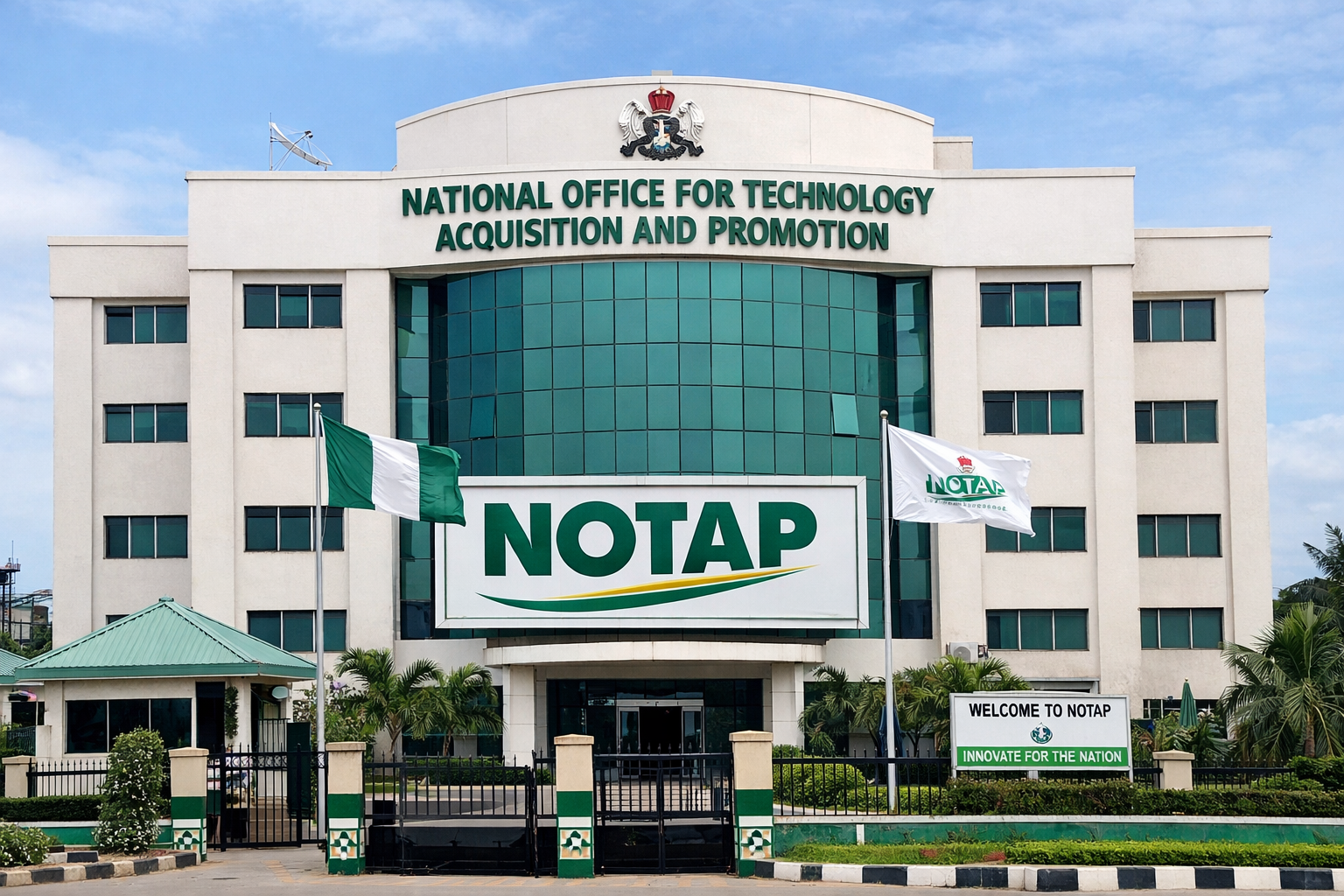
When businesses in Nigeria enter into technology transfer agreements; whether for technical services, software licensing, trademarks, or management support, they are legally required to register such agreements with the National Office for Technology Acquisition and Promotion (NOTAP).
On paper, the process may appear procedural. In reality, it is highly technical, regulatory-driven, and often misunderstood, even by experienced corporate operators.
This guide provides a deep analysis of:
- Why NOTAP applications fail
- The mistakes applicants make
- Regulatory risks and compliance traps
- Hidden complexities within NOTAP review
- Realistic timelines
- Strategic insights for successful approval
Important: All regulatory positions referenced here are derived strictly from NOTAP’s official guidelines, mandates, and regulatory framework.
What is NOTAP Registration (And Why It Is Not Optional)
NOTAP is mandated under Nigerian law to regulate and monitor all technology transfer agreements involving Nigerian entities and foreign technical partners.
This includes agreements covering:
- Technical services
- Software licensing
- Trademark licensing
- Management services
- Engineering and consultancy services
Key Regulatory Principle (from NOTAP):
No payment (royalties, fees, technical service charges) can be remitted outside Nigeria unless the agreement is registered with NOTAP.
That single rule is where most failures begin.
The Biggest Misconception: “It’s Just a Filing Process”
This is the first and most dangerous mistake.
NOTAP registration is not a documentation submission exercise. It is a substantive regulatory review.
NOTAP evaluates:
- Economic justification of the agreement
- Fairness of financial terms
- Transfer of technology value
- Local capacity development
- Compliance with national interest
If your agreement does not satisfy these criteria, it will be rejected or significantly amended.
Core Reasons NOTAP Applications Fail
1. Non-Compliant Agreement Structure
Most applicants submit agreements drafted without NOTAP compliance in mind.
Common issues identified by NOTAP include:
- Absence of clear scope of technology transfer
- Vague or overly broad service descriptions
- No defined deliverables or performance benchmarks
- Perpetual or excessively long contract durations
- Lack of provisions for Nigerian capacity development
Regulatory Reality:
NOTAP does not just review agreements, it re-engineers them to align with national policy.
2. Excessive or Unjustifiable Fees
One of the most frequent grounds for rejection is unreasonable financial terms.
NOTAP strictly evaluates:
- Royalty rates
- Technical service fees
- Management fees
- Licensing charges
From NOTAP guidelines:
- Fees must reflect actual value of services rendered
- Payments must be commensurate with technology transferred
- Double charging (e.g., royalties + management fees for same service) is often rejected
Hidden Complexity:
Even if both parties agree commercially, NOTAP can override pricing in the national interest.
3. Lack of Evidence of Technology Transfer
NOTAP’s mandate is not just payment regulation, it is technology acquisition and promotion.
Applications fail when:
- Agreements focus only on payments, not knowledge transfer
- There is no training plan for Nigerian staff
- No provision for local content development
- No evidence of skill transfer or capacity building
Key Insight:
If your agreement looks like a pure profit extraction model, it will likely fail.
4. Incomplete or Incorrect Documentation
This is a surprisingly common failure point.
Typical documentation issues include:
- Missing incorporation documents
- Inconsistent company details
- Unexecuted or improperly executed agreements
- Lack of board resolutions
- Missing feasibility or technical reports
NOTAP’s Position:
Applications must be complete, consistent, and verifiable.
Even minor discrepancies can trigger delays or rejection.
5. Non-Compliance with NOTAP’s Prescribed Clauses
NOTAP requires specific clauses to be included in agreements.
Failure to include or properly draft these clauses leads to rejection.
These include:
- Termination clauses
- Dispute resolution provisions
- Confidentiality provisions
- Scope limitation clauses
- Local participation provisions
Hidden Risk:
Even well-drafted international agreements often fail because they are not localised for Nigerian regulatory standards.
6. Improper Duration of Agreements
NOTAP regulates the tenure of agreements.
- Initial approval is often limited (e.g., 3–5 years depending on sector)
- Renewal is subject to performance review
Applications fail when:
- Duration is indefinite
- No justification for long-term engagement
- No performance milestones
7. Weak Justification for Foreign Technical Partnership
NOTAP assesses whether the foreign partner is actually necessary.
Applications are rejected where:
- Services can be provided locally
- No unique technical advantage is demonstrated
- No evidence of proprietary technology
Regulatory Logic:
Nigeria must not pay for what it already has locally.
8. Attempting to Circumvent NOTAP Oversight
Some applicants try to structure agreements to avoid NOTAP review.
Examples include:
- Splitting agreements artificially
- Mislabeling services
- Using alternative payment structures
This is a high-risk strategy.
NOTAP collaborates with:
- Central Bank of Nigeria (CBN)
- Commercial banks
If detected, consequences include:
- Refusal of remittance
- Regulatory sanctions
- Long-term scrutiny of the company
The Hidden Complexity Most Applicants Underestimate
1. NOTAP Is Both a Regulator and Economic Gatekeeper
NOTAP is not passive, it actively:
- Negotiates terms
- Reduces fees
- Requests amendments
- Imposes conditions
Your agreement is not final until NOTAP approves it.
2. Multi-Level Review Process
Applications undergo:
- Technical review
- Legal review
- Financial evaluation
- Policy compliance assessment
Each stage can trigger queries or revisions.
3. Iterative Back-and-Forth
Most applications go through multiple rounds of queries.
Each query may require:
- Agreement redrafting
- Submission of additional documents
- Clarifications and justifications
Timeline Impact:
What applicants expect to take weeks often takes months.
Realistic NOTAP Registration Timelines
Based on NOTAP’s process structure:
- Initial review: 2–4 weeks
- Query and response cycles: 4–12 weeks (or more)
- Final approval: Dependent on compliance and responsiveness
Total realistic timeline:
2 to 6 months (sometimes longer)
Key Insight:
Delays are rarely caused by NOTAP alone, they are usually triggered by non-compliant submissions.
Risks of Getting NOTAP Registration Wrong
Financial Risk
- Inability to remit foreign payments
- Blocked transactions by banks
- Contractual breaches with foreign partners
Regulatory Risk
- Non-compliance with Nigerian law
- Exposure to audits and penalties
Operational Risk
- Project delays
- Breakdown of foreign partnerships
- Loss of credibility
Strategic Risk
- Forced renegotiation of agreements
- Reduced profitability due to fee adjustments
Proven Strategy for Successful NOTAP Approval
1. Draft Agreements with NOTAP in Mind (Not After)
Your agreement should be:
- Structured around NOTAP guidelines
- Clear, specific, and measurable
- Focused on technology transfer
2. Justify Every Payment
Every fee must answer:
- What service is being rendered?
- What value is being delivered?
- Why is the foreign partner necessary?
3. Emphasise Local Capacity Development
Include:
- Training programs
- Knowledge transfer plans
- Local staff involvement
4. Ensure Documentation Integrity
All documents must be:
- Complete
- Consistent
- Properly executed
5. Anticipate Queries Before Submission
A strong application is one that:
- Pre-empts NOTAP concerns
- Provides supporting evidence upfront
- Minimises back-and-forth
6. Align with National Interest
This is the unwritten rule.
Your application must demonstrate:
- Economic benefit to Nigeria
- Reduction in foreign dependency over time
- Contribution to local development
Frequently Asked Questions (FAQs)
1. Is NOTAP registration mandatory?
Yes. Any agreement involving foreign technology transfer and payment must be registered with NOTAP before remittance can be made.
2. Can payments be made without NOTAP approval?
No. Nigerian banks will not process such payments without a NOTAP certificate.
3. How long does NOTAP approval take?
Typically between 2 to 6 months, depending on compliance and responsiveness.
4. Can NOTAP reduce agreed fees?
Yes. NOTAP has the authority to review and adjust financial terms.
5. What happens if my application is rejected?
You may:
- Amend and resubmit
- Renegotiate agreement terms
- Address identified compliance issues
6. Do all agreements require NOTAP registration?
Only those involving technology transfer and foreign payments.
7. Can an existing agreement be registered retrospectively?
Yes, but it may face stricter scrutiny and potential rejection.
Common Misconceptions About NOTAP Registration
“If both parties agree, NOTAP will approve”
False. NOTAP prioritises national interest over private agreement.
“It’s just documentation”
False. It is a substantive regulatory and economic evaluation.
“Approval is automatic”
False. Many applications are delayed, amended, or rejected.
“We can fix issues after submission”
Risky. Poor initial submissions lead to long delays and complications.
Final Warning: Why Most Applicants Get This Wrong
NOTAP registration sits at the intersection of:
- Law
- Finance
- Policy
- International business
It is not designed to be simple.
Most applicants fail because they:
- Underestimate regulatory scrutiny
- Overlook compliance details
- Focus on commercial terms instead of regulatory alignment
By the time they realise the complexity, they are already facing:
- Delays
- Rejections
- Financial exposure
Closing Insight
If there is one takeaway, it is this:
NOTAP approval is not about submitting documents, it is about satisfying a regulatory philosophy.
That philosophy is built around:
- Fair value exchange
- Technology transfer
- National economic interest
Anything short of that will struggle.

