
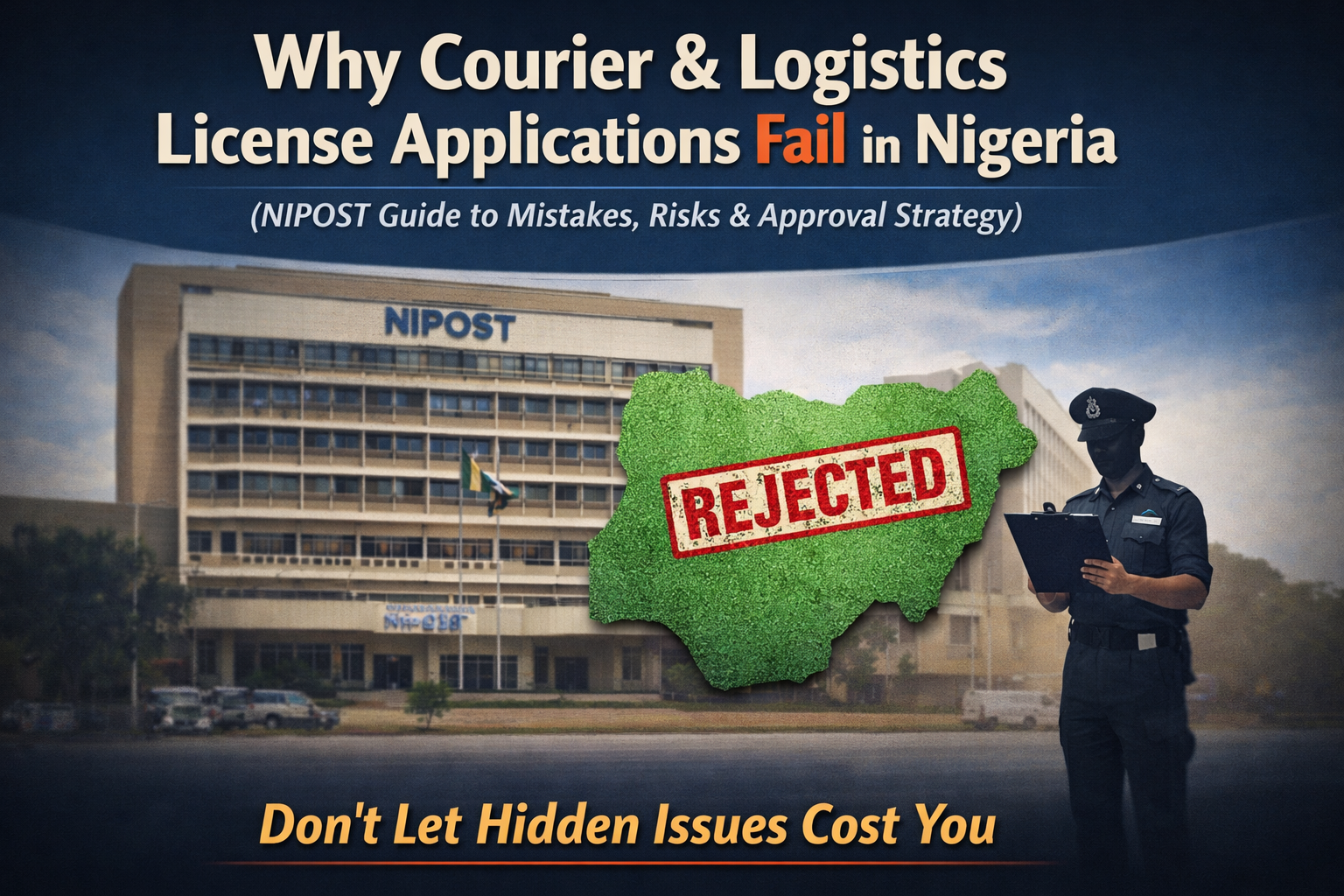
Introduction: The Cost of Getting It Wrong
The demand for courier and logistics services in Nigeria has grown rapidly, driven by e-commerce, urbanisation, and cross-border trade. Naturally, more entrepreneurs are seeking to obtain regulatory approval from the Nigerian Postal Service (NIPOST) to operate legally.
However, what most applicants fail to realise is this:
Courier licensing in Nigeria is not a routine registration process, it is a rigorous regulatory evaluation.
Every year, numerous applications are:
- Delayed for months
- Subjected to repeated queries
- Or outright rejected
Not because applicants lack ambition, but because they misunderstand the depth, expectations, and hidden compliance structure of the process.
This article provides a comprehensive, regulator-based breakdown of:
- The mistakes that cause failure
- The risks applicants overlook
- The hidden complexities within the process
- The realistic timelines
- And a strategic approach to success
If you are considering applying, read this carefully, because the biggest mistake is thinking this process is simple.
Understanding the Regulator: Why NIPOST Is Highly Selective
The Nigerian Postal Service is mandated to regulate courier and logistics operations under Nigeria’s postal framework.
This means courier operators are not just businesses, they are part of a national communications and delivery infrastructure.
As a result, NIPOST evaluates applicants based on:
- Operational capability
- Financial capacity
- Security and parcel handling standards
- Traceability and accountability systems
This level of scrutiny explains why many applications fail, even when they appear “complete” on the surface.
Section 1: The Biggest Mistake Applicants Make
Treating Courier Licensing Like a Basic Registration
One of the most common and costly assumptions is that obtaining a courier license is similar to:
- CAC company registration
- SCUML compliance
- Tax registration
It is not.
Courier licensing is a regulatory approval process, not a documentation exercise.
What This Means Practically:
- You are being assessed, not just registered
- Your entire business model is evaluated
- Your readiness to operate is scrutinised
The Result of This Misunderstanding:
Applicants who simply “submit documents” without demonstrating real capacity often face:
- Endless regulatory queries
- Delays stretching into months
- Eventual rejection or abandonment
Section 2: Key Mistakes That Lead to Rejection
1. Submitting Structurally Weak Documentation
Many applications fail at the first stage due to:
- Generic or templated submissions
- Inconsistent company records
- Poorly articulated operational frameworks
NIPOST expects documentation that clearly demonstrates:
- Defined service scope
- Operational structure
- Delivery network model
Hidden Reality:
Even when documents are technically “complete,” they can still fail if they lack depth, clarity, and alignment.
2. Weak or Unrealistic Business Plans
The business plan is one of the most critical components of your application.
It is used to evaluate:
- Your logistics framework
- Fleet and delivery model
- Staffing and operational structure
- Risk and scalability strategy
Common Errors:
- Copy-and-paste business plans
- Unrealistic revenue projections
- Lack of operational detail
- No evidence of execution strategy
Why This Is Dangerous:
A weak business plan signals lack of operational capacity, which significantly increases the likelihood of rejection.
3. Incorrect License Categorisation
Courier licensing is structured into categories based on:
- Scope of operation
- Geographic coverage
- Operational scale
Many applicants fail because they:
- Apply under the wrong category
- Understate or overstate their capacity
Consequences:
- Application queries
- Reclassification delays
- Restarting the process
4. Lack of Operational Readiness
A major misconception is that setup can happen after approval.
In reality, NIPOST evaluates whether your business is already operationally prepared.
This includes:
- Office structure
- Logistics systems
- Tracking capability
- Personnel
Critical Insight:
Approval is based on readiness, not intention.
5. Inadequate Financial Capacity Evidence
Courier operations require significant investment.
Applicants are expected to demonstrate:
- Financial strength
- Sustainability
- Ability to scale
Common Issues:
- Weak or unverifiable financial records
- Lack of capital structure evidence
- Inconsistent documentation
Risk:
If the regulator doubts your financial capacity, your application is unlikely to succeed.
6. Overlooking Compliance & Security Requirements
Courier services involve handling parcels, sensitive documents, and customer data.
As such, NIPOST evaluates:
- Security protocols
- Parcel handling systems
- Record-keeping procedures
- Reporting structures
Hidden Complexity:
These requirements are not always explicitly detailed, but they are actively assessed during evaluation.
7. Adopting a Trial-and-Error Approach
Many applicants attempt to “figure things out” during the process.
This often leads to:
- Poor responses to queries
- Repeated errors
- Increased regulatory scrutiny
Bottom Line:
This is not a process you learn by trial, it is one you prepare for strategically.
Section 3: Hidden Complexities Most Applicants Miss
Multi-Layered Evaluation System
Applications go through several stages, including:
- Administrative review
- Technical evaluation
- Compliance verification
Each stage can trigger:
- Queries
- Requests for clarification
- Additional documentation
Physical Inspection & Verification
One of the most critical stages is site inspection.
Regulators assess:
- Physical office setup
- Operational readiness
- Alignment with submitted documents
Key Risk:
If what is on ground does not match what was submitted, it raises serious concerns.
Interconnected Documentation
All submitted documents must align:
- Business plan
- Financial records
- Operational structure
Example:
If your business plan states nationwide operations, but your infrastructure suggests otherwise, it creates a red flag.
Regulatory Discretion
Even when all requirements are met:
- Approval is not automatic
- Decisions are based on regulatory judgment
This means:
- Presentation matters
- Structure matters
- Clarity matters
Section 4: Real Timelines vs Perceived Timelines
Common Expectation:
Many applicants assume the process takes a few weeks.
Reality:
Depending on various factors, timelines can extend to:
Several weeks to multiple months
What Affects Timeline:
- Quality of initial submission
- Speed of responding to queries
- Inspection outcomes
- Internal regulatory review processes
Major Delay Triggers:
- Incomplete documentation
- Inconsistent submissions
- Poor communication with regulators
Section 5: Risks of Getting It Wrong
Financial Loss
Costs incurred during the process may include:
- Application fees
- Documentation preparation
- Logistics and inspection costs
If the application fails, these costs are typically unrecoverable.
Business Delays
Without approval:
- You cannot operate legally
- Expansion plans are halted
Regulatory Exposure
Operating without proper licensing may result in:
- Enforcement actions
- Sanctions
Credibility Damage
Repeated failed applications can affect:
- Regulatory trust
- Future approval chances
Section 6: Strategic Approach to Approval
1. Start With Proper Structuring
Define clearly:
- Your service scope
- Operational model
- Target coverage
2. Develop a High-Quality Business Plan
Ensure your plan demonstrates:
- Operational capacity
- Realistic projections
- Execution strategy
3. Maintain Document Consistency
All documents must tell the same story.
4. Prepare for Inspection Early
Set up:
- Office infrastructure
- Operational systems
- Personnel
Before submitting your application.
5. Respond to Queries Professionally
Each response should be:
- Clear
- Direct
- Supported by evidence
6. Avoid Guesswork
This process requires:
- Regulatory understanding
- Strategic preparation
Section 7: Common Misconceptions
“Submission guarantees approval”
False. Submission only begins the evaluation process.
“I can complete setup after approval”
Incorrect. Readiness is assessed before approval.
“Any business plan is acceptable”
Wrong. It must demonstrate real operational capacity.
“Small operators don’t need full compliance”
False. All applicants are assessed under regulatory standards.
Frequently Asked Questions (FAQs)
1. How long does it take to obtain a courier license in Nigeria?
It can take several weeks to months depending on the quality of your submission and regulatory review process.
2. Can I apply for a courier license myself?
Yes, but the process involves technical and regulatory complexities that are often underestimated.
3. What is the most important part of the application?
The business plan and operational structure, they demonstrate your capacity to operate.
4. Does NIPOST conduct inspections?
Yes. Physical inspection is a key part of the approval process.
5. Can my application be rejected?
Yes. Common reasons include:
- Weak documentation
- Inconsistent information
- Lack of operational capacity
6. Is it legal to operate without a license?
No. Operating without proper approval exposes you to regulatory sanctions.
Final Insight: Why Most Applications Fail
Courier license applications fail because applicants:
- Underestimate the process
- Misinterpret regulatory expectations
- Submit without a clear strategy
The process is not just administrative, it is:
- Technical
- Evaluative
- Compliance-driven
Conclusion: This Is More Complex Than It Appears
At first glance, obtaining a courier or logistics license in Nigeria may seem like a checklist.
In reality, it is a structured regulatory evaluation process that requires:
- Planning
- Expertise
- Strategic execution
Most applicants only realise this after experiencing:
- Delays
- Queries
- Or rejection
By then, valuable time and resources have already been lost.
Final Takeaway
The biggest risk is not applying, it is applying incorrectly.
Because in this process:
- Mistakes are costly
- Delays are inevitable without preparation
- And rejection is more common than most people expect

