
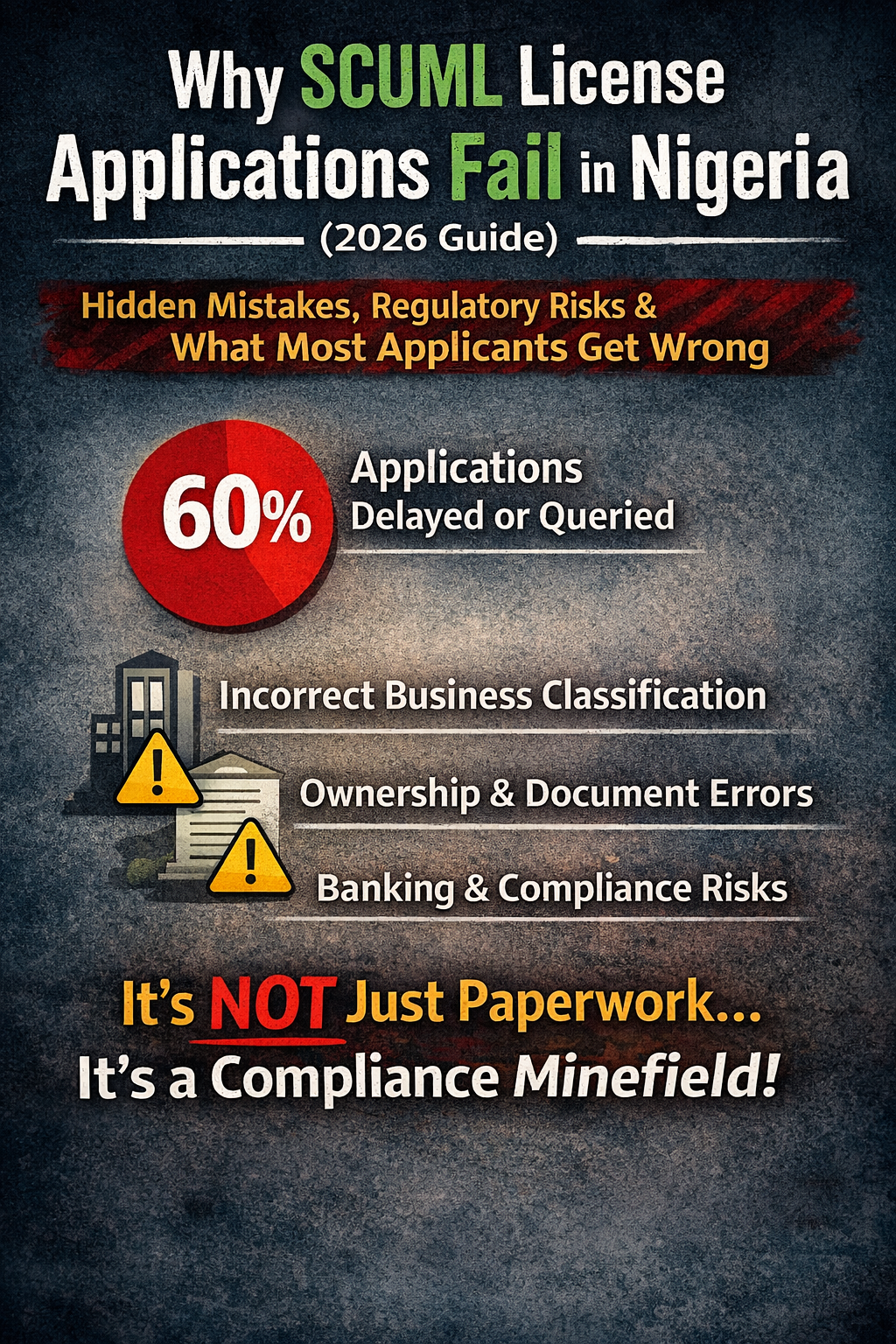
Introduction: The Illusion of Simplicity That Costs Businesses Millions
On the surface, obtaining a SCUML certificate in Nigeria appears deceptively simple; an online registration, document upload, and a few days of waiting. Many business owners approach it casually, assuming it is just another regulatory formality.
That assumption is where the problem begins.
Behind the SCUML process lies a compliance-heavy, risk-sensitive regulatory system anchored in Nigeria’s anti-money laundering framework. What most applicants do not realise is that:
-
SCUML is not just registration, it is regulatory profiling
-
The reviewing authority evaluates risk exposure, business classification, and compliance readiness
-
Errors are not just rejected, they can flag your business for further scrutiny
And here is the uncomfortable truth:
Most SCUML applications do not fail because of obvious mistakes, but because of hidden compliance gaps applicants don’t even know exist.
This guide unpacks:
-
The real reasons SCUML applications fail
-
Hidden complexities most applicants overlook
-
Regulatory risks tied to poor submissions
-
Timelines and delays explained
-
Strategic insights (without revealing everything professionals charge for)
If you think SCUML is “just filling a form,” this article will change that perspective.
What is SCUML and Why It Matters More Than You Think
The Special Control Unit Against Money Laundering (SCUML) operates under Nigeria’s anti-money laundering laws and supervises Designated Non-Financial Businesses and Professions (DNFBPs).
These include:
-
Real estate firms
-
Legal practitioners (in certain transactions)
-
Accountants
-
Dealers in luxury goods
-
Consultants and intermediaries
-
NGOs (in some cases)
SCUML registration is mandatory, and failure to comply can result in:
-
Account restrictions
-
Regulatory sanctions
-
Inability to operate legally within financial systems
However, the deeper function of SCUML is this:
It acts as a gatekeeper for financial transparency and risk classification.
This is why applications are reviewed more critically than most applicants expect.
Why SCUML Applications Fail: The Real Reasons (Not What You Think)
1. Incorrect Business Classification (The Most Dangerous Mistake)
One of the most common; and most damaging errors is misclassifying your business under the wrong category.
SCUML does not just look at what you say your business does. It examines:
-
Your CAC registration objects
-
Your operational model
-
Your revenue sources
If there is inconsistency, your application may:
-
Be rejected
-
Be flagged for clarification
-
Be delayed indefinitely
Hidden Complexity:
Some businesses fall under multiple DNFBP categories, and choosing the wrong one can trigger compliance concerns.
2. Mismatch Between CAC Records and SCUML Submission
Your SCUML application is cross-referenced with your CAC details.
Common inconsistencies include:
-
Different business descriptions
-
Unaligned object clauses
-
Missing or vague operational scope
Risk:
This signals lack of transparency, which is a red flag under anti-money laundering regulations.
3. Poorly Drafted Business Description
Many applicants write generic descriptions like:
-
“General contracts”
-
“Consultancy services”
-
“Trading”
This is a critical mistake.
SCUML requires clarity of economic activity, not vague statements.
Why this matters:
-
The system cannot classify your risk level properly
-
It creates ambiguity around your financial flows
Result: Delays, queries, or outright rejection.
4. Failure to Identify Beneficial Ownership Properly
SCUML requires disclosure of:
-
Directors
-
Shareholders
-
Beneficial owners
Mistakes include:
-
Omitting key individuals
-
Providing incomplete ownership structures
-
Using proxies without disclosure
Regulatory Risk:
This can be interpreted as concealment, which falls directly under anti-money laundering concerns.
5. Incomplete or Improper Documentation
Typical document issues include:
-
Blurred or unreadable uploads
-
Expired identification
-
Missing supporting documents
-
Incorrect file formats
While this seems basic, the implication is not:
Poor documentation = Poor compliance culture
And that is enough to delay or stall approval.
6. Applying Without Understanding DNFBP Obligations
Many applicants think SCUML ends with certificate issuance.
It does not.
Registration implies:
-
Ongoing reporting obligations
-
Record-keeping requirements
-
Compliance monitoring
If your application shows no awareness of this, it raises concerns.
7. Using “Copy-and-Paste” Applications
This is increasingly common.
Applicants reuse:
-
Business descriptions
-
Compliance statements
-
Operational summaries
Problem:
SCUML reviewers can detect patterns.
Consequence:
Applications may be:
-
Queried
-
Delayed
-
Treated as non-serious submissions
Hidden Risks Most Applicants Don’t See
Regulatory Flagging
A poorly prepared application does not just fail, it can:
-
Flag your business in compliance systems
-
Affect future financial interactions
Banking Implications
Banks often require SCUML certification for:
-
Account opening
-
Transaction processing
A delayed or problematic SCUML application can:
-
Freeze operations
-
Affect credibility
Compliance Audit Exposure
Once registered, your business can be subject to:
-
Compliance reviews
-
Reporting checks
If your initial application was weak, it creates long-term exposure.
SCUML Timelines: What the Official Process Does not Tell You
Officially, SCUML registration is often described as fast and straightforward.
But in practice, timelines depend on:
1. Accuracy of Submission
-
Clean application: faster processing
-
Errors: indefinite delays
2. Query Resolution Speed
-
Delayed responses = stalled application
3. Risk Classification
-
High-risk businesses face deeper scrutiny
Realistic Timeline Breakdown
| Stage | Expected Duration |
|---|---|
| Initial Submission | 1–2 days |
| Review Phase | 3–10 working days |
| Queries (if any) | Adds 5–20+ days |
| Final Approval | Depends on compliance clarity |
Key Insight:
The timeline is not fixed, it expands based on how “clean” your application is.
Strategic Approach: How Professionals Handle SCUML Applications
This is where most applicants underestimate the process.
Professionals do not just “submit forms.” They:
1. Align CAC Objects with SCUML Classification
Ensuring your business legally matches your regulatory category.
2. Draft Precise Business Descriptions
Avoiding vague language and clearly defining:
-
Revenue streams
-
Operational model
-
Compliance exposure
3. Structure Ownership Disclosure Properly
Ensuring transparency while maintaining legal accuracy.
4. Anticipate Compliance Queries
Submitting applications that already address likely concerns.
5. Position the Application Strategically
Reducing perceived risk without misrepresentation.
Common Misconceptions About SCUML
“It’s just a registration”
False. It is a compliance assessment process.
“Anyone can do it easily”
Technically yes, but most do it incorrectly.
“It doesn’t affect business operations”
Wrong. It directly impacts:
-
Banking
-
Credibility
-
Regulatory standing
“Once approved, you’re done”
No. SCUML introduces ongoing compliance obligations.
Frequently Asked Questions (FAQs)
1. How long does SCUML registration take in Nigeria?
While it can take a few days for straightforward applications, most cases experience delays due to queries and compliance checks.
2. Is SCUML mandatory for all businesses?
No. It applies specifically to Designated Non-Financial Businesses and Professions (DNFBPs).
3. Can my application be rejected?
Yes. Applications can be:
-
Rejected
-
Queried
-
Delayed indefinitely
4. What happens if I operate without SCUML?
You risk:
-
Regulatory sanctions
-
Banking restrictions
-
Compliance issues
5. Can I correct a rejected application?
Yes, but repeated errors may attract deeper scrutiny.
6. Is SCUML free?
The registration itself is typically free, but the cost lies in getting it right.
7. Why do applications get delayed?
Mostly due to:
-
Incomplete information
-
Misclassification
-
Poor documentation
The Reality Most Applicants Discover Too Late
By the time many applicants realise the complexity of SCUML:
-
Their application has been delayed
-
Their business operations are affected
-
Their credibility is questioned
And fixing it is often harder than doing it correctly from the start.
Final Thoughts: The Cost of Getting It Wrong
SCUML is not difficult because of paperwork, it is difficult because of regulatory interpretation.
Every section of the application communicates something:
-
About your business
-
About your compliance culture
-
About your risk level
And once submitted, that impression is hard to reverse.
The biggest mistake is not ignorance, it is underestimating the process.
Subtle but Critical Takeaway
If you have read this far, you already understand something most applicants don’t:
SCUML is not about filling forms.
It is about positioning your business correctly within Nigeria’s compliance framework.
And that is where the difference between:
-
Approval and delay
-
Compliance and scrutiny
-
Smooth operations and regulatory friction
…is quietly decided.
