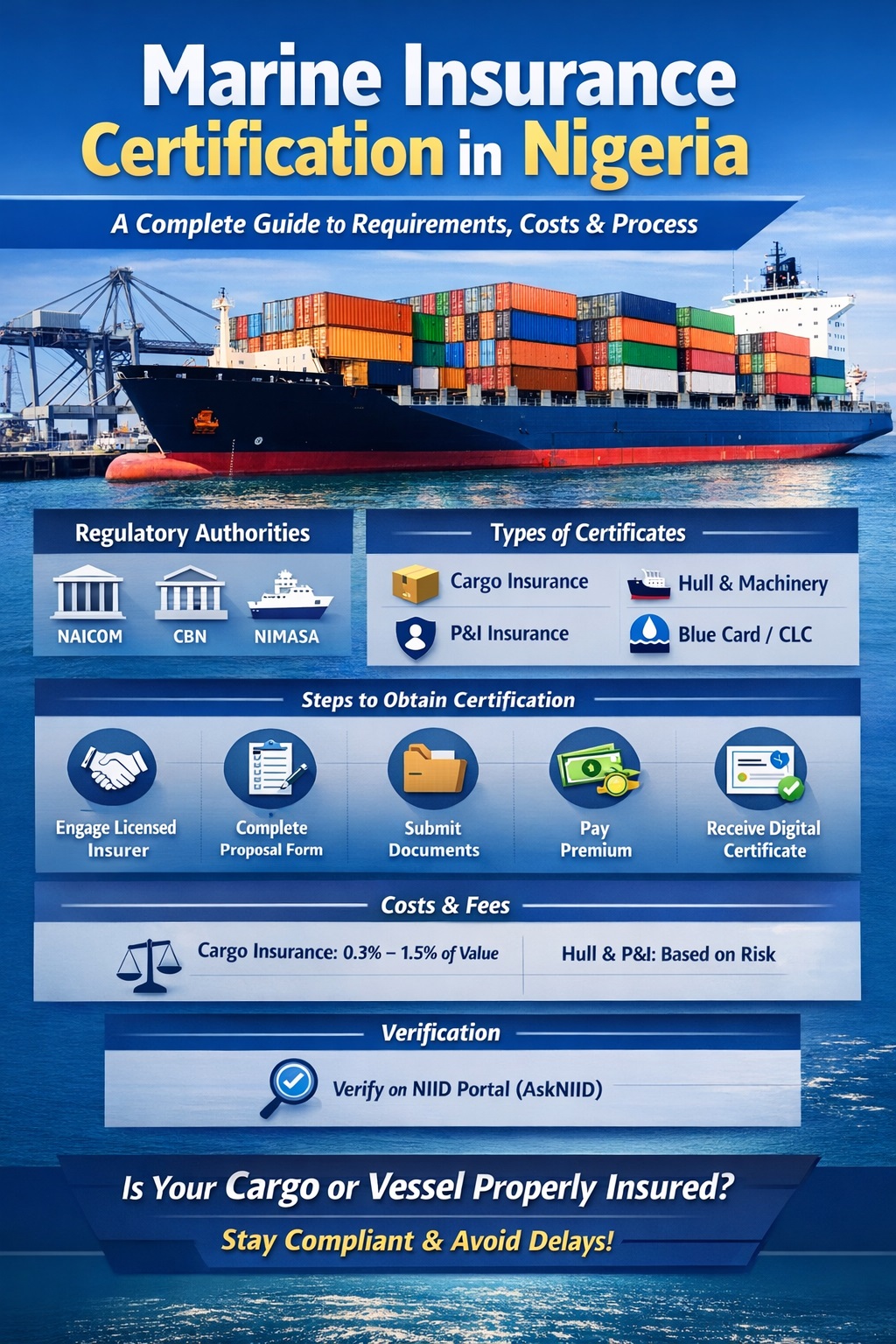
Marine Insurance Certification in Nigeria is a mandatory regulatory and commercial requirement for importers, exporters, shipping companies, logistics operators, vessel owners, and maritime service providers. Whether you are processing Form M, insuring cargo, registering a vessel, or complying with maritime safety regulations, obtaining the correct marine insurance certificate is non-negotiable.
This comprehensive guide explains what marine insurance certification is, who issues it, the regulatory authorities involved, requirements, costs, procedures, timelines, verification methods, and common misconceptions, all based strictly on official Nigerian maritime and insurance regulatory frameworks.
What Is Marine Insurance Certification in Nigeria?
Marine Insurance Certification refers to the official insurance documentation issued by a licensed Nigerian insurance company (or its authorised broker) confirming that marine risks; such as cargo loss, vessel damage, pollution liability, or third-party injury, are insured in compliance with Nigerian law.
The certificate serves as legal proof of insurance coverage and is required by:
-
Banks (for Form M and trade finance)
-
Nigeria Customs Service
-
Port authorities
-
Nigerian Maritime Administration and Safety Agency (NIMASA)
-
Vessel registries and classification societies
Without a valid marine insurance certificate, shipments may be delayed, vessels detained, or regulatory approvals denied.
Regulatory Authorities Governing Marine Insurance in Nigeria
Marine insurance certification in Nigeria is regulated under a multi-agency framework:
1. National Insurance Commission (NAICOM)
NAICOM is the primary regulator of the insurance industry in Nigeria. It:
-
Licenses insurance companies and brokers
-
Regulates marine insurance products
-
Sets compliance standards for policy issuance
-
Oversees digital insurance implementation
Only NAICOM-licensed insurers and brokers can issue valid marine insurance certificates.
2. Central Bank of Nigeria (CBN)
The CBN regulates trade documentation for imports and exports. In collaboration with NAICOM and the Nigerian Insurers Association, the CBN mandated the Digital Marine Insurance Certificate, especially for:
-
Form M processing
-
Import documentation
-
Bank trade finance approvals
3. Nigerian Maritime Administration and Safety Agency (NIMASA)
NIMASA enforces marine insurance compliance for:
-
Vessel registration
-
Shipping operations in Nigerian waters
-
Marine pollution liability
-
Protection & Indemnity (P&I) insurance
-
Civil Liability Convention (CLC) and Blue Card requirements
4. Nigerian Insurance Industry Database (NIID / AskNIID)
NIID operates the official insurance verification platform used to confirm the authenticity of marine insurance certificates issued in Nigeria.
Types of Marine Insurance Certificates in Nigeria
Depending on your activity, you may require one or more of the following:
1. Marine Cargo Insurance Certificate
Covers loss or damage to goods during sea, air, or multimodal transit.
Required for:
-
Imports and exports
-
Form M processing
-
Bank trade documentation
2. Hull and Machinery (H&M) Insurance Certificate
Covers physical damage to vessels.
Required for:
-
Vessel registration
-
Commercial shipping operations
3. Protection & Indemnity (P&I) Insurance Certificate
Covers third-party liabilities including:
-
Crew injury or death
-
Cargo damage
-
Collision liabilities
-
Environmental pollution
4. Civil Liability / Blue Card Insurance
Mandatory for vessels carrying oil or hazardous substances under international conventions enforced by NIMASA.
5. Open Cover Marine Insurance Certificate
Annual insurance arrangement allowing multiple shipments with certificates issued per declaration.
Who Can Issue Marine Insurance Certificates in Nigeria?
Only the following can legally issue marine insurance certificates:
-
Insurance companies licensed by NAICOM
-
Insurance brokers registered with NAICOM
-
Authorised underwriting agents of licensed insurers
Foreign insurers cannot issue Nigerian marine insurance certificates unless recognised under NIMASA conventions (e.g., certain P&I Clubs).
Step-by-Step Procedure to Obtain Marine Insurance Certification in Nigeria
Step 1: Identify the Required Insurance Type
Determine whether you need:
-
Cargo insurance
-
Vessel insurance
-
P&I or liability insurance
-
Open cover or single voyage policy
Step 2: Engage a Licensed Insurer or Broker
Confirm the insurer or broker is licensed by NAICOM before proceeding.
Step 3: Complete Insurance Proposal or Declaration Form
Provide accurate details including:
-
Cargo description or vessel particulars
-
Declared value
-
Origin and destination
-
Mode of transport
-
Risk extensions (war, strikes, theft)
Step 4: Submit Supporting Documents
Documents vary depending on policy type but typically include:
-
Proforma or commercial invoice
-
Bill of lading or airway bill (if available)
-
Company incorporation documents
-
Vessel particulars (for H&M and P&I)
-
Previous claims history (if requested)
Step 5: Premium Assessment and Payment
The insurer assesses risk and issues a premium quotation.
Upon payment, the insurance policy is activated.
Step 6: Issuance of Digital Marine Insurance Certificate
The insurer issues a digital certificate, compliant with CBN and NAICOM standards.
Step 7: Certificate Verification
Verify the certificate using the NIID (AskNIID) platform if required by banks, customs, or regulators.
Requirements Checklist for Marine Insurance Certification
| Requirement | Applicability |
|---|---|
| Completed insurance proposal form | Mandatory |
| Proforma or commercial invoice | Cargo insurance |
| Bill of lading / airway bill | Voyage policies |
| Certificate of incorporation | Corporate applicants |
| Vessel details (IMO, tonnage, year built) | Vessel insurance |
| Proof of premium payment | Mandatory |
| P&I or liability documents | Vessel operations |
| Valid identification / KYC documents | Mandatory |
Cost of Marine Insurance Certification in Nigeria
There is no fixed government fee for marine insurance certificates. Costs depend on risk factors.
Key Cost Determinants
-
Declared cargo value
-
Type of goods
-
Route and destination
-
Coverage type (All Risks vs Named Perils)
-
Vessel age and trading area
-
Claims history
Indicative Premium Ranges (Market Practice)
| Policy Type | Typical Premium Range |
|---|---|
| Marine Cargo (All Risks) | 0.3% – 1.5% of cargo value |
| Marine Cargo (Named Perils) | 0.1% – 0.5% |
| War/Strikes Extension | 0.1% – 2% |
| Hull & Machinery | Negotiated |
| P&I Insurance | Annual club calls based on tonnage |
Processing Timeline
-
Cargo insurance: Same day to 48 hours
-
Open cover issuance: 1–3 business days
-
Vessel insurance: Several days to weeks depending on complexity
-
Digital certificate verification: Instant
How to Verify a Marine Insurance Certificate in Nigeria
-
Obtain the policy or certificate number
-
Visit the NIID (AskNIID) verification portal
-
Enter the certificate details
-
Confirm insurer name, coverage validity, and status
For vessel insurance, confirm NIMASA recognition where applicable.
Common Misconceptions About Marine Insurance Certification
Myth 1: Marine insurance certificates are government-issued
False. Certificates are issued by licensed insurers, not government agencies.
Myth 2: Any insurance document is acceptable for Form M
False. Banks require compliant digital marine insurance certificates.
Myth 3: Marine insurance is optional
False. It is mandatory for imports, exports, and vessel operations.
Myth 4: Verification is unnecessary
False. Fake certificates can result in cargo seizure or vessel detention.
Frequently Asked Questions (People Also Ask)
Is marine insurance mandatory in Nigeria?
Yes. It is mandatory for imports, exports, and maritime operations.
Can I get a marine insurance certificate online?
Yes. Digital marine insurance certificates are now standard in Nigeria.
Who regulates marine insurance in Nigeria?
NAICOM regulates insurers; CBN regulates trade documentation; NIMASA regulates maritime compliance.
How long is a marine insurance certificate valid?
Validity depends on policy type, single voyage or annual coverage.
Can I use foreign marine insurance in Nigeria?
Only if recognised by NIMASA for specific international conventions.
Final Compliance Checklist
-
Use only NAICOM licensed insurers
-
Ensure certificate is digital and verifiable
-
Verify on NIID before submission
-
Renew vessel insurance before expiry
-
Maintain accurate cargo declarations
Conclusion
Obtaining Marine Insurance Certification in Nigeria is a critical compliance requirement for trade and maritime operations. By following the correct regulatory process, using licensed insurers, and verifying certificates properly, businesses can avoid costly delays, penalties, and operational disruptions.
This guide provides everything you need from requirements, costs, steps, and compliance insights to secure your marine insurance certificate confidently and lawfully.
