
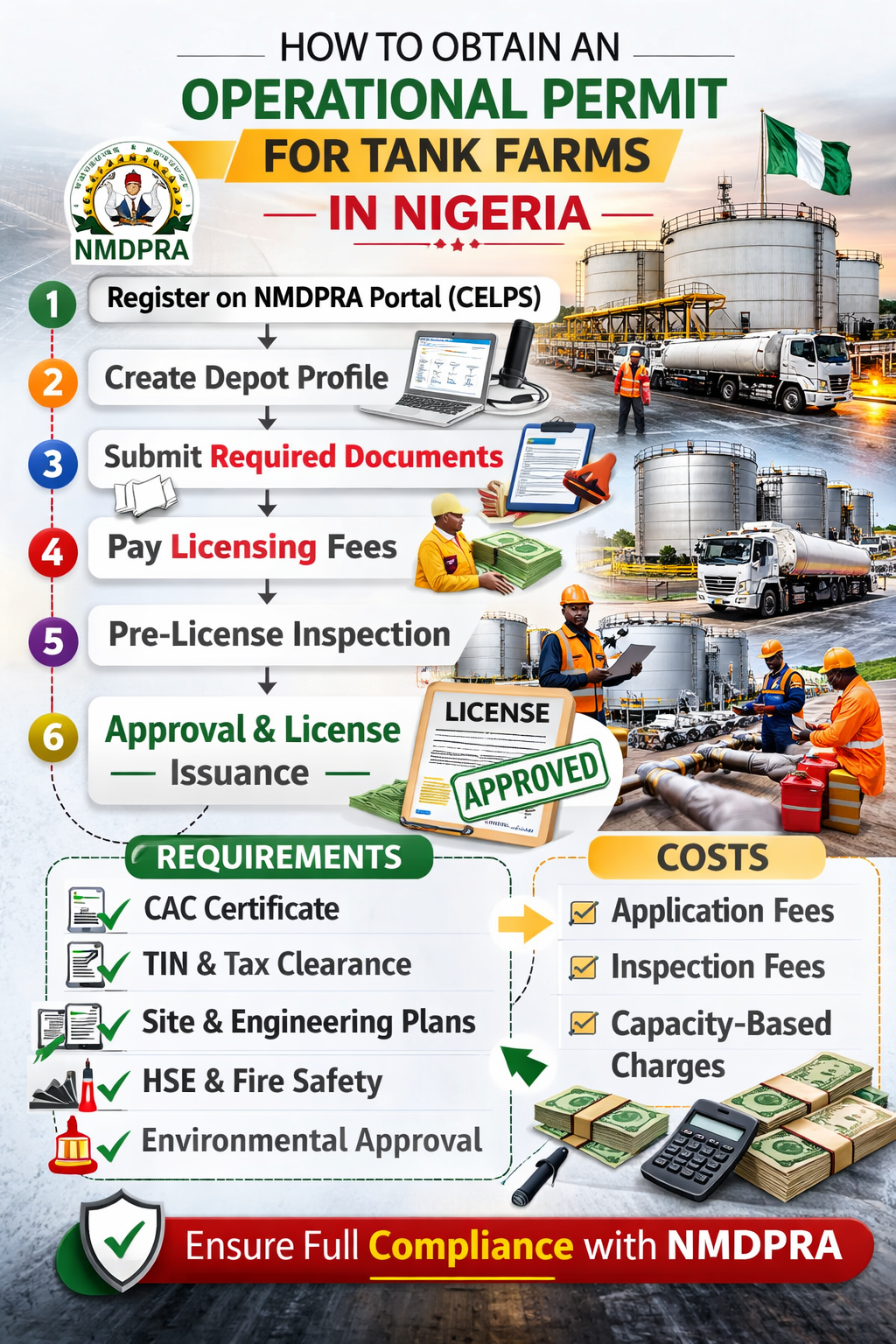
(For Storage and Distribution of Petroleum Products)
If you are planning to establish or operate a tank farm (petroleum depot) in Nigeria for the storage and distribution of petroleum products, securing the appropriate Operational Permit / Depot License from the regulator is mandatory.
This comprehensive guide explains, step-by-step, how to obtain an Operational Permit for Tank Farms for storage and distribution of petroleum products in Nigeria, including the regulatory authority, requirements, costs, inspection process, compliance obligations, and frequently asked questions.
All procedures referenced in this article are derived from official guidance, licensing portals, statutory schedules, and regulatory publications of the Nigerian Midstream and Downstream Petroleum Regulatory Authority (NMDPRA).
Who Issues the Operational Permit for Tank Farms in Nigeria?
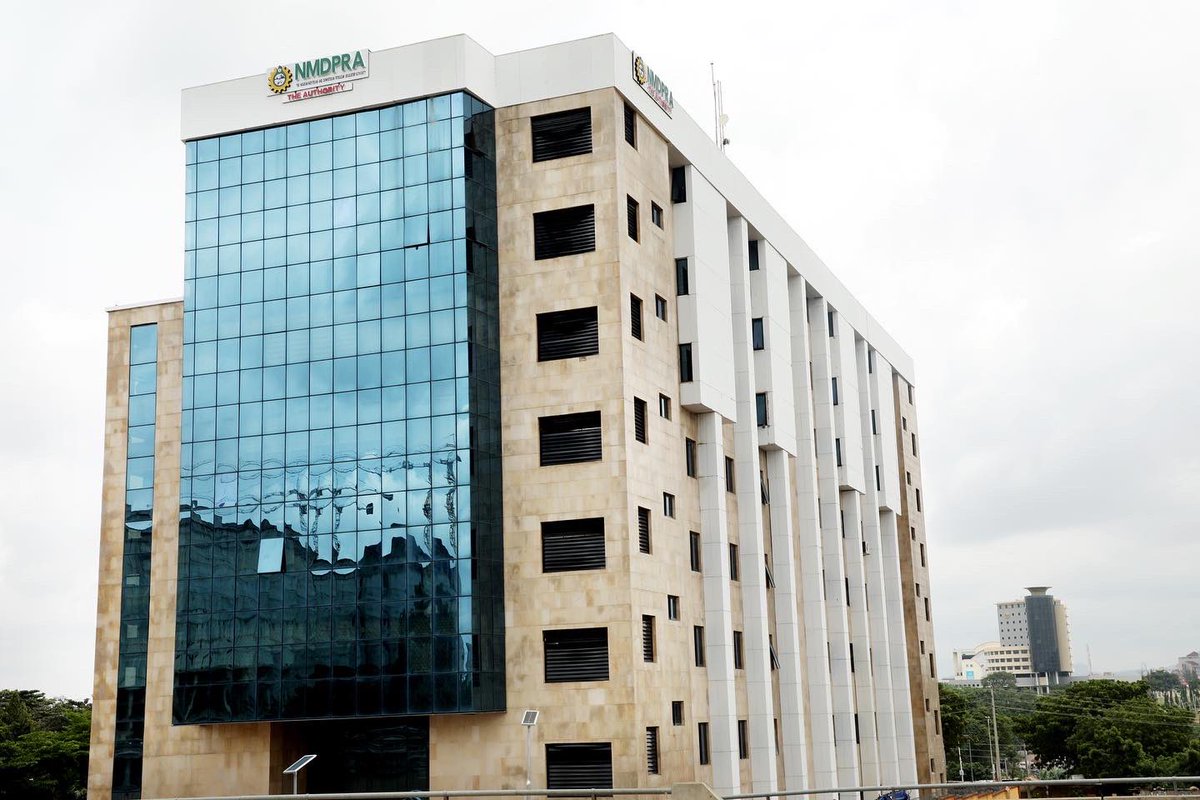
The regulatory authority responsible for issuing operational permits (Depot Licenses) for tank farms in Nigeria is the Nigerian Midstream and Downstream Petroleum Regulatory Authority (NMDPRA).
The Authority derives its powers from the Petroleum Industry Act (PIA) and the Midstream and Downstream Petroleum Operations Regulations.
No company is legally permitted to operate a petroleum storage depot, tank farm, or bulk storage facility without obtaining the relevant operational license from NMDPRA.
What is a Tank Farm Operational Permit?
A Tank Farm Operational Permit (commonly referred to as a Depot License or Petroleum Products Storage & Sales License) authorises a company to:
-
Store petroleum products in bulk tanks
-
Receive products via pipeline, vessel, or road tanker
-
Distribute products through loading gantries
-
Conduct bulk trading activities
-
Operate jetty or discharge facilities (where applicable)
This license confirms that the facility meets:
-
Engineering standards
-
Environmental requirements
-
Fire safety standards
-
HSE (Health, Safety & Environment) standards
-
Fiscal metering and calibration standards
Step-by-Step Process to Obtain an Operational Permit for Tank Farms in Nigeria
Below is the official procedural framework based on the NMDPRA electronic licensing system.
Step 1: Register on the NMDPRA Central Licensing Portal (CELPS)
All applications begin with registration on the Central Electronic Licensing & Permit System (CELPS) portal.
You must:
-
Create a corporate account
-
Input CAC registration details
-
Upload TIN information
-
Verify your official email address
This registration grants access to licensing modules including:
-
Depot License Portal
-
IMPEX Portal (for imports)
-
Retail Outlet Management System (ROMS)
-
Gas Licensing Portal (AGS)
Step 2: Create Depot Profile on the Depot Portal
Once your CELPS registration is approved:
-
Log into the Depot Management System
-
Register your tank farm facility
-
Provide site location and coordinates
-
Declare tank capacities
-
Indicate product types handled
-
Specify whether the facility has jetty/discharge infrastructure
Step 3: Upload Required Documentation
The Authority requires extensive documentation before scheduling inspection.
Corporate Documentation
| Requirement | Description |
|---|---|
| Certificate of Incorporation | CAC registration certificate |
| Memorandum & Articles | Corporate structure documentation |
| Tax Identification Number (TIN) | Federal tax registration |
| Company Address Verification | Utility bill or equivalent |
| Board Resolution | Authorising depot operation |
Technical & Engineering Documentation
| Requirement | Description |
|---|---|
| Site Layout Plan | Approved facility layout |
| As-Built Drawings | Engineering drawings |
| Piping & Instrumentation Diagram (P&ID) | Technical flow documentation |
| Tank Capacity Schedule | Volume details |
| Bund Wall Specifications | Spill containment system |
Safety & Compliance Documentation
| Requirement | Description |
|---|---|
| Fire Service Certification | State or Federal Fire Service clearance |
| Environmental Approval (EIA) | Where required |
| HSE Manual | Safety procedures |
| Emergency Response Plan | Incident management plan |
| Staff Training Certificates | Competency documentation |
| Calibration Certificates | Metering and measurement verification |
| SON Certification (if applicable) | Equipment compliance |
Step 4: Payment of Statutory Fees
Fees vary depending on:
-
Category of license
-
Tank capacity
-
Type of operation
-
Import/discharge activities
Example Statutory Charges (Subject to Portal Confirmation)
| Fee Type | Typical Amount (₦) |
|---|---|
| OGISP Category Permit | 5,000 – 250,000 |
| IMPEX Vessel Notification | ~220,000 |
| LPG Depot Pre-License Inspection | ~50,000 |
| Capacity-Based License Fee | Scaled by volume |
Important: The official payable amount is always displayed on the NMDPRA portal at the point of payment.
Payments are typically made via:
-
Remita
-
Bank Draft
-
Card Payment
Step 5: Pre-License Inspection by NMDPRA
After document verification, NMDPRA schedules a physical inspection.
Inspectors assess:
-
Structural integrity of tanks
-
Fire safety infrastructure
-
Spill containment systems
-
Calibration accuracy
-
HSE compliance
-
Environmental safeguards
-
Loading gantry systems
-
Jetty facilities (if applicable)
Any deficiencies must be corrected before approval.
Step 6: Final Approval & License Issuance
Upon satisfactory inspection and compliance clearance:
-
The Depot License is issued electronically
-
A downloadable PDF license is generated
-
License number is assigned
-
Portal confirmation is provided
How Long Does It Take?
Typical timeline:
| Stage | Estimated Duration |
|---|---|
| Portal Registration | 1–7 days |
| Document Review | 2–3 weeks |
| Inspection Scheduling | 2–6 weeks |
| Final Approval | 1–4 weeks |
Total estimated timeframe: 6–12 weeks, depending on readiness and compliance.
Renewal & Compliance Obligations
A Depot License must be renewed before expiry.
Operators must:
-
Maintain accurate stock records
-
Provide loading program reports
-
Maintain calibrated meters
-
Notify regulator of capacity upgrades
-
Seek approval before expansion
-
Submit required fiscal reports
Failure to comply may result in:
-
Suspension
-
Monetary penalties
-
Revocation of license
Common Misconceptions About Tank Farm Licensing in Nigeria
Myth: Local government approval is enough.
Fact: Only NMDPRA approval authorises operation.
Myth: License is permanent.
Fact: It requires renewal and continued compliance.
Myth: Inspection is just procedural.
Fact: Non-compliance can delay approval indefinitely.
Myth: Import depots require no additional permits.
Fact: Import depots must also use the IMPEX portal for vessel notifications and product discharge permits.
Frequently Asked Questions (FAQ)
1. Can a foreign company obtain a Tank Farm Operational Permit?
A foreign investor must incorporate a Nigerian company before applying for a depot license.
2. Is an Environmental Impact Assessment mandatory?
Yes, where required under environmental regulations for the project size and location.
3. Can I upgrade my depot capacity after approval?
Yes, but you must apply for modification approval and undergo further inspection.
4. What happens if I operate without a license?
Operating without NMDPRA authorisation is a regulatory offense under the Petroleum Industry Act.
5. Is the license issued physically or electronically?
Licenses are issued electronically via the NMDPRA portal.
Complete Application Checklist
Before submitting your application, ensure you have:
- CAC registration documents
- TIN certificate
- Site ownership/lease documentation
- Engineering drawings
- Fire Service approval
- Environmental approval
- HSE manual
- Staff competency records
- Calibration certificates
- Payment receipts
Conclusion
Obtaining an Operational Permit for Tank Farms in Nigeria requires strict regulatory compliance, detailed documentation, and successful inspection by the Nigerian Midstream and Downstream Petroleum Regulatory Authority.
While the process is structured and fully digitised through the NMDPRA licensing portal, it demands technical preparation and regulatory awareness.
For companies planning to establish or operate petroleum storage and distribution facilities in Nigeria, early preparation of engineering documentation, environmental approvals, and safety compliance materials significantly accelerates approval timelines.
