
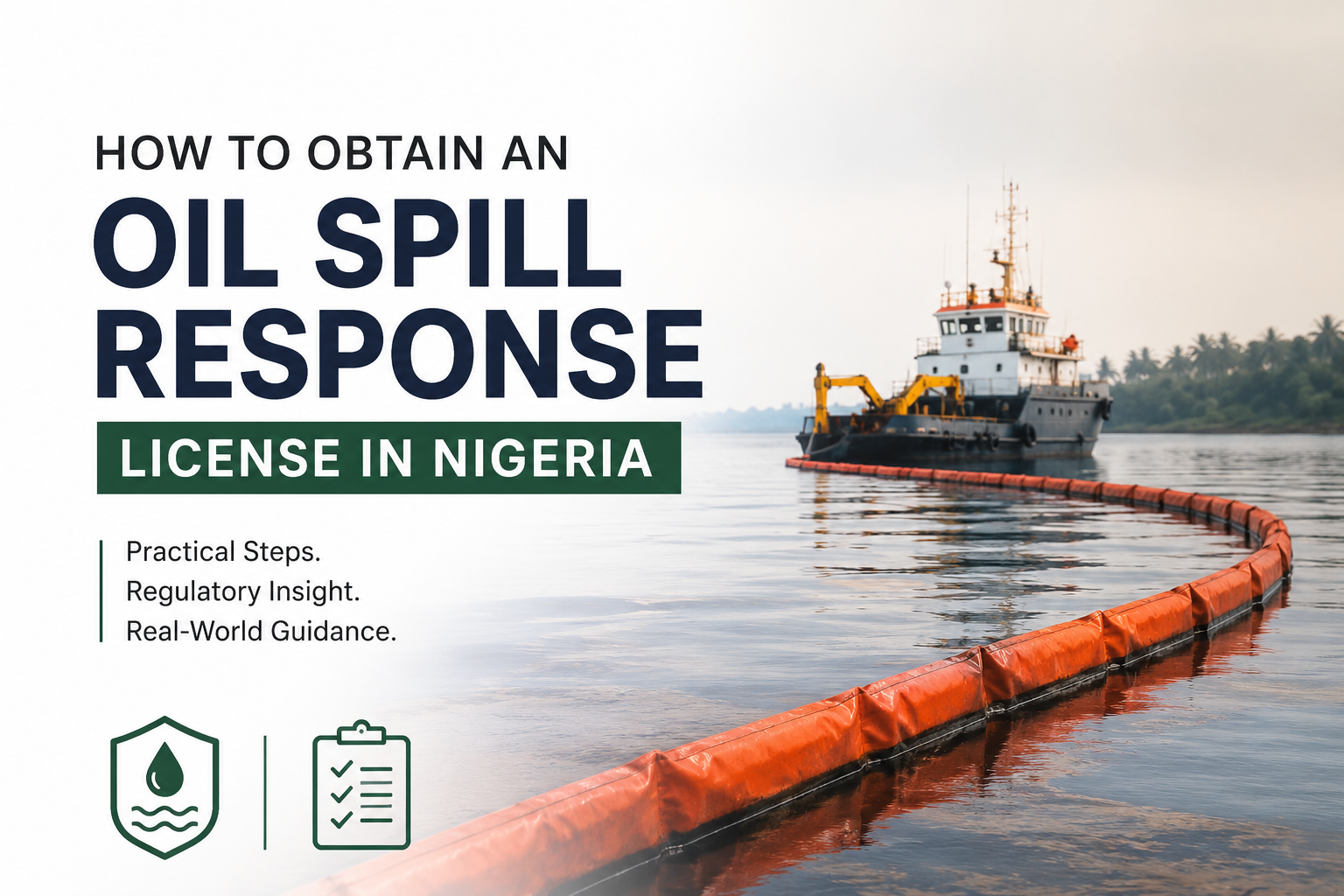
If your company intends to provide oil spill response services in Nigeria, this article will help you:
- Understand who needs an Oil Spill Response License.
- Know the regulator responsible for issuing it.
- Avoid common mistakes that delay approvals.
- Understand the practical requirements beyond what is written on paper.
- Position your company for successful licensing and business opportunities in the oil and gas sector.
More importantly, you will understand how the process works in the real world, not just how it appears in regulations.
After over fifteen years of advising companies on regulatory compliance in Nigeria, I have learned one simple truth:
Many businesses lose opportunities not because they lack capacity, but because they misunderstand compliance.
The Oil Spill Response License is one of those areas.
Why This License Matters
Nigeria remains one of the largest oil-producing countries in Africa.
With oil exploration, transportation, storage, and production comes a recurring challenge: oil spills.
When spills occur, operators are required by law to respond quickly and professionally.
This is where licensed oil spill response contractors come in.
Without the appropriate approval, a company cannot legitimately position itself as a specialist provider of oil spill response services to operators in the petroleum industry.
In many procurement exercises, the absence of this license can automatically disqualify a bidder.
Who Regulates Oil Spill Response Activities?
The principal regulator is the Nigerian oil and gas environmental regulator.
Today, environmental compliance within the petroleum sector falls under the supervision of the relevant authorities established under Nigeria’s petroleum regulatory framework.
The regulator’s primary concern is straightforward:
Can your company effectively respond to an oil spill when lives, communities, and the environment are at risk?
That is the question every application must answer.
Who Needs an Oil Spill Response License?
The license is generally required by companies involved in:
| Activity | License Requirement |
|---|---|
| Oil spill containment | Required |
| Oil spill recovery | Required |
| Environmental remediation support | Required |
| Emergency response services | Required |
| Pollution control services | Required |
| Offshore spill response operations | Required |
| Shoreline cleanup services | Required |
If your company intends to offer any of the above services to operators in the oil and gas industry, licensing should be treated as a priority.
The Biggest Mistake Companies Make
Many promoters believe that incorporation is enough.
It is not.
A company may have:
- CAC registration.
- Tax clearance.
- Corporate bank account.
- Nice profile.
- Impressive website.
Yet still be completely unqualified for licensing.
Why?
Because the regulator is assessing operational competence.
They want evidence.
Not promises.
The days when a colorful company profile could carry an application are largely gone.
Key Requirements You Should Expect
While requirements may vary depending on the scope of operations, regulators generally focus on the following areas:
1. Corporate Documentation
Expect to provide:
- Certificate of Incorporation.
- Memorandum and Articles of Association.
- CAC status report.
- Tax documentation.
- Evidence of statutory compliance.
Nothing unusual here.
But this is only the starting point.
2. Technical Personnel
This is where many applications begin to struggle.
The regulator wants to know:
Who will perform the work?
You may need personnel with experience in:
- Environmental management.
- Pollution control.
- Marine operations.
- Health, Safety and Environment (HSE).
- Emergency response management.
A company without competent personnel immediately raises concerns.
3. Equipment and Operational Capacity
This is the area that often separates serious applicants from speculative ones.
The regulator may require evidence of access to appropriate response equipment.
Examples include:
| Equipment Category | Purpose |
|---|---|
| Oil containment booms | Containment of spills |
| Skimmers | Recovery of oil |
| Storage systems | Temporary storage |
| Response vessels | Marine operations |
| Safety equipment | Personnel protection |
| Communication systems | Emergency coordination |
The regulator wants confidence that your company can actually respond when called upon.
Not merely submit quotations.
4. Health, Safety and Environment Framework
A robust HSE system is critical.
Expect scrutiny of:
- HSE policy.
- Emergency response procedures.
- Risk management framework.
- Incident reporting procedures.
- Staff safety training.
This is often underestimated.
It should not be.
The Practical Nigerian Reality
Let me say something many consultants avoid saying.
Compliance in Nigeria is expensive.
Competence is even more expensive.
A genuine oil spill response company requires investment.
Real investment.
Equipment.
Personnel.
Training.
Insurance.
Operational systems.
Many applicants approach the process hoping to “manage” things.
That approach usually becomes more expensive in the long run.
The regulator increasingly asks practical questions.
If an oil spill occurs in the Niger Delta at 2 a.m., can your company mobilize?
How quickly?
With what equipment?
With which personnel?
Those questions matter.
How Long Does the Process Take?
There is no universal timeline.
Several factors affect processing time:
- Completeness of documentation.
- Readiness of personnel.
- Availability of equipment.
- Regulatory review timelines.
- Inspection outcomes.
- Requests for additional information.
The most successful applications are usually those prepared properly before submission.
Before You Apply
I generally advise clients to conduct a readiness assessment first.
This helps answer three critical questions:
| Question | Why It Matters |
|---|---|
| Are we technically qualified? | Avoid rejection |
| Do we have the required personnel? | Demonstrates competence |
| Do we have adequate operational capacity? | Supports approval |
A readiness assessment often saves months of delay and substantial cost.
My Advice After Fifteen Years in Regulatory Compliance
Do not treat this license as a paperwork exercise.
Treat it as a business-building exercise.
The companies that succeed are not necessarily the biggest.
They are the most prepared.
Regulators can identify the difference between a company that genuinely understands oil spill response and one that simply wants another certificate.
Invest in competence.
Invest in systems.
Invest in compliance.
The license will then become a natural outcome of your preparedness.
Frequently Asked Questions (FAQ)
Can a newly incorporated company obtain an Oil Spill Response License?
Yes, provided it satisfies the applicable technical, operational, personnel, and regulatory requirements.
Is ownership of equipment always necessary?
The regulator typically expects evidence of operational capacity. Depending on circumstances, proof of access arrangements may be considered, but applicants should seek professional guidance on acceptable structures.
Can foreign companies apply?
Yes. However, they must comply with applicable Nigerian corporate and petroleum sector requirements.
Does the license guarantee contract awards?
No.
The license creates eligibility.
Winning contracts depends on additional factors such as technical capability, commercial competitiveness, experience, and client requirements.
Should I engage a compliance consultant?
In my experience, yes.
Not because the process is impossible.
But because mistakes are expensive.
A properly structured application saves time, money, and regulatory frustration.
Final Thoughts
The Nigerian oil and gas sector continues to offer significant opportunities for environmental service providers.
However, opportunities increasingly belong to companies that can demonstrate compliance, competence, and credibility.
An Oil Spill Response License is more than a regulatory requirement.
It is a statement that your company is ready to protect lives, communities, assets, and the environment when incidents occur.
And in today’s industry, that credibility is often worth far more than the certificate itself.

