Introduction
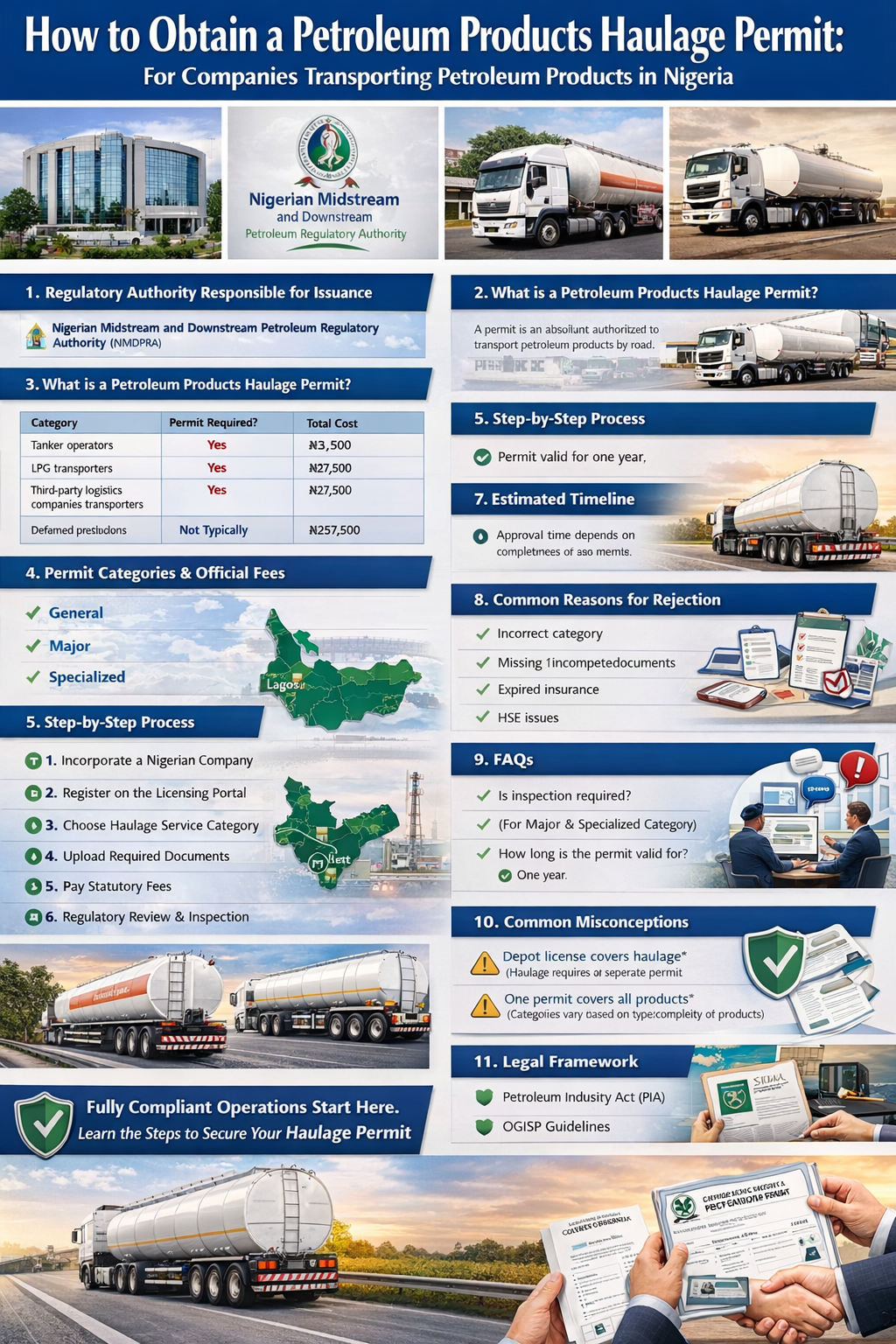
The transportation of petroleum products in Nigeria is a strictly regulated activity. Any company engaged in hauling Premium Motor Spirit (PMS), Automotive Gas Oil (AGO), Dual Purpose Kerosene (DPK), LPG, or other petroleum products must obtain the appropriate industry service permit before commencing operations.
The Petroleum Industry Act (PIA) and applicable downstream regulations mandate regulatory approval for petroleum logistics operations. The relevant permits are processed electronically through the official licensing platforms of the regulator.
This guide provides a comprehensive, step-by-step explanation of how to obtain a Petroleum Products Haulage Permit in Nigeria, including:
-
Official requirements
-
Statutory fees
-
Application procedure
-
Inspection process
-
Renewal obligations
-
Frequently asked questions
All information in this guide is derived strictly from official regulatory guidelines and portal documentation.
1. Regulatory Authority Responsible for Issuance


The Petroleum Products Haulage Permit is issued by the
Nigerian Midstream and Downstream Petroleum Regulatory Authority (NMDPRA).
Applications are processed electronically through:
-
The Central Electronic Licensing and Permit System (CELPS)
-
The Oil & Gas Industry Service Permit (OGISP) platform
The OGISP framework governs service providers operating in the petroleum midstream and downstream sectors, including haulage companies.
2. What is a Petroleum Products Haulage Permit?
A Petroleum Products Haulage Permit is an industry service authorisation issued under the OGISP framework that allows a registered Nigerian company to legally transport petroleum products by road.
It confirms that the company:
-
Is duly incorporated in Nigeria
-
Has met statutory documentation requirements
-
Has appropriate safety and operational systems
-
Maintains trained personnel
-
Complies with regulatory and HSE standards
Without this permit, petroleum haulage operations are considered non-compliant and may attract regulatory sanctions.
3. Who Requires This Permit?
| Category | Permit Required? | Explanation |
|---|---|---|
| Petroleum tanker operators (PMS, AGO, DPK) | Yes | Commercial transportation falls under regulated downstream operations |
| LPG / Gas transporters | Yes | Classified under haulage service category |
| Third-party logistics companies transporting petroleum | Yes | Service providers require OGISP authorisation |
| Individuals transporting petroleum privately | Not typically | Commercial activity triggers regulatory requirement |
Any company operating petroleum tankers for commercial purposes must obtain this permit before commencing operations.
4. Permit Categories and Official Statutory Fees
Under the OGISP Guidelines, permits fall into three categories:
| Category | Statutory Fee | Processing Fee | Total Official Cost |
|---|---|---|---|
| General | ₦5,000 | ₦500 | ₦5,500 |
| Major | ₦25,000 | ₦2,500 | ₦27,500 |
| Specialised | ₦250,000 | ₦7,500 | ₦257,500 |
Which Category Applies to Haulage?
Most petroleum haulage companies fall under the Major category.
Highly technical operations (e.g., specialised gas or cryogenic transport) may fall under Specialised classification depending on scope.
All fees are statutory and non-refundable.
5. Step-by-Step Process: How to Obtain a Petroleum Products Haulage Permit
STEP 1: Incorporate a Nigerian Company
The applicant must be a duly registered company with the Corporate Affairs Commission (CAC).
Required incorporation documents include:
-
Certificate of Incorporation
-
Memorandum and Articles of Association
-
CAC Form showing directors and shareholders
STEP 2: Register on the Official Licensing Portal
Create an account on the NMDPRA Central Electronic Licensing and Permit System (CELPS).
During registration, you will provide:
-
Company name
-
RC number
-
Tax Identification Number (TIN)
-
Official company email
-
Contact information
Applicants are strongly advised to manage their own portal account directly.
STEP 3: Select the Appropriate Service Category
Within the portal:
-
Choose “Oil & Gas Industry Service Permit (OGISP)”
-
Select the appropriate haulage service classification
-
Choose the correct category (General, Major, or Specialised)
Incorrect classification may result in delays or rejection.
STEP 4: Prepare and Upload Required Documents
Below is the consolidated list of documentation required for petroleum haulage permit applications:
Corporate Documentation
-
CAC Certificate of Incorporation
-
Memorandum & Articles
-
TIN certificate
-
Company profile
-
Evidence of tax compliance
Operational & Safety Documentation
-
List of fleet vehicles
-
Vehicle registration papers
-
Tank calibration certificates
-
Vehicle insurance certificates
-
Cargo insurance
-
Health, Safety & Environment (HSE) policy
-
Emergency response plan
Personnel Requirements
-
List of drivers
-
Driver licenses
-
Safety training certificates
-
Operational staff CVs
Social & Statutory Compliance
-
NSITF evidence
-
Pension compliance evidence
-
Expatriate quota (if applicable)
Documents must be uploaded in approved format (typically PDF).
STEP 5: Pay Statutory Fees
Payment is made through the portal’s approved payment gateway.
Upon successful payment:
-
A payment receipt is generated
-
The application proceeds to review
All fees are non-refundable.
STEP 6: Regulatory Review & Inspection
For Major and Specialised categories, the Authority may conduct:
-
Physical inspection of premises
-
Fleet verification
-
Calibration validation
-
HSE system review
-
Personnel verification
Applicants must ensure vehicles and documentation are readily available for inspection.
STEP 7: Approval & Permit Issuance
Once approved:
-
The permit becomes available for download via the portal dashboard
-
The permit should be printed and retained
-
Copies should be accessible during operations
6. Validity and Renewal
-
The Petroleum Products Haulage Permit is valid for one year.
-
Renewal must be completed before expiration.
-
Renewal follows similar portal procedures and fee payment.
Failure to renew may result in suspension of operations.
7. Estimated Timeline
The regulator does not publish a fixed processing timeline. Approval depends on:
-
Completeness of documentation
-
Correct classification
-
Inspection scheduling (if applicable)
-
Portal compliance
Incomplete applications significantly delay approval.
8. Common Reasons for Rejection or Delay
-
Incorrect service category selection
-
Missing or uncertified documents
-
Incomplete HSE documentation
-
Expired insurance certificates
-
Calibration discrepancies
-
Failure to respond to portal queries
Careful document preparation prevents avoidable delays.
9. Frequently Asked Questions (FAQs)
1. Is the haulage permit mandatory?
Yes. Commercial transportation of petroleum products requires regulatory authorisation.
2. Can I operate while my application is pending?
Operating without approval exposes the company to regulatory enforcement action.
3. How much does the permit cost?
Most haulage companies pay ₦27,500 under the Major category.
4. Is inspection compulsory?
For Major and Specialised categories, inspection is commonly required.
5. How long is the permit valid?
One year from date of issuance.
6. Can a foreign company apply?
Only Nigerian-registered companies are eligible. Foreign companies must incorporate locally.
7. Are the fees refundable?
No. Statutory fees are non-refundable.
10. Common Misconceptions
Misconception 1: “A depot license covers haulage.”
False. Haulage requires a separate industry service permit.
Misconception 2: “One permit covers all petroleum products.”
False. Classification may differ depending on product type and operational complexity.
Misconception 3: “An agent can handle everything without company oversight.”
Applicants remain responsible for portal submissions and compliance.
11. Compliance Checklist
Before submitting your application, confirm:
- CAC documents ready
- TIN and tax compliance evidence
- Fleet list & calibration certificates
- Insurance documentation
- HSE policy & emergency response plan
- Driver licenses and safety certifications
- NSITF and pension compliance
- Correct OGISP category selected
- Statutory fees available
12. Legal Framework
The Petroleum Products Haulage Permit requirement derives from:
-
The Petroleum Industry Act (PIA)
-
Midstream and Downstream Petroleum Operations Regulations
-
OGISP Guidelines issued by the Nigerian Midstream and Downstream Petroleum Regulatory Authority
These instruments empower the Authority to regulate petroleum transportation activities within Nigeria.
Conclusion
Obtaining a Petroleum Products Haulage Permit in Nigeria is a structured regulatory process designed to ensure safety, accountability, and operational compliance within the downstream petroleum sector.
Companies transporting petroleum products must:
-
Register on the official licensing portal
-
Select the correct OGISP category
-
Submit required corporate and safety documentation
-
Pay statutory fees
-
Undergo inspection (where applicable)
-
Download and maintain an active annual permit
Compliance is not optional, it is a legal requirement.
If your organisation intends to operate petroleum tanker services in Nigeria, early preparation of documentation and adherence to official regulatory guidelines will significantly accelerate approval and ensure uninterrupted operations.
