
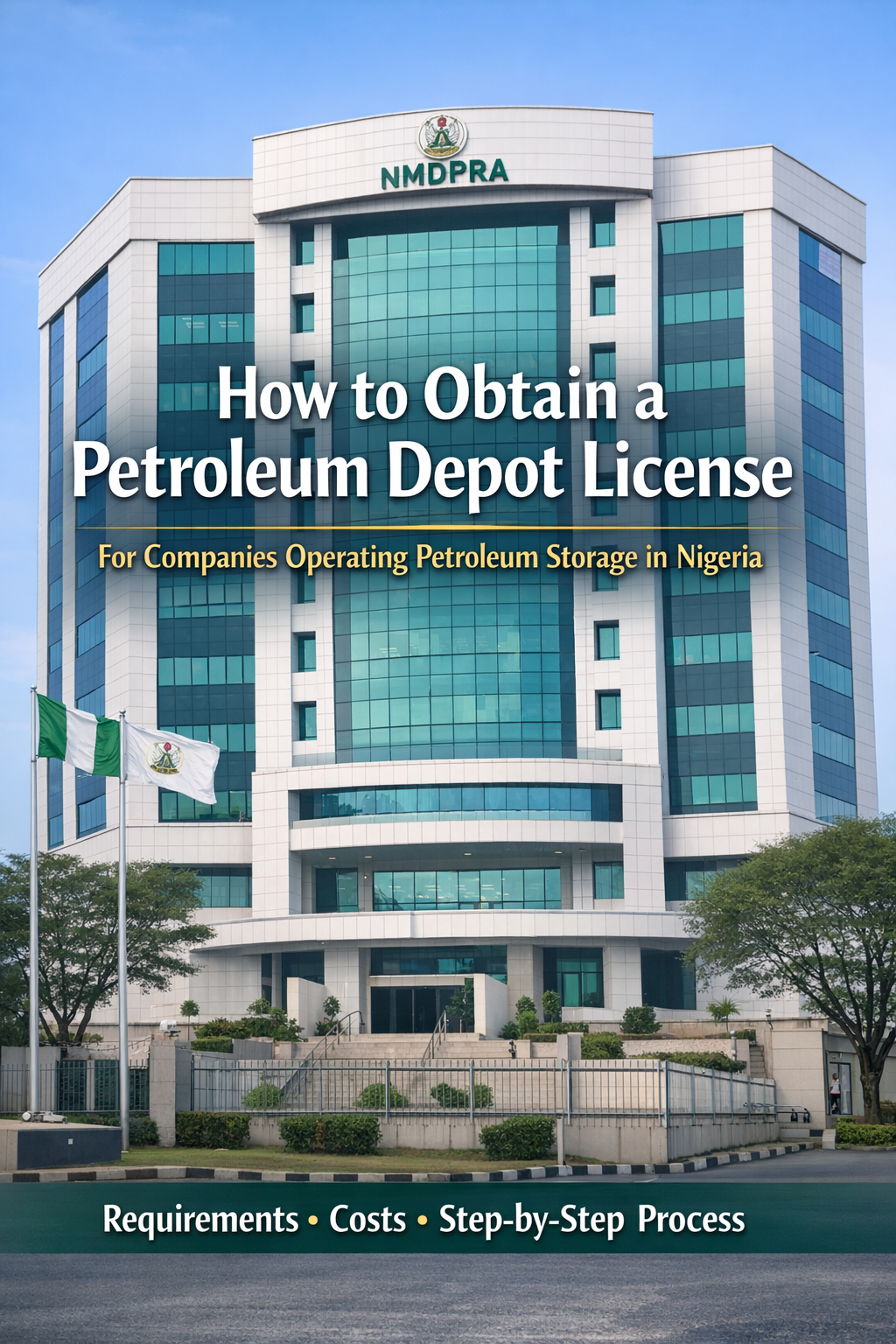
Introduction
Nigeria’s petroleum storage sector sits at the heart of the country’s energy supply chain. Whether you are importing PMS, AGO, Jet A1, or managing bulk storage for distribution, you cannot legally operate a petroleum depot without a valid license issued by the Nigerian Midstream and Downstream Petroleum Regulatory Authority (NMDPRA).
Under the Petroleum Industry Act (PIA) 2021 and the Midstream and Downstream Petroleum Operations Regulations, no company is permitted to store, distribute, or sell petroleum products without regulatory approval.
This guide explains step by step how to obtain a Petroleum Depot License in Nigeria, including:
- Legal framework
- Requirements
- Application steps
- Costs and fees
- Approval process
- Practical compliance tips
- FAQs (People Also Ask)
- Common misconceptions
1. What is a Petroleum Depot License?
A Petroleum Depot License is an official authorisation issued by NMDPRA that allows a company to:
- Construct and operate petroleum storage facilities
- Store refined petroleum products
- Load, discharge, and distribute products
- Provide throughput services for third parties
This license applies to:
- Tank farms
- Coastal depots
- Inland storage terminals
- Bulk petroleum storage facilities
2. Regulatory Authority and Legal Framework
Governing Authority
The Nigerian Midstream and Downstream Petroleum Regulatory Authority regulates all depot licensing in Nigeria.
It was established under the Petroleum Industry Act (2021) and now oversees functions previously handled by DPR, PPPRA, and PEF.
Legal Instruments Governing Depot Licensing
| Regulation | Role |
|---|---|
| Petroleum Industry Act (PIA) 2021 | Primary law governing licensing |
| Midstream & Downstream Petroleum Operations Regulations 2022 | Operational guidelines |
| NMDPRA Technical & Safety Standards | Engineering, HSE compliance |
| Environmental Laws (EIA Act) | Environmental compliance |
Key Legal Rule:
No person shall store, sell, or distribute petroleum products without a valid license.
3. Types of Petroleum Storage Licenses
Depending on your operation, you may need:
| License Type | Description |
|---|---|
| Depot (Storage) License | For bulk storage facilities |
| Terminal License | For export/import terminals |
| Wholesale Supply License | For distribution to bulk customers |
| Import Permit | Required for bringing products into Nigeria |
In most cases, depot operators combine multiple licenses for full operations.
4. Requirements for Petroleum Depot License
Below is a complete checklist based on NMDPRA portal requirements.
A. Corporate Requirements
- Certificate of Incorporation (CAC)
- Memorandum & Articles of Association
- Tax Identification Number (TIN)
- Tax Clearance Certificate
- NSITF compliance evidence
B. Legal & Land Documentation
- Land title (C of O / Deed of Assignment)
- Lease or storage agreement (if not owner)
- Survey plan
- Location approval
C. Technical Requirements
- Tank design and calibration details
- Engineering drawings (layout, piping, manifolds)
- Storage capacity breakdown
- Metering systems
D. Health, Safety & Environment (HSE)
- Environmental Impact Assessment (EIA)
- Emergency Response Plan (ERP)
- Spill containment plan
- Firefighting system design
NMDPRA will inspect:
- Tank integrity
- Fire safety systems
- Spill control infrastructure
- Pipeline connections
E. Operational Documentation
- Standard Operating Procedures (SOPs)
- Product quality control processes
- Laboratory setup (if applicable)
- Throughput agreements
F. Financial Requirements
- Bank reference letter
- Evidence of financial capacity
- Payment receipts (Remita/portal)
5. Step-by-Step Process to Obtain Petroleum Depot License
Step 1: Register on NMDPRA Portal
- Visit the official NMDPRA licensing portal
- Create a company account
- Complete company profile
Step 2: Select License Category
Choose:
- “Depot License” or
- “Petroleum Storage Facility License”
Step 3: Fill Application Form
Provide:
- Company details
- Depot location
- Storage capacity
- Product types
Incomplete applications are automatically rejected.
Step 4: Upload Required Documents
Upload all documents listed above in correct format.
Step 5: Pay Applicable Fees
Payments are made via:
- Remita
- Debit/credit card
Step 6: Technical Evaluation
NMDPRA reviews:
- Engineering design
- Compliance with standards
- Financial capacity
Step 7: Site Inspection
Inspectors verify:
- Tank calibration
- Fire systems
- Environmental compliance
- Metering systems
Step 8: Compliance Correction (If Required)
Any deficiencies must be corrected before approval.
Step 9: License Approval & Issuance
- License issued digitally via portal
- Physical copy available if needed
Step 10: Post-License Obligations
- Submit operational reports
- Renew annually
- Maintain compliance
6. Cost of Petroleum Depot License in Nigeria
Note: Fees vary based on capacity, product type, and regulatory updates.
Typical Fee Structure
| Fee Type | Estimated Cost (₦) |
|---|---|
| Application Fee | Varies (portal-based) |
| Processing Fee | Varies |
| Import Permit (if applicable) | ₦75,000 per 30MT |
| Processing (Import) | ~₦210,000 |
| Vessel Notification | ~₦220,000 |
| Modification Fees | From ₦165,000 |
Key Insight
- Fees may be volume-based or capacity-based
- Large depots pay significantly higher regulatory charges
- Always confirm via NMDPRA portal
7. Timeline for Approval
| Stage | Duration |
|---|---|
| Application submission | 1–2 weeks |
| Document review | 2–4 weeks |
| Inspection | 1–3 weeks |
| Approval | 2–4 weeks |
Total Estimated Time: 6–12 weeks (if no issues)
8. Common Reasons Applications Fail
- Incomplete documentation
- Poor HSE compliance
- Substandard tank design
- Invalid land title
- Failure to meet technical standards
- Upload errors on portal
9. Compliance & Operational Obligations
After obtaining the license, you must:
- Maintain safety systems
- Allow inspections
- Submit periodic returns
- Notify regulator of modifications
Failure to comply may result in:
- License suspension
- Fines
- Facility shutdown
10. Frequently Asked Questions (People Also Ask)
1. Who issues petroleum depot licenses in Nigeria?
The Nigerian Midstream and Downstream Petroleum Regulatory Authority.
2. Can I operate a depot without a license?
No. It is illegal and punishable under Nigerian law.
3. How long is the license valid?
Typically 1 year, subject to renewal.
4. Do I need an EIA for a depot?
Yes. Environmental approval is mandatory.
5. Can foreigners own petroleum depots?
Yes, but must register a Nigerian company.
6. Is inspection compulsory?
Yes. Physical inspection is a key approval stage.
7. Can I use a third-party depot?
Yes, with a valid throughput agreement.
8. What happens if I fail inspection?
You must fix issues before approval.
11. Common Misconceptions About Petroleum Depot Licensing
“Once I build a tank farm, I can start operating”
False. You must obtain NMDPRA approval before operation.
“Depot license covers importation automatically”
False. Import permits are separate.
“Inspection is just a formality”
False. Many applications fail at this stage.
“All depots pay the same fees”
False. Fees vary by capacity and operations.
12. Pro Tips for Fast Approval
- Hire certified engineers for design
- Ensure full HSE compliance before applying
- Double-check all uploads
- Engage professionals familiar with NMDPRA systems
- Avoid using agents with no track record
13. Final Thoughts
Obtaining a Petroleum Depot License in Nigeria is a highly regulated but achievable process if approached correctly.
The key success factors are:
- Complete documentation
- Strong technical design
- Strict HSE compliance
- Accurate portal submission
With the right preparation, your company can successfully navigate the licensing process and operate legally within Nigeria’s petroleum storage sector.
