Need a PDF copy of this guide?
Download the professionally formatted PDF version of this article for offline reading, sharing with colleagues, or future reference.
📄 Download PDF: How to Obtain a Mandatory Conformity Assessment Programme (MANCAP) Certificate in Nigeria_PDF
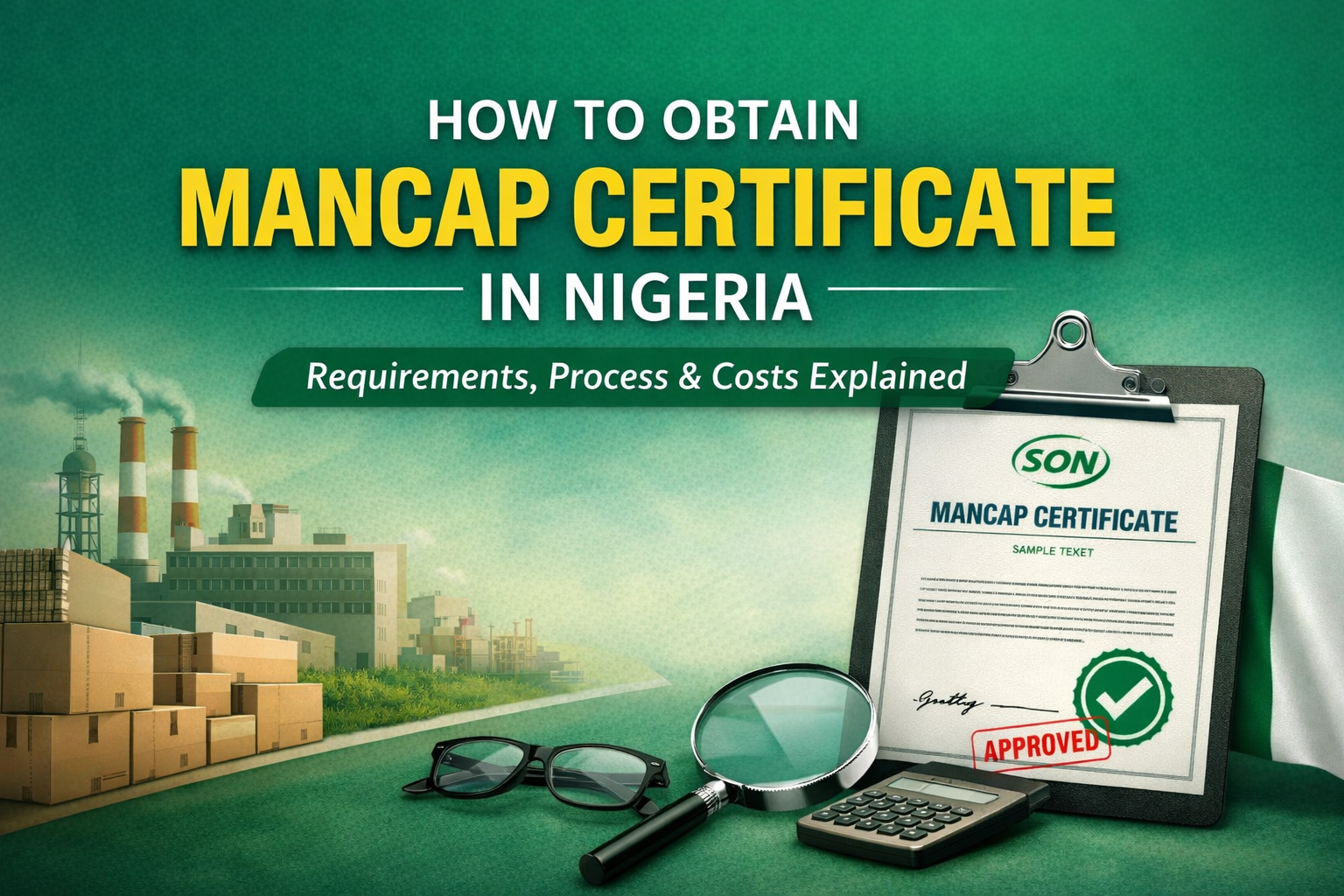
If you manufacture products in Nigeria and intend to sell them legally, scale distribution, supply supermarkets, bid for contracts, export regionally, or build consumer trust, one certification you cannot ignore is the Mandatory Conformity Assessment Programme (MANCAP) Certificate.
Issued by Standards Organisation of Nigeria, MANCAP is the official product conformity certification for locally manufactured goods in Nigeria. It confirms that a product complies with relevant Nigerian Industrial Standards (NIS) and quality requirements.
Many manufacturers wrongly assume MANCAP is just “paperwork.” It is not. It can involve factory inspections, product sampling, laboratory testing, quality control review, administrative charges, periodic surveillance, and recertification obligations.
This detailed guide explains:
- What MANCAP means
- Who needs it
- Requirements
- Step-by-step application process
- Official timelines
- Fees and costs
- Common mistakes causing delays
- FAQs
- How to fast-track approval strategically
Table of Contents
- What is MANCAP?
- Who Issues MANCAP in Nigeria?
- Who Needs MANCAP?
- Products That Typically Require MANCAP
- Benefits of MANCAP Certification
- Requirements for MANCAP Certificate
- Step-by-Step Process to Obtain MANCAP
- Official Fees / Costs
- Timeline for Approval
- Common Reasons Applications Fail
- MANCAP vs SONCAP
- Renewal / Revalidation
- FAQs
- Final Strategic Advice
What is MANCAP?
MANCAP means Mandatory Conformity Assessment Programme.
According to the official SON FAQ, it is a product certification scheme for locally manufactured products in Nigeria conducted by SON pursuant to the SON Act.
Its purpose is to ensure products manufactured in Nigeria meet applicable safety and quality standards before being sold locally or exported.
Who Issues MANCAP in Nigeria?
The certificate is issued by:
Standards Organisation of Nigeria
SON is the federal agency responsible for standardisation, product quality assurance, testing, and conformity assessment in Nigeria.
Who Needs a MANCAP Certificate?
You likely need MANCAP if you manufacture products in Nigeria such as:
- Electrical items
- Plastic products
- Building materials
- Packaging materials
- Household goods
- Mechanical products
- Consumer goods
- Furniture
- Industrial products
- Chemical items (where applicable under SON standards)
If your product is locally manufactured and falls under technical standards oversight, MANCAP may be required.
Products That Commonly Require MANCAP
| Industry | Examples |
|---|---|
| Plastics | Buckets, chairs, containers |
| Electrical | Cables, switches, sockets |
| Building Materials | Pipes, rods, fittings |
| Household | Fans, utensils |
| Packaging | Bottles, wraps |
| Furniture | Desks, chairs |
| Industrial | Tools, equipment |
Why MANCAP Matters
1. Legal Market Access
Products may face enforcement issues without certification.
2. Distributor Confidence
Major retailers often prefer compliant products.
3. Consumer Trust
Certification signals quality assurance.
4. Export Advantage
SON states MANCAP-certified products can be exported to West African countries.
5. Competitive Edge
Substandard competitors struggle where standards enforcement increases.
Requirements for MANCAP Certificate in Nigeria
Based on SON official sources, common requirements include:
| Requirement | Purpose |
|---|---|
| CAC incorporation documents | Legal existence |
| Completed application | Official request |
| Product details/specifications | Technical review |
| Factory address | Inspection |
| Quality control process | Compliance review |
| Laboratory test report | Product conformity |
| Payment evidence | Administrative processing |
| Packaging/label samples | Product identification |
SON states documents may include:
- CAC Certificate
- On-the-spot test report
- SON laboratory report or IPAN accredited laboratory report
- Proof of payment for form/certification fees
Step-by-Step Process to Obtain MANCAP Certificate
Step 1: Determine Applicable Standard
Your product must be matched with the relevant Nigerian Industrial Standard (NIS).
This is where many manufacturers fail early.
Step 2: Prepare Factory for Inspection
SON may assess:
- Production process
- Hygiene
- Equipment condition
- Calibration
- Quality assurance system
- Storage system
- Traceability process
Step 3: Submit Application
Applications may be initiated via SON state offices or official e-MANCAP portal. SON also provides digital access.
Step 4: Product Sampling and Testing
SON states products are sampled and tested against relevant standards.
Step 5: Inspection Reports & Evaluation
Inspection/test reports move for internal review and recommendation.
Step 6: Pay Certification Charges
Applicable fees must be paid.
Step 7: Issuance of Certificate & Logo
If compliant, SON issues:
- MANCAP Certificate
- Unique MANCAP logo/number for product use
Step 8: Post-Certification Surveillance
SON states quarterly factory inspections may continue during validity period.
Official Timeline
SON states:
It takes 60 days from receipt of MANCAP applications if all requirements are met.
Realistically, delays happen when:
- Documents incomplete
- Factory not ready
- Failed lab tests
- Wrong product classification
- Fee issues
- Weak quality control systems
MANCAP Fees / Cost in Nigeria
SON notes fees are officially published and obtainable from state offices.
Archived SON administrative charge schedule indicates examples:
| Category | Estimated Historic Charges |
|---|---|
| Cottage / Micro | ₦7,500+ |
| Small Industry | ₦37,500+ |
| Medium Industry | ₦97,500+ |
| Large Industry | ₦195,000+ |
Important Note
Actual payable sums may vary based on:
- Product category
- Number of products
- Testing scope
- Current tariff review
- Inspection logistics
- Revalidation charges
Always verify current fees directly with SON.
Hidden Complexity Most Applicants Underestimate
1. One Product, One Standard
Some products may involve multiple technical requirements.
2. Factory Readiness Matters
Poor documentation can delay certification.
3. Packaging Errors Cause Problems
Incorrect labeling can trigger corrections.
4. Testing Failure Can Restart Process
Substandard raw materials often become expensive later.
5. Surveillance Continues After Approval
Certification is not “one and done.”
Common Reasons MANCAP Applications Fail or Delay
| Problem | Effect |
|---|---|
| Incomplete documents | Rejection / query |
| Poor factory conditions | Inspection failure |
| Failed lab tests | Delay |
| Wrong product description | Misclassification |
| No quality manual | Weak compliance profile |
| Packaging defects | Corrections required |
| Unpaid fees | File stalled |
MANCAP vs SONCAP (Very Important)
Many people confuse both schemes.
| Feature | MANCAP | SONCAP |
|---|---|---|
| For | Local manufacturers | Imported products |
| Issued by | SON | SON system |
| Purpose | Local conformity | Import conformity |
| Applies before | Local sale/distribution | Customs clearance |
SONCAP is mainly for imports, while MANCAP is for locally manufactured goods.
Validity Period
SON states MANCAP certificate validity is three (3) years, after which recertification/revalidation is required.
Frequently Asked Questions (People Also Ask)
Is MANCAP compulsory in Nigeria?
Yes. It is a mandatory conformity programme for applicable locally manufactured products.
Can I sell products without MANCAP?
Depending on product type, enforcement risk may arise.
How long does MANCAP take?
Officially about 60 days if all requirements are met.
Can small businesses apply?
Yes. SON fee schedules historically include cottage/micro industries.
Can I export with MANCAP?
SON states certified products can be exported to West African countries.
Is MANCAP same as NAFDAC registration?
No. NAFDAC regulates foods, drugs, cosmetics and health-related products; MANCAP is a SON technical conformity scheme.
Strategic Advice for Faster Approval
To avoid months of delay:
- Confirm applicable standard first
- Pre-audit your factory
- Test products before submission
- Fix labels/packaging early
- Organise QC records
- Use professionals who understand SON process flow
Final Thoughts
Obtaining a Mandatory Conformity Assessment Programme (MANCAP) Certificate in Nigeria is more than filing forms. It is a structured regulatory process involving technical standards, inspections, testing, documentation, and ongoing compliance.
Businesses that treat it casually often lose time, money, and market opportunities.
Businesses that prepare properly gain:
- Faster approval
- Stronger brand trust
- Retail access
- Export credibility
- Reduced enforcement risk
If you manufacture in Nigeria and want to scale responsibly, MANCAP should be part of your growth strategy.
Need a PDF copy of this guide?
Download the professionally formatted PDF version of this article for offline reading, sharing with colleagues, or future reference.
📄 Download PDF: How to Obtain a Mandatory Conformity Assessment Programme (MANCAP) Certificate in Nigeria_PDF
