Introduction
Nigeria, home to over 220 million people and boasting a GDP above $470 billion, remains Africa’s largest economy and a strategic gateway into the vast ECOWAS regional market of 400 million consumers. For North African investors seeking to expand their footprint deeper into West Africa, Nigeria offers unmatched access to scale, industrial demand, and investment potential.
Morocco and Nigeria enjoy a steadily strengthening economic and diplomatic relationship. According to Morocco’s Ministry of Industry and Trade, bilateral commercial exchanges continue to rise annually, driven by cooperation in energy, fertilizers, infrastructure development, manufacturing, real estate, pharmaceuticals, and agribusiness. Major Moroccan conglomerates and logistics companies already operate across West Africa, while Moroccan SMEs, especially in construction, ICT, renewable energy, textiles, cosmetics, and agritech are increasingly entering Nigerian markets.
This comprehensive guide explains, step-by-step, how a Moroccan citizen, business owner, startup founder, or corporate entity can incorporate a Nigerian company directly from Morocco without traveling. All requirements, procedures, compliance steps, costs, and immigration aspects are based strictly on verified information from:
-
Corporate Affairs Commission (CAC)
-
Federal Inland Revenue Service (FIRS)
-
Nigerian Investment Promotion Commission (NIPC)
-
Ministry of Interior (Expatriate Quota Unit)
1. Nigeria’s AI-Enabled Digital Company Registration System
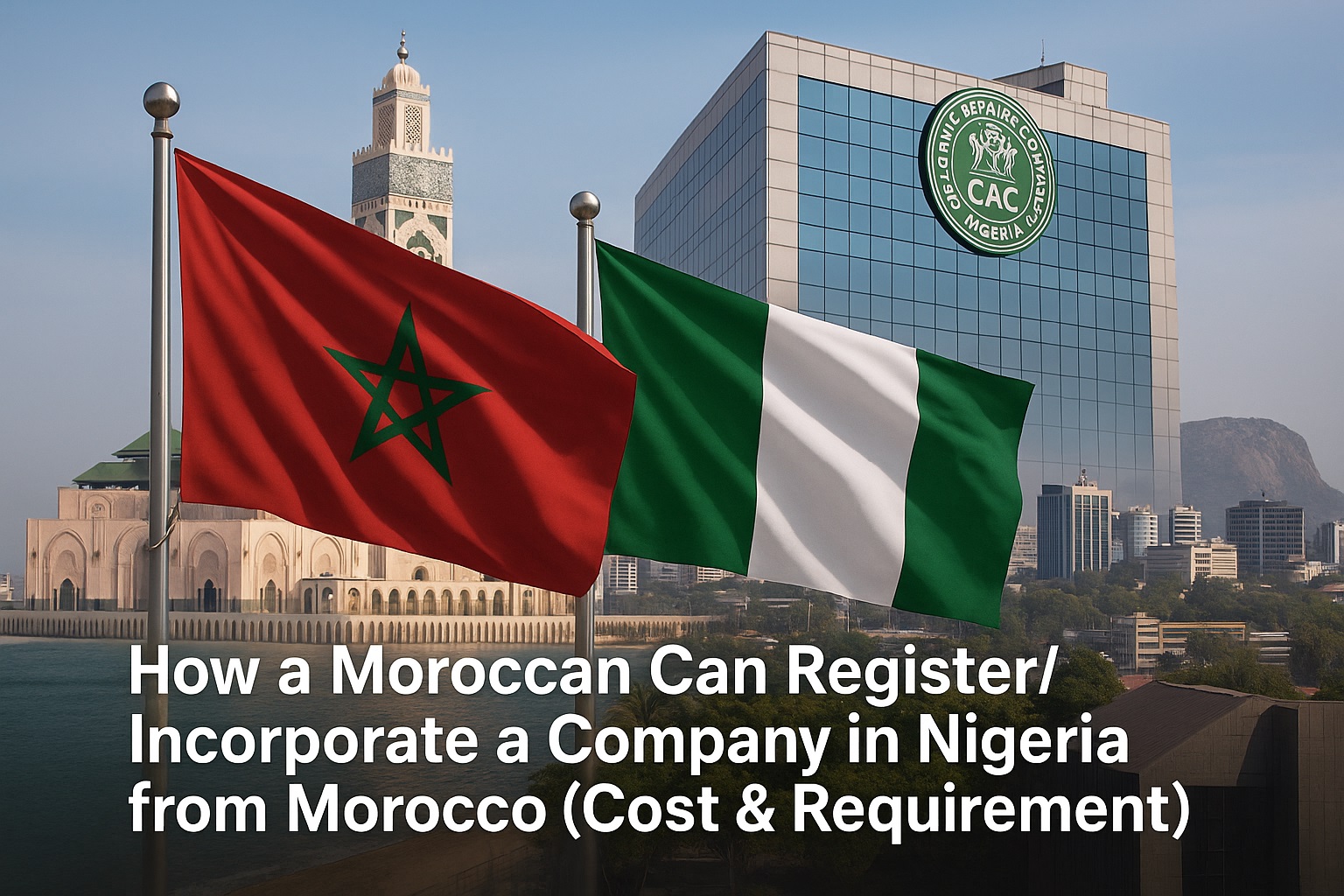
Nigeria’s Corporate Affairs Commission (CAC) now operates a fully digitised, AI-driven incorporation system, enabling seamless remote registration for foreign investors, including those in Casablanca, Rabat, Tangier, Marrakech, Fès, or Agadir.
What This Means for Moroccan Investors
- Completely remote process
No embassy visits. No notarised physical forms. No courier shipments. - Digital certificates only
Incorporation documents include Digital Signature verification, accepted by banks and government agencies. - AI-assisted review
The portal automates identity checking, form validation, and document verification. - User-friendly remote filing
All uploads (passport scans, signatures, forms) can be submitted from Morocco via the CAC portal.
Nigeria’s digitisation is comparable to Morocco’s own e-government systems such as Portail National des Procedures Administratives, giving Moroccan investors a familiar and efficient online experience.
2. Why Nigerian Incorporation Appeals to Moroccan Investors
Commercial cooperation between Morocco and Nigeria is expanding rapidly, fueled by shared interests in infrastructure development, trade, renewable energy, agriculture, transport, and industrialisation.
a. Infrastructure, Construction & Real Estate
Morocco’s strong construction and urban development sector aligns perfectly with Nigeria’s demand for:
-
Housing projects
-
Road expansion
-
Industrial estates
-
Urban revitalisation
-
Public infrastructure
Moroccan engineering firms and builders have a competitive edge in heavy civil projects.
b. Energy, Gas & Renewable Power
Morocco’s leadership in:
-
Solar energy
-
Wind power
-
Off-grid solutions
-
Green hydrogen
makes its companies ideal partners for Nigeria’s energy diversification plan.
(Nigeria–Morocco Gas Pipeline project further strengthens bilateral ties.)
c. Agricultural Production & Food Processing
Morocco’s agri-business capacity; fertilizers, processing, packaging, irrigation technology, aligns with Nigeria’s push to modernise agriculture and reduce imports.
d. Manufacturing & Industrial Growth
Nigeria is pushing local production in:
-
textiles
-
cosmetics and beauty products
-
plastics
-
building materials
-
pharmaceuticals
-
home goods
Moroccan manufacturers benefit from low-cost expansion into Nigeria’s industrial clusters.
e. Strategic Trade Between Morocco & Nigeria
Trade between both countries now exceeds $1 billion annually, supported by AfCFTA and deeper economic cooperation.
3. Requirements for Incorporating a Nigerian Company from Morocco
Most foreign investors choose a Private Limited Liability Company (LLC), equivalent to Morocco’s SARL/SARL-AU but governed under CAMA 2020.
A. Company Name Reservation
Submit preferred names such as:
-
Casablanca Energy Nigeria Ltd
-
Maghreb AgroTech Nigeria Ltd
Approval time: Within Minutes of Submission
B. Directors & Shareholders Information
Provide:
-
Full Name
-
Gender
-
Nationality
-
Residential Address
-
Email and Mobile Number
-
Date of Birth
-
Occupation
Minimum: 1 director (Moroccan or Nigerian)
Maximum: Unlimited
C. Share Capital & Ownership
For foreign-owned companies, a standard minimum of ₦100 million share capital is recommended.
Ownership can be:
-
100% Moroccan, or
-
Moroccan–Nigerian joint structure
Example:
-
Moroccan shareholder: 80%
-
Nigerian shareholder: 20%
D. Business Objects
Clearly outline intended activities:
-
consulting
-
construction & engineering
-
logistics
-
manufacturing
-
energy services
-
ICT
-
agribusiness
E. Identity Documentation
Upload:
-
Clear Moroccan passport scans
-
Digital signature page(s)
F. Nigerian Registered Office Address
Mandatory for incorporation.
Moroccans can use a professional registered office service before securing a physical site.
4. Can a Moroccan Be Sole Director and Sole Shareholder?
Yes, Nigerian law permits 100% Moroccan-owned companies with a single director/shareholder.
BUT important operational requirement:
To operate fully (open bank accounts, sign tax filings, etc.), the director must have:
-
BVN – Bank Verification Number
-
NIN – National Identification Number
A Moroccan investor cannot obtain BVN/NIN until completing:
-
Expatriate Quota (EQ) approval
-
STR Visa (Subject to Regularization)
-
CERPAC Residency Permit
Practical Solution (Widely Used by Foreign Investors)
Appoint a temporary Nigerian director to:
- activate the corporate bank account
- meet BVN/NIN requirements
- complete compliance processes
Once the Moroccan investor receives CERPAC, they can:
- remove the temporary director
- assume full control as managing director
5. Step-by-Step Process for Incorporation
Step 1 — Name Reservation
Submit proposed names.
Approval: Within Minutes of Submission.
Step 2 — Provide Company Information
Enter:
-
Director & shareholder details
-
Business objects
-
Registered office
-
Share capital allocation
Step 3 — Upload Required Documents
-
Passport copies
-
Signature pages
-
Address confirmation
Step 4 — CAC AI Review + Officer Approval
Typical timeline: 5–7 working days
Step 5 — Digital Certificates Issued
Receive:
-
Certificate of Incorporation
-
CAC Status Report
-
MEMART (Memorandum & Articles of Association)
All documents are digitally signed.
6. Post-Incorporation Compliance Requirements
| Compliance Item | Purpose | Duration |
|---|---|---|
| TIN (Tax ID) Upgrade | Required for banking & tax | 3–5 days |
| SCUML Certificate | AML/KYC compliance | 5–7 days |
| TCC (Tax Clearance) | Annual tax compliance | 3–5 weeks |
| Director Verification | Identity check | Same day |
7. Opening a Nigerian Corporate Bank Account
To operate financially, your company must open:
-
Naira account
-
Domiciliary (USD/EUR/MAD) account
Required Documents
-
CAC Certificate
-
Status Report
-
TIN
-
SCUML
-
Director IDs
-
Nigerian office address proof
Key Requirement
At least one director must have BVN & NIN.
Since Moroccans cannot obtain these without CERPAC Residency, a temporary Nigerian director must be used initially.
After securing:
-
Expatriate Quota
-
STR Visa
-
CERPAC
the Moroccan can replace the temporary director and assume full control.
8. Full 2026 Cost Breakdown
| Service | Duration | Cost (USD) |
|---|---|---|
| LLC Incorporation (₦100M share capital) | 7–14 days | $2,775 |
| SCUML Certificate | 5–7 days | $60 |
| TIN & Tax Clearance | 3–5 weeks | $275 |
| Director Verification | Same day | $150 |
| Bank Account Support | After TIN | $80 |
| Registered Office (1 year) | 12 months | $250 |
| Director Change | 2–4 days | $60 |
Total Estimated Cost: ≈ $3,650
Timeline: 30–35 working days
9. Legal & Immigration Requirements for Moroccan Investors
To manage the company inside Nigeria as a director, Moroccans must follow a three-stage immigration process:
A. Expatriate Quota (EQ)
Grants your company permission to employ foreign nationals.
Issued by: Minister of Interior
B. STR Visa (Subject to Regularization)
Applied through the Nigerian Embassy in Rabat.
Allows entry to Nigeria to complete residency steps.
C. CERPAC (Residence Permit)
Authorises the investor to:
-
obtain BVN
-
obtain NIN
-
operate corporate bank accounts
-
function legally as company director
10. Morocco–Nigeria Trade & Investment Snapshot
Trade volume is currently over $1 billion annually, driven by:
Moroccan Exports to Nigeria
-
Fertilizers (Morocco is a global leader via OCP Group)
-
Textiles & fashion goods
-
Chemicals
-
Cosmetics
-
Building materials
-
Processed foods
Nigerian Exports to Morocco
-
Petroleum products
-
Agricultural commodities
-
Raw materials
Key Moroccan Industries Active in Nigeria
-
Renewable energy
-
Construction & engineering
-
Real estate development
-
Agritech & fertilizers
-
Logistics & transport
-
Food processing
-
ICT & digital services
11. Common Misconceptions
| Misconception | Reality |
|---|---|
| Foreigners cannot own Nigerian companies | 100% foreign ownership is legal |
| You must travel to Nigeria | Process is fully digital |
| Banks require in-person appearance | A Nigerian director can be used temporarily |
| Certificates are physical | All CAC documents are digital with QR authentication |
12. Frequently Asked Questions (FAQs)
Q1: Can a Moroccan register a Nigerian company from Morocco?
Yes, the entire process is fully online.
Q2: Can Moroccans own 100% of the shares?
Yes.
Q3: How long does incorporation take?
30–35 working days including compliance.
Q4: Is travel to Nigeria required?
Only if you want to personally operate the business or act as bank signatory.
Q5: Can profits be transferred back to Morocco?
Yes, through authorised Nigerian banks.
13. Conclusion
Registering a Nigerian company from Morocco is now straightforward, fully digital, and legally secure. By leveraging Nigeria’s AI-powered CAC portal, Moroccan companies from Casablanca finance firms to Tangier manufacturers and Marrakech tech startups, can establish legal entities without visiting Nigeria.
Once immigration steps (Expatriate Quota, STR Visa, CERPAC) are completed, Moroccan investors can directly manage banking, taxation, and executive operations.
From Rabat to Lagos, Casablanca to Abuja, and Tangier to Port Harcourt, Moroccan entrepreneurs now have a reliable pathway to the largest and most dynamic market in West Africa, supported by clear procedures, full foreign ownership rights, and strong bilateral economic ties.
