By Ibe Chinedu Okpi, Esq. | Managing Partner, ICA / Ibe, Chido & Associates
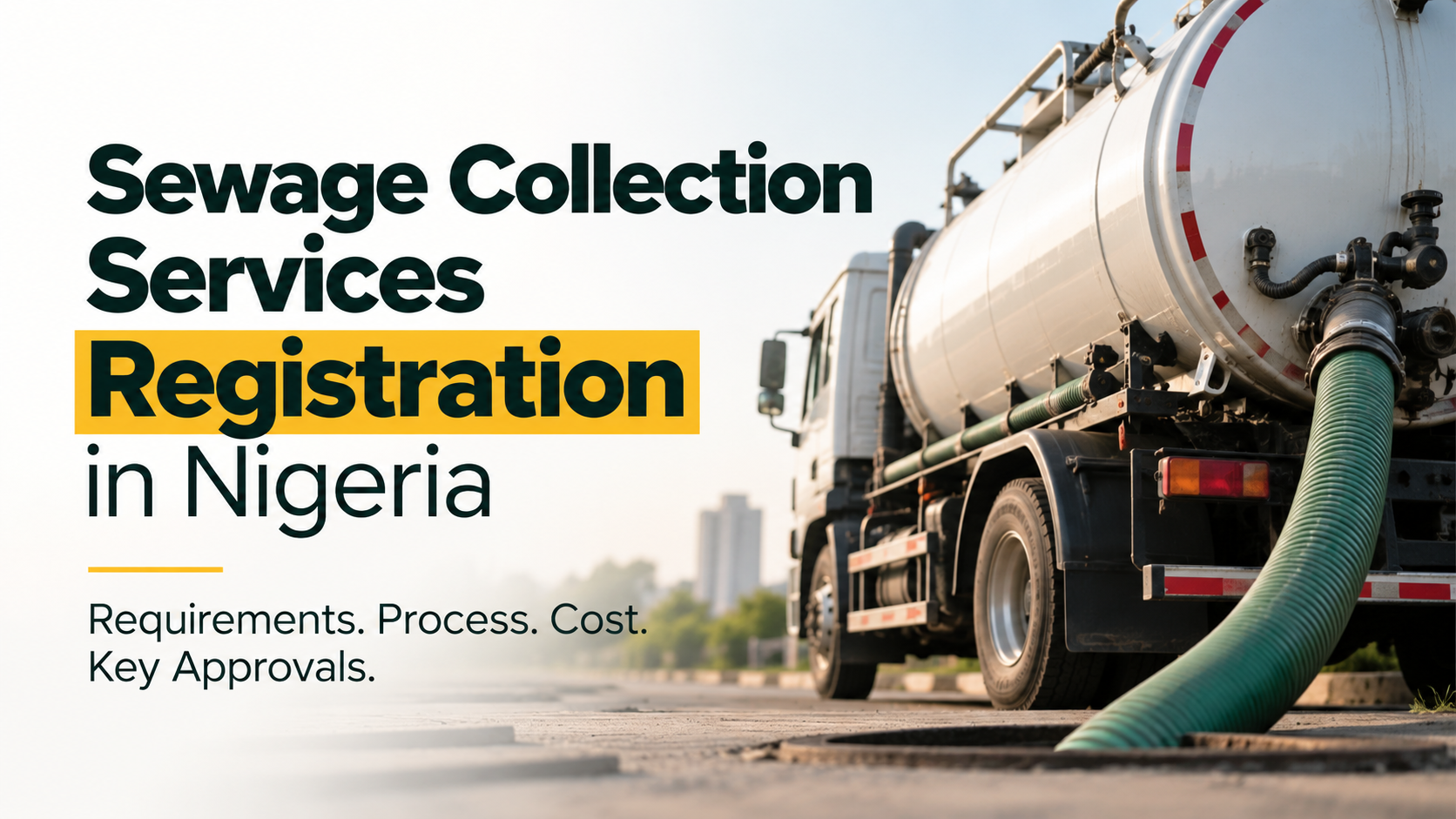
If you intend to start a sewage evacuation business in Nigeria, this article will help you identify the regulator responsible for registering your business, understand the official registration process, prepare for the requirements and avoid spending money on the wrong license.
Let me start with a practical warning.
You can register a company with the Corporate Affairs Commission (CAC), buy a sewage evacuation truck, print business cards and even secure customers. Yet, you may still have a regulatory problem if you have not obtained the registration required to provide sewage collection services.
This is not guesswork. The Environmental Health Council of Nigeria (EHCON) expressly identifies sewage collection as one of the environmental health services for which corporate service providers must be registered. Its official website also publishes a list of registered sewage collection service providers.
In my 15 years of legal practice and regulatory compliance work, I have learnt that one of the most expensive mistakes a business owner can make is to invest in equipment before confirming the approvals required to operate.
Let us look at the actual regulatory position.
1. Which government agency registers sewage collection service providers?
EHCON is the key federal regulatory body to approach for corporate registration as a sewage collection service provider. Its official website confirms that corporate registration covers sewage collection services and that eligible companies are registered for liquid waste collection.
EHCON lists sewage collection as a distinct category of environmental health service.
Its published list of registered sewage collection service providers includes companies operating in Nigeria, demonstrating that this is an established registration category.
What if your business will operate in Abuja or another state?
You should distinguish between the federal registration of an environmental health service provider and any additional requirements imposed by the environmental authority in the area where you operate.
For example, the Abuja Environmental Protection Board (AEPB) is responsible for environmental protection and management within the FCT. Its official website identifies liquid waste management among its functions.
For operations in another state, confirm the relevant state environmental authority’s requirements. Do not assume that EHCON registration automatically replaces every local permit, vehicle approval or disposal requirement that may apply to your particular operation.
2. What does EHCON registration cover?
EHCON’s official corporate registration page identifies six service categories, including sewage collection services. It describes sewage collection providers as companies with the relevant equipment and expertise in liquid waste collection.
This matters if your proposed business will provide services such as:
-
Evacuating septic tanks and cesspools.
-
Collecting liquid waste from residential and commercial premises.
-
Providing sewage collection services to estates, hotels and other facilities.
Your exact scope of work should be stated clearly when approaching the Council. If your business will also operate a treatment plant or undertake other waste management activities, ask whether additional registration or permits apply.
3. How to register with EHCON: the official process
Based on the Council’s published corporate registration information, the process involves a formal application and an assessment of the applicant company.
1 Prepare your corporate details
Have your CAC incorporation documents and company particulars available. Make sure the information you provide accurately describes the company seeking registration.
2 Apply under the sewage collection category
Obtain the appropriate corporate registration application and confirm the current documentary checklist and fees directly with EHCON.
3 Prepare for the company’s assessment
EHCON states that, after receiving a completed application, it engages a licensed Environmental Health Officer as a consultant to visit the applicant’s company. The published procedure includes interviewing the proprietor or proprietors, inspecting facilities and checking the information supplied.
4 Await the Council’s decision
EHCON’s corporate registration page states that the Council conveys its decision within 90 days from receipt of the application, following the inspection and receipt of the consultant’s report. Treat this as the published decision period, not a guarantee that every application will be approved within that time.
5 Obtain registration and confirm licensing obligations
Ask the Council to clarify the certificate or registration letter issued upon approval, the applicable practice license requirements and any renewal obligations.
Official starting point: EHCON — Corporate/Company Registration
4. What documents and facilities should you prepare?
The final list must come from EHCON’s current application requirements. However, because its published procedure involves reviewing the company’s information and inspecting its facilities, you should be ready to demonstrate that the business is properly organised for the service it intends to provide.
| Area | What to prepare or clarify |
|---|---|
| Corporate records | CAC incorporation documents and current company particulars. |
| Business premises | Details of the business address and facilities available for inspection. |
| Equipment | Details of the sewage collection equipment and vehicles available to the company. |
| Technical competence | Information about the company’s experience, relevant personnel and operational capacity. |
| Service scope | A clear description of the liquid waste collection services you intend to provide. |
| Operational arrangements | How sewage will be collected, transported and delivered to an appropriate receiving facility. |
| Application requirements | EHCON’s prescribed forms, supporting documents and current payment instructions. |
This is a preparation guide, not an official exhaustive checklist. Confirm which items are mandatory before submitting your application.
My practical advice is to avoid presenting a company as fully equipped if it has not yet acquired the relevant equipment. Explain your actual position and ask the Council what evidence is acceptable at the application stage.
5. How much does sewage collection registration cost?
I would not publish a specific registration fee without confirming the current amount on EHCON’s official fee schedule.
The Council provides a Corporate Licensing page with information on corporate licensing and a link to its reviewed service fees. Its published guidance also refers to a practice license cycle of two years for corporate environmental health service providers.
Before budgeting, obtain confirmation of:
-
The current application and registration charges for sewage collection services.
-
Any applicable assessment or inspection charges.
-
The current corporate practice license fee and its validity period.
-
Whether any mandatory workshop or other condition applies to your particular application.
-
Any separate state or FCT regulatory charges.
Do not confuse registration charges with the professional fee payable to a consultant or lawyer who manages the process for you.
6. Do not overlook the rules on sewage disposal
This is where the business owner’s responsibility extends beyond obtaining a certificate.
The National Environmental (Sanitation and Wastes Control) Regulations 2009, published on the official website of the National Environmental Standards and Regulations Enforcement Agency (NESREA), address sewage handling and disposal. Among other provisions, regulation 10 requires regular dislodgement and safe disposal of septic tank contents and prohibits untreated sewage from being piped or discharged into public drains or roads. Regulation 19 states that licensed sewage management operators must register with the appropriate authority.
In practical terms, you need to establish where the collected sewage will go.
A truck may be capable of removing sewage from a customer’s premises, but that does not resolve the question of lawful disposal.
Before accepting contracts, verify the appropriate receiving facility and any requirements imposed by the relevant environmental authority. Keep adequate operational records and make sure your staff understand the proper handling and disposal procedures.
For further regulatory information, consult NESREA’s official laws and regulations.
7. What if you intend to operate in Abuja?
If your proposed business is in Abuja, contact EHCON regarding the corporate sewage collection registration and separately confirm the applicable FCT operational requirements with AEPB.
The AEPB’s official website identifies liquid waste management, sludge evacuation and wastewater treatment among its functions. It also provides contact channels for enquiries.
Abuja Environmental Protection Board (AEPB)
+234 815 675 4058
+234 815 675 4018
+234 901 982 3895
Contact details published on the Board’s official website.
When contacting AEPB, explain that you intend to provide commercial sewage collection or evacuation services. Ask whether your proposed operations require an additional FCT registration, permit, vehicle approval or other authorisation, and request the applicable requirements in writing.
Do not assume that the general waste management billing service advertised on the AEPB website is the same as a commercial sewage collection operator’s registration.
8. Frequently asked questions
Is EHCON registration compulsory for a sewage collection company?
EHCON identifies sewage collection as a corporate environmental health service requiring registration. Its public announcement also warns against engaging unregistered environmental health service providers. You should therefore confirm and complete the applicable registration before commencing the service.
How long does EHCON corporate registration take?
The Council’s published corporate registration procedure states that it conveys its decision within 90 days of receiving an application, following the assessment process. This is the stated decision period, not a guarantee of approval.
Can I register my company before buying a sewage truck?
You should confirm EHCON’s current documentary and equipment requirements before making that investment. Its published process includes a facility inspection, but the webpage does not establish that every applicant must own a truck before applying.
Does EHCON registration cover every state in Nigeria?
Do not assume it replaces all state or FCT requirements. Confirm the scope of the EHCON registration and the local operational rules applicable to each area where you intend to work.
Does the registration need to be renewed?
EHCON’s corporate licensing guidance states that the corporate practice license cycle is two years. Confirm the current conditions and applicable renewal charges directly with the Council.
Can a regulatory consultant handle the process?
Yes. A consultant or legal practitioner can assist with the application, document preparation, regulatory correspondence, inspection coordination and follow-up. However, the registration decision remains with the responsible authority.
Final advice: Confirm the license before spending your money
Sewage collection is a practical business opportunity. Residential estates, hotels, commercial premises and other facilities need reliable evacuation services.
But the business requires more than a truck and a list of customers.
Start by confirming the EHCON corporate registration requirements. Establish the relevant local approvals. Verify your disposal arrangements. Then budget for the process using official fees rather than estimates supplied without supporting evidence.
In my 15 years of legal practice and regulatory compliance work, I have learnt that the best time to resolve a licensing question is before the business commits money, not after a regulator raises an objection.
At ICA / Ibe, Chido & Associates, we assist businesses with regulatory requirements, application documentation and engagement with the relevant authorities.
If you intend to register a sewage collection business, have your proposed location, company details and exact scope of services ready. These are the starting points for determining the applicable requirements.
