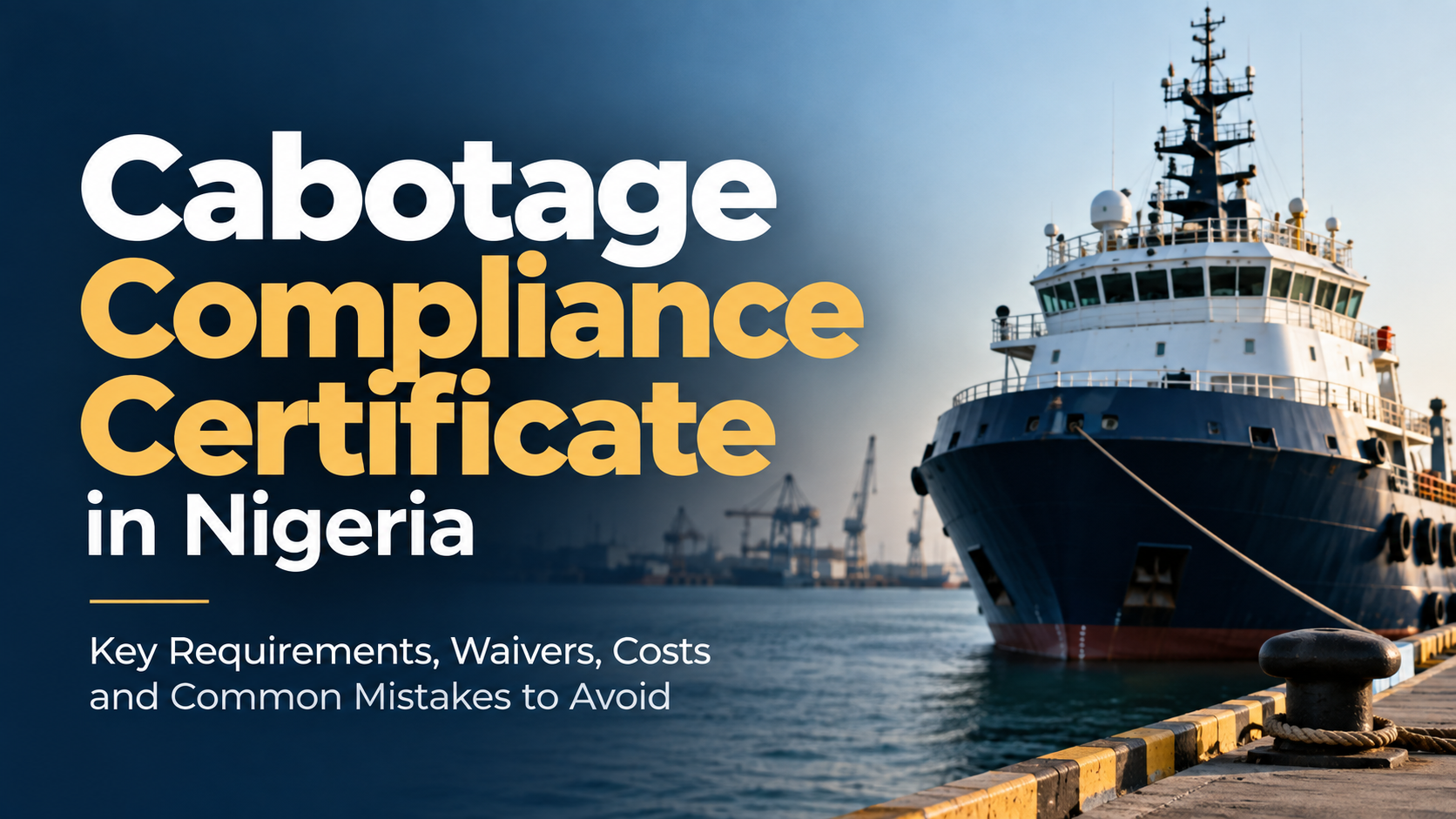
If you operate a vessel in Nigeria’s coastal or inland waters, Cabotage compliance is not something you should start thinking about when NIMASA stops your vessel.
By then, you may already have a problem.
This article explains, in plain language, what Cabotage compliance means, the documents involved, who needs registration or a waiver, the practical requirements, and the mistakes that commonly delay applications.
I have dealt with regulatory compliance for years, and one thing I have learnt is simple:
A company can have a good vessel, a good contract and a good business opportunity and still lose money because its regulatory documentation is not in order.
That is particularly true in the Nigerian maritime sector.
What is Cabotage?
Cabotage is essentially the regulation of commercial maritime activities carried out within Nigeria’s coastal and inland waters.
The legal framework is principally the Coastal and Inland Shipping (Cabotage) Act 2003.
The policy behind the law is to reserve domestic coastal and inland shipping activities substantially for Nigerian participation.
NIMASA explains that the Cabotage regime is intended to reserve the commercial transportation of goods and services within Nigerian coastal and inland waters to vessels flying the Nigerian flag and owned by Nigerian citizens.
So, if your business involves vessels operating within Nigerian waters, you cannot simply assume that having a valid vessel registration certificate is enough.
It is not.
You need to look at the vessel’s Cabotage status.
What is a Cabotage Compliance Certificate?
In practice, people sometimes use the expression “Cabotage Compliance Certificate” as a general description for the regulatory documentation showing that a vessel and its operator have complied with the applicable Cabotage requirements.
However, it is important to be precise.
There is not necessarily one universal document officially titled “Cabotage Compliance Certificate” for every situation.
Depending on the vessel and the transaction, the relevant documentation may include:
- Cabotage Registration Certificate;
- Cabotage waiver;
- evidence of waiver fees;
- Nigerian Ship Registry Certificate;
- NIMASA registration as a shipping company;
- crew documentation;
- applicable vessel certificates;
- evidence of payment of the required Cabotage charges; and
- other supporting compliance documents.
NIMASA maintains a Special Cabotage Register for vessels participating in the Cabotage trade.
That distinction matters.
Because I have seen businesses approach regulatory applications using the wrong terminology or asking for the wrong certificate.
The first question should always be: What exactly is the vessel doing, who owns it, how is it registered and under what category will it participate in Nigerian Cabotage trade?
Who Needs Cabotage Compliance?
If your company operates vessels for activities covered by the Nigerian Cabotage regime, you should determine your compliance position before commencing operations.
This is particularly important for businesses involved in:
| Business Activity | Cabotage Consideration |
|---|---|
| Offshore support services | Cabotage compliance may apply |
| Coastal transportation | Cabotage compliance is critical |
| Oil and gas marine services | Cabotage requirements may apply |
| Marine logistics | Cabotage status should be verified |
| Tug and supply vessel operations | Cabotage requirements may apply |
| Crew/supply transportation | Cabotage compliance may be required |
| Offshore construction support | Vessel status must be examined |
| Marine contracting | Contract and vessel deployment should be reviewed |
| Foreign-owned vessels | Waiver and other requirements may arise |
| Bareboat chartered vessels | Special registration requirements apply |
The important point is this:
Do not wait until the vessel is already working before asking the compliance question.
The Main Categories of Cabotage Registration
NIMASA recognises different categories of Cabotage registration.
These include:
- Wholly Nigerian-owned vessels
- Bareboat-chartered vessels
- Joint venture arrangements
- Foreign-owned vessels, where the applicable regulatory conditions and waivers are satisfied.
NIMASA’s Cabotage registration requirements specifically provide for registration of vessels in the Special Cabotage Register.
The category matters because the documentation is not exactly the same for every vessel.
Wholly Nigerian-Owned Vessel
For a wholly Nigerian-owned vessel, NIMASA’s published requirements include documents such as:
- Completed Cabotage registration application;
- Certificate of Nigerian Registry;
- Cabotage Affidavit;
- Crew List Declaration;
- applicable waiver certificate, where required;
- evidence of registration of the shipping company with NIMASA;
- Certificate of Incorporation;
- Memorandum and Articles of Association;
- relevant CAC corporate filings;
- current Tax Clearance Certificate; and
- evidence of payment of registration fees.
NIMASA also states that the minimum share capital for a vessel owned by a Nigerian company is ₦25 million.
What About a Foreign Vessel?
This is where things become more interesting.
A foreign vessel does not simply become compliant because it has been hired by a Nigerian company.
The Cabotage regime has specific requirements for foreign vessels.
NIMASA’s published requirements include documentation such as:
- application form;
- Certificate of Registry;
- declaration of ownership;
- crew declaration;
- Cabotage license;
- tonnage certificate;
- applicable safety certificates;
- Minimum Safe Manning Certificate;
- International Safety Management Certificate;
- Load Line Certificate;
- Survey Certificate;
- Radio Certificate;
- Classification Certificate;
- current vessel insurance;
- Nigerian company incorporation documents;
- Tax Clearance Certificate;
- evidence of NIMASA registration; and
- evidence of payment of applicable registration fees.
There may also be a requirement for an undertaking relating to Nigerian cadet training.
This is why foreign vessel operators should not treat Cabotage as a simple registration exercise.
It is a compliance exercise involving the vessel, the owner, the charterer, the company and the underlying contract.
The Cabotage Waiver Issue
This is one area where businesses frequently get confused.
The Cabotage regime provides for waivers in certain circumstances.
NIMASA’s implementation guidance states that vessels wholly owned, crewed or manned by Nigerians do not require a ministerial waiver in relation to those requirements, while the Minister is empowered to grant specified waivers, including on ownership, manning and construction requirements.
The waiver process is therefore not simply:
“We have a foreign vessel. Give us a waiver.”
There is a regulatory justification behind it.
For example, the documentation published by NIMASA includes certification relating to whether a wholly Nigerian-owned vessel suitable and available for the specified activity exists.
That is important.
A waiver is not supposed to be treated as a shortcut around the Cabotage regime.
What Documents Should You Prepare?
For a typical Cabotage compliance exercise, I normally advise clients to prepare their documentation in groups.
1. Corporate Documents
- Certificate of Incorporation;
- Memorandum and Articles of Association;
- CAC Status Report or Form 1.1, 2 or 7
- current Tax Clearance Certificate;
- evidence of NIMASA shipping company registration.
2. Vessel Documents
- Certificate of Registry;
- Class Certificate;
- Tonnage Certificate;
- Survey Certificate;
- Insurance;
- Safety certificates;
- Minimum Safe Manning Certificate;
- other applicable statutory vessel certificates.
3. Cabotage Documents
- Cabotage application;
- Cabotage affidavit;
- ownership declaration;
- crew declaration;
- applicable waiver documentation;
- waiver fee evidence;
- Cabotage registration documentation.
4. Commercial Documents
Depending on the transaction:
- Charter Party Agreement;
- vessel engagement contract;
- relevant contract with the client;
- invoices;
- cargo manifest;
- bill of lading where applicable.
NIMASA’s published requirements for foreign-owned Cabotage registration, for example, include the vessel’s charter contract, technical information, insurance, tax documentation and evidence of payment of Cabotage-related fees.
The 2% Surcharge: Don’t Ignore It
This is another area where operators sometimes get caught.
NIMASA’s Cabotage requirements include procedures for the 2% surcharge on contracts performed.
For processing, NIMASA lists documents including:
- Charter Party Agreement;
- invoices on contracts performed;
- cargo manifest and bill of lading for applicable coastal product tanker billing; and
- self-assessment.
The lesson is straightforward:
Cabotage compliance does not end when you obtain the registration document.
You have continuing obligations.
What Happens When Compliance Is Poor?
This is where the matter becomes serious.
NIMASA’s published Cabotage procedures expressly provide for enforcement and detention.
For release of a detained vessel, NIMASA lists requirements including:
- Letter of undertaking by the defaulting owner/operator to comply with the Cabotage Act;
- receipt of payment of relevant waiver fees and 2% surcharge; and
- release order.
Think about what vessel detention means commercially.
The vessel is not earning.
The contract may still be running.
Your client may be waiting.
Crew costs continue.
Port and operational costs continue.
And your company is now trying to solve a regulatory problem under pressure.
That is an expensive way to discover that your Cabotage documentation was incomplete.
The Biggest Mistake I See
The biggest mistake is treating regulatory compliance as paperwork.
It is not.
Regulatory compliance is part of project planning.
If a company is bidding for a major offshore contract, the Cabotage question should be asked before the bid is submitted.
Not after the contract has been awarded.
If a foreign vessel is going to be used, determine the regulatory route early.
If a waiver is required, understand the requirements early.
If the vessel’s certificates are expiring, deal with them before deployment.
If the company itself is not properly registered with NIMASA, fix that before the vessel arrives.
Do not allow the vessel to arrive in Nigerian waters before you start asking what documents you need.
Cabotage Compliance Checklist
Before deploying a vessel, I recommend checking the following:
| Compliance Area | Status |
|---|---|
| Company incorporated in Nigeria | ☐ |
| NIMASA shipping company registration | ☐ |
| Vessel Certificate of Registry | ☐ |
| Cabotage registration status | ☐ |
| Cabotage waiver, where applicable | ☐ |
| Crew documentation | ☐ |
| Minimum Safe Manning Certificate | ☐ |
| Class Certificate | ☐ |
| Survey Certificate | ☐ |
| Insurance | ☐ |
| Tax Clearance Certificate | ☐ |
| Charter Party Agreement | ☐ |
| Applicable 2% surcharge compliance | ☐ |
| Nigerian cadet training requirement | ☐ |
| Dry-docking requirement, where applicable | ☐ |
| Other vessel-specific statutory certificates | ☐ |
The actual checklist should always be matched against the vessel category and the particular operation.
How Long Does Cabotage Registration Take?
NIMASA’s current Ship Registration Office fee information lists Cabotage Registration for a foreign vessel under waiver with a processing time of approximately 10–14 working days, subject to the applicable process and documentation.
But here is the practical advice:
Do not build your project mobilisation around the assumption that every application will take exactly 10–14 working days.
Regulatory applications can slow down because of:
- incomplete documents;
- inconsistent vessel information;
- expired certificates;
- corporate documentation issues;
- waiver issues;
- outstanding regulatory payments;
- queries from the regulator;
- incorrect applications; or
- delays in obtaining supporting documents from vessel owners.
That is why I always advise clients to start early.
How Much Does Cabotage Compliance Cost?
There is no single professional fee that applies to every Cabotage application.
Government charges can depend on the type of application and vessel.
For example, NIMASA’s current published fee information lists foreign-vessel Cabotage registration under waiver at 2% of contract value.
Professional fees are separate.
They depend on the complexity of the work.
A straightforward renewal is different from a foreign vessel requiring waiver processing, registration, document review, regulatory liaison and contract-related compliance.
So when a consultant gives you a price, ask:
Does the fee cover only submission of documents, or does it cover the entire compliance process?
That question can save you money.
My Practical Advice to Vessel Owners and Operators
After years of working around Nigerian regulatory processes, my advice is simple.
1. Start with the vessel.
Don’t start with the form.
Understand the vessel.
Who owns it?
Where is it registered?
What is its gross tonnage?
Who operates it?
Who is chartering it?
What is it being used for?
Where will it operate?
2. Look at the contract.
The nature of the contract can affect the regulatory requirements.
A vessel being brought in for a specific offshore project should not be assessed in isolation from the underlying commercial arrangement.
3. Check the certificates before mobilisation.
Do not discover at the point of deployment that the Class Certificate has expired.
Or the insurance is not current.
Or the vessel documentation does not correspond with the information submitted to NIMASA.
4. Deal with foreign vessels early.
If the vessel is foreign-owned, determine whether a waiver is required.
Do not assume that because a Nigerian company is the charterer, the vessel automatically becomes Cabotage-compliant.
It doesn’t.
5. Keep compliance documents together.
A vessel should have a properly organised compliance file.
NIMASA’s published guidance itself identifies documents expected onboard a coastal vessel, including vessel registry, safety, manning, insurance, classification and applicable Cabotage documentation.
When an inspection happens, you do not want your Master calling the office asking:
“Sir, where is the certificate?”
That is not compliance management.
That is crisis management.
Cabotage Compliance Is Also a Commercial Issue
This is the point many lawyers and business owners sometimes miss.
Cabotage compliance is not merely a regulatory issue.
It is a commercial risk issue.
Suppose you secure a ₦500 million offshore contract.
You mobilise a vessel.
You engage crew.
You make logistics arrangements.
Then the vessel is detained because the necessary Cabotage documentation was not properly handled.
Your problem is no longer just regulatory.
You now have:
- downtime;
- contractual exposure;
- financial losses;
- client dissatisfaction;
- possible demurrage issues;
- reputational damage; and
- pressure to resolve everything immediately.
That is why regulatory compliance should be built into the project from day one.
Frequently Asked Questions
1. Is Cabotage registration the same as vessel registration?
No.
Vessel registration and Cabotage registration are related but distinct regulatory matters.
NIMASA maintains different registers, including the Special Cabotage Register.
2. Does every vessel operating in Nigeria need a Cabotage waiver?
No.
A waiver is applicable to the relevant requirements and circumstances.
For example, NIMASA’s guidance states that vessels wholly owned, crewed or manned by Nigerians do not require ministerial waiver in respect of those requirements.
The vessel’s ownership, construction, manning and operational circumstances should therefore be examined.
3. Can a foreign vessel operate in Nigeria?
Yes, but the applicable Cabotage requirements must be satisfied.
This can include obtaining the appropriate waiver and completing the required registration and supporting documentation.
4. Does a Nigerian charterer make a foreign vessel Nigerian?
No.
The nationality of the charterer does not automatically change the ownership or regulatory status of the vessel.
This is one of the most dangerous assumptions to make.
5. Is Cabotage compliance only required for oil and gas companies?
No.
The regime covers commercial transportation of goods and services within Nigerian coastal and inland waters.
Oil and gas is a major user of offshore marine services, but Cabotage is not limited to oil and gas.
6. What happens if a vessel is detained?
NIMASA’s published enforcement requirements include an undertaking to comply with the Cabotage Act, evidence of payment of relevant waiver fees and 2% surcharge, and a release order.
But my advice is simple:
Do not wait for detention before regularising the vessel.
7. Can someone handle the Cabotage application for my company?
Yes.
A company can engage a competent maritime regulatory consultant or legal practitioner to handle the compliance process, including document review, application preparation, submission, regulatory follow-up and compliance advisory.
But make sure the person handling it understands the maritime regulatory environment.
Cabotage is not just another government application.
Final Word
The Nigerian maritime industry is full of opportunities.
But it is also heavily regulated.
And regulatory mistakes can be expensive.
If you are bringing a vessel into Nigeria for a coastal, inland, offshore, marine logistics, oil and gas or other commercial operation, do not wait until the vessel is at the port or offshore before checking its Cabotage position.
Start with compliance.
Review the vessel.
Review the ownership.
Review the contract.
Review the certificates.
Determine whether registration, waiver or both are required.
Then mobilise.
That is how you avoid the Nigerian regulatory fire brigade approach of:
“Let’s solve it when the problem comes.”
After 15 years in legal and regulatory compliance, I can tell you this:
The cheapest regulatory problem is the one you prevent before it becomes a problem.
And when the value of the vessel and the underlying contract runs into millions, spending money to get the compliance right at the beginning is not an expense.
It is risk management.

