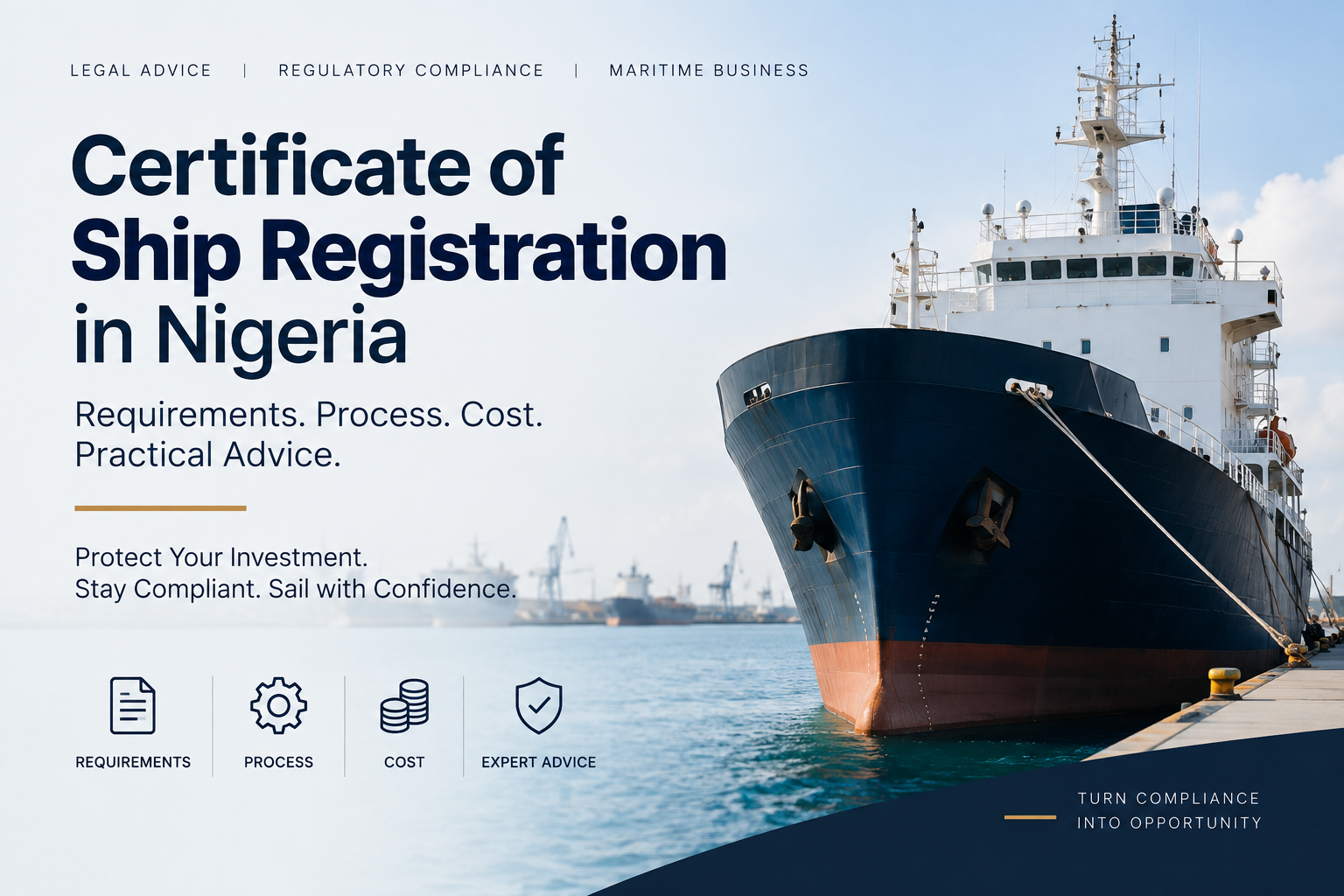
Thinking of buying a vessel, operating a barge, running a tugboat business, or entering Nigeria’s maritime industry?
Before you spend millions on a vessel, there is one question you must answer:
Can this vessel be legally registered and operated under the Nigerian flag?
This is where the Certificate of Ship Registration comes in.
I have spent years advising businesses on regulatory compliance. One thing I have learnt is that a business can have the money, the equipment, and the opportunity, yet still get stuck because the regulatory foundation was not properly laid.
Ship registration is one of those areas.
The vessel may be physically available. The seller may be pressing you to pay. The business opportunity may look attractive. But if the ownership documents are defective, the vessel cannot satisfy registration requirements, or the regulatory approvals are missing, you may end up with an expensive asset that cannot do the work you bought it for.
In this article, I will explain, in plain language:
-
What a Certificate of Ship Registration means.
-
Who is responsible for ship registration in Nigeria.
-
The requirements and application process.
-
The difference between registration, survey and other maritime licenses.
-
The costs you should budget for.
-
The practical challenges businesses face.
-
How to avoid expensive mistakes.
This is not just about obtaining a certificate. It is about making sure your vessel can support your business legally and commercially.
1. What Is a Certificate of Ship Registration?
A Certificate of Ship Registration is an official document issued by the Nigerian Ship Registration Office under the administration of the Nigerian Maritime Administration and Safety Agency (NIMASA).
It is evidence that a vessel has been registered in the Nigerian ship registry.
In simple terms, it establishes the vessel’s registration status and records the ownership and particulars of the ship.
It is an important document for vessel owners, shipping companies, offshore service providers, marine transport businesses and other maritime operators.
But let me make something clear.
A Certificate of Ship Registration is not the same thing as a license to do every maritime business.
Registering a vessel does not automatically mean you can:
-
Transport passengers commercially.
-
Carry petroleum products.
-
Operate in Nigeria’s cabotage trade.
-
Carry dangerous goods.
-
Engage in offshore oil and gas support services.
-
Sail internationally without other required approvals.
Those activities may require additional approvals, certificates, licenses or compliance documents.
That distinction is where many people get it wrong.
Who issues the certificate?
The Nigerian Ship Registration Office, under NIMASA, is responsible for the registration of Nigerian ships.
NIMASA is Nigeria’s principal maritime regulatory agency. Its official website provides ship registration services, registration guidelines, forms and information on renewal and cancellation of registration.
2. Why Do You Need a Certificate of Ship Registration?
Let us bring this down to business.
Imagine you have acquired a vessel worth ₦200 million.
You intend to use it for offshore support services.
You have already paid the seller. You have recruited your crew. You have secured a potential contract.
Then you discover that the vessel’s registration is not in order.
Or the previous owner’s title documents are defective.
Or the vessel’s technical condition does not support the registration process.
Or you discover that the vessel cannot lawfully be used for the particular operation you have in mind.
That is where the problem begins.
A Certificate of Ship Registration is important because it supports the legal and regulatory identity of the vessel.
Key benefits
|
Benefit |
Why it matters |
|---|---|
|
Evidence of registration |
Shows that the vessel is registered in the Nigerian ship registry. |
|
Ownership documentation |
Supports the official record of ownership and vessel particulars. |
|
Regulatory compliance |
Helps establish the vessel’s status with the maritime regulator. |
|
Commercial operations |
Forms part of the documentation required for many maritime activities. |
|
Financing and transactions |
May be relevant to lenders, investors, insurers and vessel buyers. |
|
International recognition |
Supports the vessel’s registration status where additional international requirements are satisfied. |
Important: Registration alone does not guarantee financing, insurance, a commercial contract or permission to operate in every trade. Those depend on the particular transaction and the applicable regulatory requirements.
3. Who Can Register a Ship in Nigeria?
The answer depends on the vessel, ownership structure, applicable Nigerian maritime law and the requirements of the Nigerian Ship Registration Office.
NIMASA provides a specific guide for registration of vessels and states that the minimum share capital for a vessel owned by a Nigerian company is ₦25,000,000.
This is an important point for companies planning to acquire vessels.
Nigerian company ownership
If your company intends to own a vessel, you need to examine:
-
Whether the company is properly incorporated.
-
Whether the company’s share capital satisfies the applicable requirement.
-
Whether the ownership structure complies with the relevant maritime law.
-
Whether the vessel meets the applicable registration requirements.
-
Whether the company has the necessary operational capacity.
The ₦25 million figure is the minimum share capital stated on NIMASA’s ship registration page. It should not be confused with the cost of buying a vessel or the total funds needed to operate one.
What about foreign-owned vessels?
This is where you need proper advice.
A foreign company or foreign investor cannot simply assume that because it has money to buy a vessel, the vessel can automatically be registered under the Nigerian flag.
The applicable ownership, eligibility, cabotage and registration requirements must be examined.
If the vessel is intended for coastal trade, offshore oil and gas services or other restricted activities, the ownership and eligibility requirements become even more important.
Do not buy the vessel first and start asking these questions later.
4. Requirements for Certificate of Ship Registration in Nigeria
The requirements will depend on the vessel, the ownership structure and the nature of the application.
NIMASA’s official registration guidelines identify a number of documents and information that may be required.
These include ownership evidence, vessel particulars, technical reports and other supporting documents.
Below is a practical checklist.
A. Corporate and ownership documents
For a vessel owned by a company, you should prepare:
|
Document |
Purpose |
|---|---|
|
Certificate of Incorporation |
Evidence of the company’s legal existence. |
|
Corporate ownership details |
Establishes who owns the vessel. |
|
Application letter |
Formal request for registration. |
|
Declaration of ownership |
Records the ownership particulars required by the registry. |
|
Bill of Sale |
Evidence of transfer or purchase of the vessel. |
|
Builders Certificate |
May be required as evidence of title for a newly built vessel. |
|
Evidence of financial resources |
May be required to show capacity to operate and maintain the vessel. |
For a second-hand vessel, the Bill of Sale and warranty against liens and encumbrances are particularly important.
This is not a document you should sign carelessly.
A vessel may be physically in Nigeria but still have unresolved ownership issues, mortgages, liens or other encumbrances.
You need to investigate these matters before completing the acquisition.
NIMASA’s official guidelines identify the Bill of Sale, evidence of title and evidence of financial resources among the registration requirements.
B. Vessel documents
The vessel itself must also be properly documented.
The NIMASA registration guidelines identify the following vessel-related documents and particulars:
-
Name of the vessel.
-
Time and place of purchase.
-
Name of the Master.
-
Tonnage and description of the vessel.
-
Bill of Sale or Builders Certificate.
-
Condition Survey Report.
-
Tonnage Measurement Certificate.
-
Certificate of Carving and Marking Note.
-
Call Sign Certificate.
-
Load Line Certificate.
-
Report of Pre-Purchase Survey.
Not every vessel will have the same documents or technical requirements.
The appropriate documents must be confirmed for the particular vessel and application.
Official source: NIMASA Registration Guidelines .
5. The Practical Process of Registering a Ship in Nigeria
This is where the difference between reading an article and engaging a competent consultant becomes clear.
The process may look straightforward on paper.
But if your documents are incomplete, the vessel has technical issues, or the ownership structure is not properly aligned, the application can become frustrating.
Let us break it down.
Step 1: Confirm the vessel’s eligibility
Before preparing the application, confirm that the vessel is eligible for registration under the applicable Nigerian maritime law.
This involves reviewing:
-
Ownership.
-
Vessel type.
-
Vessel particulars.
-
Intended use.
-
Previous registration.
-
Applicable technical requirements.
-
Any relevant cabotage or other statutory restrictions.
My advice: Do not start with payment.
Start with eligibility.
It is better to spend money on proper due diligence than to spend millions acquiring a vessel that creates regulatory problems.
Step 2: Conduct ownership and title due diligence
This is one of the most important stages.
If the vessel is being purchased, obtain and review the ownership documents.
Where it is a second-hand vessel, examine the Bill of Sale and the seller’s title.
You should also investigate whether the vessel is subject to:
-
Mortgage.
-
Maritime lien.
-
Encumbrance.
-
Dispute.
-
Previous registration issues.
-
Outstanding obligations.
A vessel is not like buying a used car from a dealer down the street.
The consequences of defective title can be substantial.
Do not rely solely on the seller’s assurance that the vessel is “clean.”
Obtain documentary evidence.
Step 3: Reserve and obtain approval of the vessel name
NIMASA provides a process for reservation and approval of ship names.
The applicant may specify a preferred name and alternatives.
A name may be refused if, among other reasons:
-
It is already the name of a Nigerian registered ship.
-
It is so similar to an existing ship name that confusion may arise.
-
It is offensive or contrary to public interest.
-
It is calculated to deceive.
NIMASA states that a name reservation is for 60 days, after which it lapses.
Official source: NIMASA Ship Name Reservation .
Practical advice
Prepare at least two or three alternative names.
Do not build your entire branding around a name before checking its availability.
A rejected name can waste time and create unnecessary costs.
Step 4: Prepare the application and supporting documents
NIMASA’s applicant guide provides a three-step outline:
-
Send an application to the Director-General with the required supporting documents.
-
Liaise with the Nigerian Ship Registry Office for payment of the required fees.
-
Pick up the certificate or document from the Nigerian Ship Registry Office.
That is the official high-level process.
In practice, the quality of your application matters.
A properly arranged application makes it easier to identify missing documents and respond to queries.
Official source: NIMASA Applicant’s Guide .
Step 5: Apply for the required survey and tonnage measurement
This is a point many new vessel owners overlook.
NIMASA’s registration guidelines state that the shipowner is expected to submit an application for survey and issuance of a Certificate of Tonnage Measurement concurrently with the application for registration.
The technical side is not optional simply because the ownership documents are ready.
The vessel must meet the applicable requirements.
You may need to deal with:
-
Survey arrangements.
-
Tonnage measurement.
-
Condition assessment.
-
Vessel markings.
-
Safety-related documentation.
-
Technical queries from the regulator.
The registry is not merely registering a piece of property. It is dealing with a vessel that is expected to operate safely and lawfully.
Official source: NIMASA Flag Registration Guidelines .
Step 6: Pay the applicable fees
The Nigerian Ship Registration Office will advise on the required payments.
The amount will depend on the applicable tariff and the particulars of the application.
Do not assume that the fees for every vessel are the same.
A barge, tugboat, passenger vessel, tanker and other categories of vessel may have different requirements.
You should obtain the current official fee assessment before making payment.
Step 7: Obtain the Certificate of Ship Registration
Once the application has been processed and the applicable requirements satisfied, the certificate may be issued.
But the work does not necessarily end there.
You must keep the vessel’s registration and other required statutory documents current.
6. How Much Does Certificate of Ship Registration Cost in Nigeria?
Let me be straightforward.
There is no single flat fee that I can responsibly quote for every vessel.
The total cost depends on the vessel and the requirements of the application.
You should not use a random figure from an old article or a WhatsApp message to budget for a vessel acquisition.
Cost components to budget for
|
Cost item |
What it covers |
|---|---|
|
Official registration fees |
Fees payable to the Nigerian Ship Registration Office. |
|
Name reservation |
Applicable fee for vessel name reservation, where required. |
|
Survey and tonnage measurement |
Technical survey and measurement costs. |
|
Professional fees |
Legal, regulatory and documentation support. |
|
Due diligence |
Ownership and title investigation. |
|
Technical documentation |
Preparation or updating of required technical reports. |
|
Other statutory approvals |
Additional certificates or licenses required for the intended operation. |
What about the ₦25 million figure?
The ₦25 million minimum share capital stated by NIMASA for a vessel owned by a Nigerian company is not the registration fee.
It is a corporate capital requirement stated on the Agency’s ship registration page.
Do not confuse it with the amount payable to register the vessel.
Official source: NIMASA Ship Registration Requirements .
My recommendation on costing
Before giving your client a final quotation, obtain:
-
Vessel type.
-
Gross tonnage.
-
Ownership structure.
-
Whether the vessel is new or second-hand.
-
Whether it has previous registration.
-
Whether it is intended for cabotage.
-
Whether it will operate in the oil and gas sector.
-
The current applicable official fees.
Then prepare a proper quotation.
That is how you avoid underbilling and returning to the client every two days with another request for money.
7. Certificate of Ship Registration vs Other Maritime Licenses
This is one of the most important distinctions.
A ship can be registered and still require additional approvals to operate.
|
Document |
What it generally addresses |
|---|---|
|
Certificate of Ship Registration |
Registration status and ownership particulars of the vessel. |
|
Certificate of Tonnage Measurement |
Tonnage measurement of the vessel. |
|
Certificate of Class |
Technical classification, where applicable. |
|
Load Line Certificate |
Compliance with applicable load line requirements. |
|
Safety certificates |
Applicable safety and operational requirements. |
|
Cabotage registration or waiver |
Requirements for relevant domestic coastal trade activities. |
|
Shipping company or shipping agent licence |
The business’s authorisation to engage in applicable shipping activities. |
|
Other sector-specific permits |
Approvals required for particular cargoes, services or operations. |
The exact requirements depend on the vessel and intended operation.
NIMASA separately provides ship registration, cabotage registration and shipping company or shipping agent licensing services.
8. Do You Need Cabotage Registration?
If your vessel is intended to operate in Nigeria’s domestic coastal trade, this question must be addressed.
The Coastal and Inland Shipping (Cabotage) Act, 2003 is relevant to cabotage activities.
The fact that a vessel has a Nigerian Certificate of Ship Registration does not, by itself, settle every cabotage compliance issue.
The applicable requirements may depend on:
-
The vessel’s ownership.
-
The nature of the trade.
-
The vessel’s activities.
-
Whether the vessel is Nigerian-owned.
-
Whether an exemption or waiver is applicable.
-
Other statutory requirements.
Example
A company wants to acquire a vessel to provide offshore support services to an oil and gas company.
The company says:
“We have registered the vessel. We are ready to commence.”
Not so fast.
You need to examine the applicable cabotage requirements, vessel eligibility, ownership and the specific operation.
The vessel may also require other regulatory approvals.
This is why vessel registration should be planned together with the business model.
Do not treat it as a separate issue.
9. Common Problems Businesses Face in Ship Registration
This is the part I want business owners to pay attention to.
The law may provide a process.
But the practical experience can be different.
Here are the problems I have seen businesses encounter in regulatory work generally, and the issues you should anticipate in ship registration.
Problem 1: Buying the vessel before checking eligibility
This is a costly mistake.
The seller is in a hurry.
The buyer is excited.
The opportunity looks attractive.
Money changes hands.
Then the buyer discovers that the vessel’s ownership structure or other particulars create a registration problem.
My advice
Conduct regulatory due diligence before acquisition.
Not after.
Problem 2: Incomplete documentation
The application may be submitted without all the required documents.
The applicant then spends weeks going back and forth.
One missing document can delay the process.
This is especially problematic when the vessel is already required for a contract.
My advice
Prepare a document checklist before filing.
Review every document.
Make sure names, dates and vessel particulars are consistent.
Problem 3: Defective title documents
This is a serious issue.
The vessel may have changed hands several times.
The seller may not be the actual owner.
There may be outstanding encumbrances.
There may be discrepancies in the Bill of Sale.
My advice
Use a maritime lawyer to review the title documents.
Do not treat a Bill of Sale as a mere formality.
Problem 4: Confusing vessel registration with operational licensing
This is common.
A client obtains the Certificate of Ship Registration and assumes all other requirements have been satisfied.
Then the client discovers that a separate approval is required for the actual operation.
My advice
Prepare a complete regulatory compliance matrix for the vessel.
Identify every approval needed for the business.
Problem 5: Using outdated information
Regulatory requirements and fees can change.
Old articles may contain old fees.
Old forms may no longer be the current forms.
An old WhatsApp message may be misleading.
My advice
Confirm current requirements and fees directly from the relevant authority.
For ship registration, start with NIMASA’s official ship registration resources.
10. How Long Does Ship Registration Take?
The duration will depend on the particular application.
Factors include:
-
Completeness of documents.
-
Ownership issues.
-
Technical survey requirements.
-
Tonnage measurement.
-
Name approval.
-
Queries from the regulator.
-
Payment and administrative processing.
-
Other statutory requirements.
I would not advise a client to rely on a guaranteed completion date without first reviewing the vessel and the application.
A practical approach
Before accepting a contract or committing a vessel to a commercial operation, establish:
-
What documents are ready?
-
What documents are outstanding?
-
Is the vessel available for inspection?
-
Are there title issues?
-
What survey is required?
-
What payments are required?
-
What is the expected processing timeline?
-
What could delay the application?
That is how you manage expectations.
11. Why You Should Engage a Regulatory Compliance Consultant
Let me say this from the perspective of someone who has spent years in regulatory compliance.
The value of a consultant is not just in filling forms.
It is in understanding the transaction.
A competent consultant should help you identify problems before they become expensive.
What we can help with
At ICA-Ibe, Chido & Associates, our approach to regulatory work is to understand the client’s business and the legal requirements around it.
For ship registration matters, the scope of professional support may include:
|
Service |
What we do |
|---|---|
|
Regulatory assessment |
Review the proposed vessel and intended business activity. |
|
Documentation review |
Examine ownership and supporting documents. |
|
Application preparation |
Prepare and coordinate the registration application. |
|
Regulatory liaison |
Engage with the relevant authority on application matters. |
|
Survey coordination |
Help coordinate the documentation and process relating to required surveys. |
|
Compliance advisory |
Identify additional approvals relevant to the vessel’s intended operation. |
|
Follow-up |
Track queries and outstanding requirements. |
The exact scope depends on the client’s needs.
What we do not do
We do not treat regulatory compliance as a guarantee of automatic approval.
The regulator must still review and determine the application.
Our role is to help the client prepare properly, identify issues and navigate the process professionally.
12. Practical Advice Before Buying a Vessel in Nigeria
If you are planning to buy a vessel, use this checklist.
Vessel acquisition checklist
Frequently Asked Questions
1. What is a Certificate of Ship Registration?
It is an official document evidencing the registration of a vessel in the Nigerian ship registry.
It records the registration status and relevant ownership and vessel particulars.
2. Who issues a Certificate of Ship Registration in Nigeria?
The Nigerian Ship Registration Office under NIMASA.
3. How much does ship registration cost?
The cost depends on the vessel, its particulars, the applicable tariff and the requirements of the application.
There is no single flat fee for every vessel.
4. Is ₦25 million the registration fee?
No.
NIMASA states that ₦25 million is the minimum share capital for any vessel owned by a Nigerian company.
It is not the vessel registration fee.
5. Can a foreign company register a vessel in Nigeria?
This depends on the applicable eligibility, ownership and maritime law requirements.
Foreign investors should obtain specific advice before acquiring the vessel.
6. Is a Certificate of Ship Registration the same as a Cabotage licence?
No.
Ship registration and cabotage compliance are distinct matters.
A vessel intended for cabotage activities must satisfy the applicable cabotage requirements.
7. Do I need a survey before registration?
NIMASA’s registration guidelines state that an application for survey and issuance of a Certificate of Tonnage Measurement is expected to be submitted concurrently with the registration application.
8. Can I operate my vessel immediately after registration?
Not necessarily.
The vessel may require other certificates, permits or licences depending on its intended operation.
9. Can ICA help with ship registration?
Yes. ICA can assist with regulatory assessment, documentation, application preparation, regulatory liaison and compliance advisory, subject to the scope of the engagement.
10. Where can I get the official registration forms?
NIMASA provides ship registration forms and other related forms on its official website.
You can access the NIMASA Ship Registry Forms .
Conclusion: Register the Vessel Properly. Protect Your Investment.
The maritime industry is full of opportunities.
But it is also an industry where regulatory mistakes can become very expensive.
A vessel is not just an asset.
It is an asset that must operate within a legal and regulatory framework.
If you are buying a vessel, do not wait until after the transaction to ask whether it can be registered.
If you are setting up a shipping company, do not wait until you have secured a contract to start checking the requirements.
If you are entering offshore oil and gas services, do not assume that ship registration alone is enough.
Start with compliance.
Review the vessel.
Review the ownership.
Review the intended operation.
Review the applicable requirements.
Then proceed.
That is how you reduce avoidable problems.
At ICA-Ibe, Chido & Associates, we advise businesses on regulatory compliance and legal matters. Our approach is simple: understand the client’s business, identify the legal requirements and help the client navigate the process professionally.
If you need assistance with Certificate of Ship Registration in Nigeria, contact us for an assessment of your vessel and the applicable requirements.
ICA-Ibe, Chido & Associates
Corporate Office: No.7 Makeni Street, Wuse Zone 6, Abuja, FCT.
Email: info@ica.ng | support@ica.ng
Website: ica.ng

