
By Okpi, Ibe Chinedu Esq
Lead Consultant, ICA-Ibe, Chido & Associates
Many Nigerian businesses spend millions of Naira building factories, warehouses, hotels, estates, hospitals, recycling plants and production facilities.
Then they discover one painful reality.
The regulator is not interested in how much they invested.
The regulator wants to know one thing.
“How do you intend to protect the environment while carrying on your business?”
That is where the Environmental Management Plan (EMP) comes in.
In this article, you will learn:
- What an Environmental Management Plan (EMP) really is.
- Who needs EMP Certification in Nigeria.
- Why many businesses get into regulatory trouble.
- The mistakes that delay approvals.
- The practical steps to obtain EMP Certification.
- How to prepare for inspections.
- Frequently asked questions businesses ask us every week.
If you are planning a project or already operating a facility in Nigeria, this article may save you from expensive regulatory problems.
The Biggest Mistake Nigerian Businesses Make
After nearly fifteen years advising businesses on regulatory compliance, I have noticed a pattern.
Most entrepreneurs are willing to spend money on buildings.
They are willing to buy machines.
They are willing to hire staff.
But very few are willing to invest time in understanding environmental compliance.
Many people believe environmental compliance is simply “government paperwork.”
It is not.
It is a legal obligation.
And regulators are becoming more proactive every year in monitoring environmental compliance across different sectors. NESREA is responsible for enforcing environmental laws, standards and regulations across sectors within its mandate.
What is an Environmental Management Plan (EMP)?
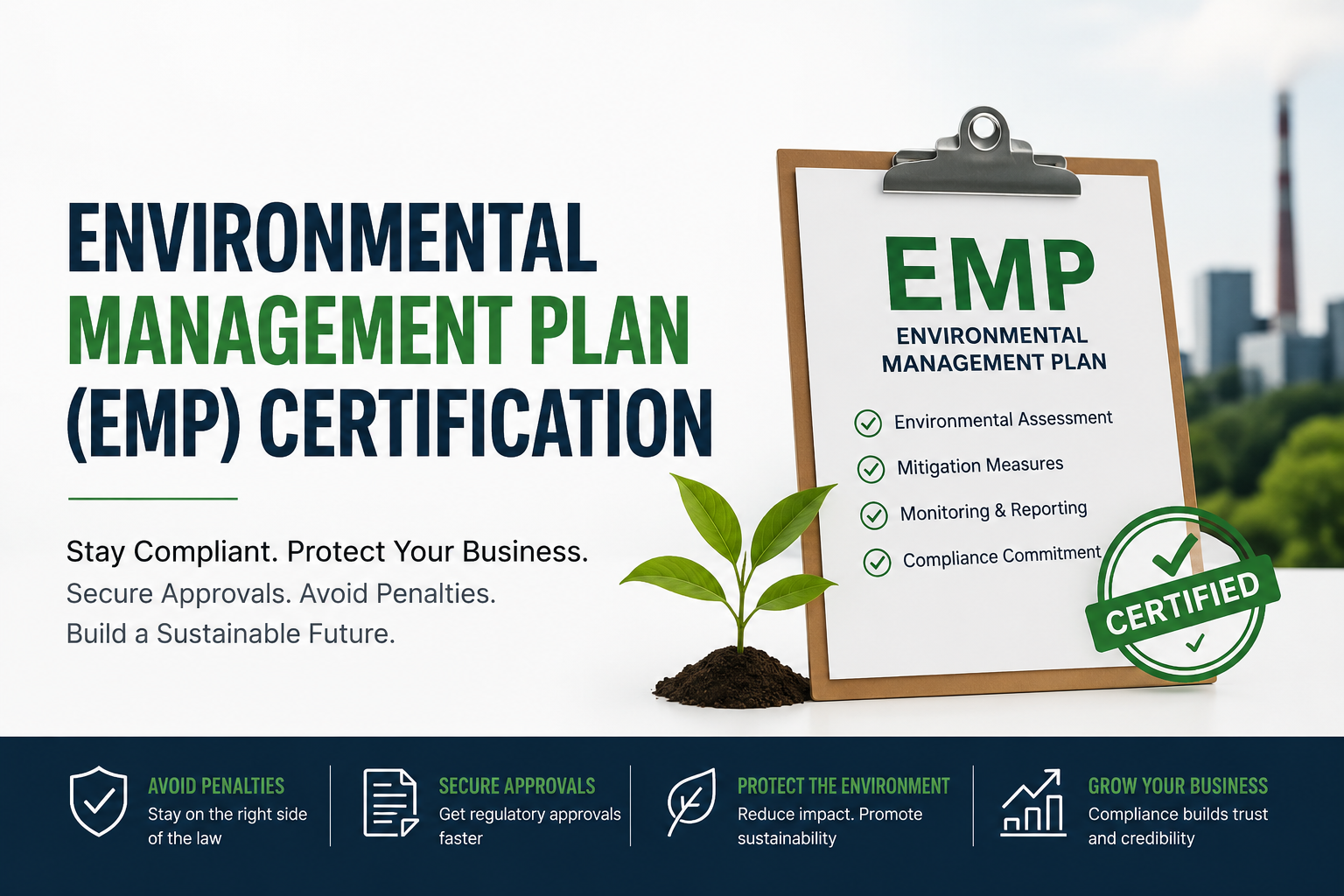
An Environmental Management Plan (EMP) is a structured document that explains how a company intends to identify, prevent, reduce, monitor and manage the environmental impacts of its activities. It is submitted as part of Nigeria’s environmental compliance process for certain projects and regulated facilities.
Think of it as your company’s environmental operating manual.
It answers practical questions like:
- How will waste be managed?
- How will wastewater be treated?
- How will dust be controlled?
- How will noise be reduced?
- What happens when there is an oil spill?
- How will workers respond during environmental emergencies?
- Who monitors compliance?
- How often are environmental records kept?
If your EMP cannot answer these questions, regulators will likely ask for more information before approval.
Why EMP Certification Matters
Businesses often ask me,
“Barrister, nobody has asked us for it before.”
That may be true.
Until the day somebody asks.
Environmental compliance usually becomes important when:
- applying for another government approval;
- seeking financing;
- bidding for contracts;
- facing an inspection;
- receiving a compliance notice; or
- after a complaint from neighbours or the public.
At that point, everyone begins searching for documents they should have prepared months earlier.
That is the expensive way to do compliance.
Who Needs an Environmental Management Plan?
Depending on the nature of the project, sector and regulatory requirements, an EMP may be required for facilities and developments such as:
| Business Activity | EMP May Be Required |
|---|---|
| Manufacturing | ✔ |
| Recycling facilities | ✔ |
| Industrial processing | ✔ |
| Waste management | ✔ |
| Large construction projects | ✔ |
| Estates and property developments | ✔ |
| Hospitals and healthcare facilities | ✔ |
| Food processing plants | ✔ |
| Mining and mineral processing | ✔ |
| Logistics and industrial parks | ✔ |
The exact requirement depends on the applicable environmental laws, the project’s environmental impact and the relevant regulator’s assessment.
An EMP Is Not Just About Trees
One misconception I hear repeatedly is this:
“We don’t pollute the environment.”
Every business affects the environment in one way or another.
Sometimes it is:
- Noise.
- Smoke.
- Dust.
- Wastewater.
- Chemicals.
- Generator emissions.
- Used oil.
- Plastic waste.
- Battery disposal.
- Sewage.
- Construction activities.
- Fuel storage.
The question is not whether there is environmental impact.
The question is whether you have planned how to manage it.
The Cost of Ignoring Environmental Compliance
From experience, regulatory problems rarely arrive alone.
One inspection often leads to another.
Before long, a business is dealing with:
- Compliance notices.
- Delay in project commissioning.
- Suspension of approvals.
- Difficulties obtaining permits.
- Loss of investor confidence.
- Contract delays.
- Additional compliance costs.
Most of these problems are avoidable.
Practical Components of a Good EMP
A professionally prepared Environmental Management Plan usually addresses areas such as:
| Component | Purpose |
|---|---|
| Project Description | Explains the nature of the project |
| Environmental Baseline | Describes existing site conditions |
| Risk Assessment | Identifies likely environmental impacts |
| Mitigation Measures | Explains how risks will be reduced |
| Waste Management Plan | Covers collection and disposal |
| Air Quality Management | Controls emissions and dust |
| Water Management | Protects surface and groundwater |
| Emergency Response Plan | Guides response to spills and incidents |
| Monitoring Programme | Tracks environmental performance |
| Roles and Responsibilities | Assigns accountability |
| Reporting Framework | Documents ongoing compliance |
An EMP is a management tool.
It should not become another document that sits on a shelf gathering dust.
EMP and Eco-Guard Certification
One area that many project developers overlook is the relationship between an Environmental Management Plan and NESREA’s Eco-Guard Certification.
For projects at the pre-construction or construction stage, an EMP is one of the documents required when applying for Eco-Guard Certification. Other required documents include evidence of payment of the processing fee, certificate of incorporation, tax clearance (where applicable) and an Environmental Impact Statement (where required). NESREA states that completed applications are acknowledged within seven working days, after which additional information may be requested if necessary.
Practical Advice From Years of Practice
If there is one lesson I have learnt in regulatory consulting, it is this:
Do not prepare compliance documents because an inspector is coming.
Prepare them because your business deserves to operate properly.
When regulators visit a facility, they can usually tell within minutes whether environmental compliance has been integrated into daily operations or whether documents were hurriedly assembled after receiving a notice.
Compliance leaves evidence.
So does non-compliance.
Common Mistakes Businesses Make
These are some of the mistakes we regularly see:
- Copying another company’s EMP.
- Using generic environmental reports downloaded online.
- Ignoring site-specific risks.
- Leaving environmental responsibilities undefined.
- Failing to train staff.
- Not implementing the measures contained in the EMP.
- Treating the EMP as a one-time document instead of a living management system.
How to Obtain EMP Certification
Although the exact process may differ depending on the project and regulatory requirements, it generally involves:
| Stage | Activity |
|---|---|
| 1 | Determine whether your project requires an EMP |
| 2 | Engage a competent environmental consultant where necessary |
| 3 | Prepare the Environmental Management Plan |
| 4 | Enrol your company on the relevant NESREA platform where applicable |
| 5 | Upload or submit the required documentation |
| 6 | Respond to any regulatory observations |
| 7 | Receive approval or certification where applicable |
NESREA’s environmental management platform requires companies to enrol, update their profile, and submit the EMP for review as part of the certification process.
My Advice to Business Owners
Please stop seeing environmental compliance as an unnecessary expense.
It is part of running a responsible business.
Good compliance protects your investment.
It improves your reputation.
It reduces regulatory surprises.
It makes expansion easier.
And in many cases, it saves money that would otherwise be spent fixing avoidable compliance problems.
In today’s Nigeria, environmental compliance is no longer optional.
It is becoming part of doing business properly.
Businesses that understand this early will always have an advantage over those waiting for enforcement before acting.
Frequently Asked Questions (FAQs)
Is an Environmental Management Plan the same as an Environmental Impact Assessment (EIA)?
No.
An Environmental Impact Assessment evaluates the likely environmental effects of a proposed project before implementation, while an Environmental Management Plan sets out how identified environmental impacts will be managed during construction and operation. Depending on the project, an EMP may form part of, or complement, the broader environmental assessment and compliance framework.
Who regulates EMP Certification in Nigeria?
For projects within its statutory mandate, the National Environmental Standards and Regulations Enforcement Agency (NESREA) administers environmental permitting and certification processes, including EMP-related submissions through its environmental management systems.
Can a company prepare its own EMP?
While companies provide operational information, an effective EMP usually requires technical environmental expertise and should accurately reflect the realities of the specific project and applicable regulatory requirements.
Does every business require an EMP?
No.
The requirement depends on the nature, size, environmental impact and regulatory classification of the project or facility.
Can an EMP be updated?
Yes.
An Environmental Management Plan should be reviewed whenever operations change significantly, new risks emerge, expansion occurs or regulators require revisions.
What happens if my business operates without the necessary environmental approvals?
Depending on the circumstances, businesses may face enforcement actions, compliance directives, delays in obtaining permits, or other regulatory consequences under applicable environmental laws and regulations.
Final Thoughts
Businesses do not fail because regulators exist.
Many businesses run into trouble because they assume compliance can wait.
It cannot.
The earlier environmental compliance becomes part of your business planning, the cheaper, smoother and more predictable your operations become.
That has been my experience after many years of helping Nigerian businesses navigate the country’s regulatory landscape.
Compliance is always less expensive than enforcement.

