
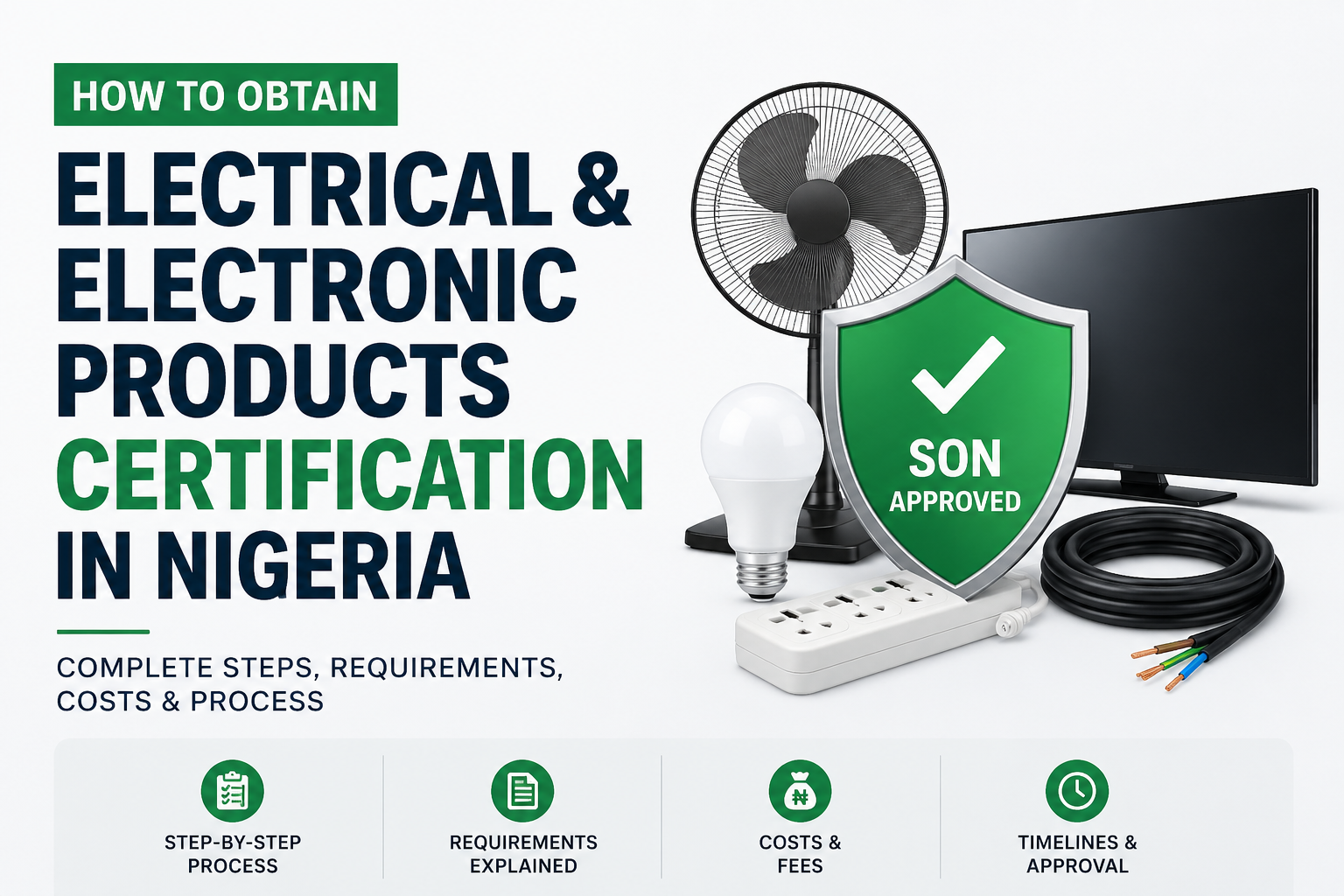
If you manufacture, import, distribute, or sell electrical and electronic products in Nigeria, certification is not optional, it is often a legal and commercial necessity. Products such as cables, switches, sockets, LED lamps, extension boxes, circuit breakers, fans, refrigerators, TVs, computers, power banks, solar inverters, batteries, and many other electrical/electronic goods may require compliance approval under the Standards Organisation of Nigeria (SON).
Many businesses wrongly assume they only need Customs clearance or a supplier invoice. In reality, SON runs separate certification systems depending on whether the goods are imported or locally manufactured. If you get it wrong, your cargo may be delayed, detained, rejected, or your locally made products may face enforcement action.
This guide explains exactly how to obtain an Electrical and Electronic Products Certification in Nigeria, including steps, requirements, costs, timelines, procedures, common mistakes, and how to avoid expensive compliance delays.
Table of Contents
- What Is Electrical and Electronic Products Certification in Nigeria?
- Who Regulates It?
- Which Certificate Do You Need?
- SONCAP for Imported Electrical/Electronic Products
- MANCAP for Locally Manufactured Electrical/Electronic Products
- Required Documents
- Official Costs and Fees
- Step-by-Step Application Process
- Timelines
- Common Mistakes That Cause Delays
- FAQs
- Final Compliance Strategy
1. What Is Electrical and Electronic Products Certification in Nigeria?
Electrical and electronic products certification is the regulatory process used to confirm that products meet applicable Nigerian Industrial Standards (NIS), approved international standards, and safety requirements before sale, importation, or distribution in Nigeria.
The main purpose is to prevent:
- Fire hazards
- Electrocution risks
- Fake/substandard electronics
- Unsafe wiring products
- Low-quality batteries and chargers
- Non-compliant appliances
- Consumer deception
SON specifically regulates conformity of many electrical and electronic products through national certification schemes.
2. Who Regulates It in Nigeria?
The regulator is the:
Standards Organisation of Nigeria
SON is responsible for standardisation, product quality regulation, conformity assessment, and enforcement of standards for many non-food products in Nigeria.
3. Which Certificate Do You Need?
This depends on whether the product is imported or manufactured in Nigeria.
| Business Situation | Required Certification |
|---|---|
| Imported electrical/electronic goods | SONCAP |
| Manufactured in Nigeria | MANCAP |
| High-performing local products | NIS Mark / Voluntary schemes |
SON confirms that:
- SONCAP applies to regulated imported products
- MANCAP applies to locally manufactured products
4. SONCAP for Imported Electrical and Electronic Products
What Is SONCAP?
SONCAP means:
Standards Organisation of Nigeria Conformity Assessment Programme
It is a pre-shipment conformity verification system for imported regulated products.
This means many imported electrical goods must be tested/verified before shipment to Nigeria.
Common Electrical/Electronic Goods Often Covered
- Electrical cables
- Switches
- Sockets
- Extension boxes
- LED lamps
- Fans
- TVs
- Refrigerators
- Air conditioners
- Inverters
- Batteries
- Solar equipment
- Chargers
- Adapters
- Circuit breakers
- Power tools
5. MANCAP for Locally Manufactured Products
What Is MANCAP?
MANCAP means:
Mandatory Conformity Assessment Programme
It applies to products manufactured in Nigeria before sale in the market or export.
If you manufacture:
- Electrical cables
- Bulbs
- Power banks
- Extension cords
- Switches
- Solar accessories
- Electronic appliances
…you may require MANCAP approval before lawful market distribution.
6. Requirements for Electrical/Electronic Certification in Nigeria
A. SONCAP Requirements (Imported Products)
| Requirement | Details |
|---|---|
| Importer company documents | CAC documents |
| Product invoice | Commercial invoice |
| Packing list | Shipment details |
| Product specification | Technical datasheet |
| Test reports | Recognized lab reports |
| Form M | Often required in import process |
| Manufacturer details | Factory information |
| Product labels | Packaging compliance |
B. MANCAP Requirements (Local Manufacturing)
| Requirement | Details |
|---|---|
| CAC registration | Nigerian company |
| Factory address | Production site |
| Product samples | For testing |
| Quality manual | Where applicable |
| Equipment list | Production capability |
| Internal QC system | Quality control evidence |
| Labels/packaging | Marking compliance |
| Applicable standard | NIS benchmark |
7. Official Costs and Fees
Important Note
SON fees vary by:
- Product type
- Testing complexity
- Quantity/SKU count
- Factory inspection needs
- Number of models
- Shipment volume
- Applicable route
Because electrical/electronic goods vary widely, there is no one universal fee for all products.
Typical Cost Heads
| Cost Head | May Apply To |
|---|---|
| Application fee | MANCAP / SONCAP |
| Product testing fee | Both |
| Inspection fee | Both |
| Surveillance fee | MANCAP |
| Certification fee | Both |
| Logistics/admin cost | Depending on process |
SON publishes service structures and administrative charges under specific services.
Practical Budget Range
For many businesses, total compliance budgeting may range from moderate to substantial, especially where multiple SKUs/models require separate testing.
8. Step-by-Step: How to Obtain SONCAP for Imported Electronics
Step 1: Determine If Product Is Regulated
Not every item follows the same route. Product HS code and category matter.
Step 2: Obtain Product Certificate
SONCAP routes commonly involve Product Certificate categories such as:
- PC1 (Unregistered)
- PC2 (Registered)
- PC3 (Licensed)
Step 3: Testing / Inspection
Product may undergo:
- Lab testing
- Physical inspection
- Document review
- Factory review (some routes)
Step 4: SONCAP Certificate Issued
Once compliant, shipment certificate may be issued.
Step 5: Use for Import Clearance
Documents are used during import clearance process.
9. Step-by-Step: How to Obtain MANCAP for Local Manufacturers
Step 1: Submit Application to SON
Apply with company and product details.
Step 2: Factory Inspection
SON may inspect production process.
Step 3: Product Sampling & Testing
Samples tested against Nigerian Industrial Standard.
Step 4: Evaluation
Inspection and test reports reviewed.
Step 5: Approval & Certificate
If successful, MANCAP certificate/logo may be issued.
Step 6: Market Surveillance
Periodic compliance monitoring continues.
10. Timelines
| Process | Typical Range |
|---|---|
| SONCAP simple repeat shipment | Faster |
| SONCAP new product with testing | Longer |
| MANCAP simple product | Several weeks |
| MANCAP multiple SKUs/factory issues | Longer |
Timelines depend heavily on documentation readiness and test outcomes.
11. Common Mistakes That Delay Approval
For Importers
- Wrong HS code
- Fake lab report
- Shipping before approval
- Poor labeling
- Using unapproved supplier specs
- Missing Form M details
For Manufacturers
- No QC system
- Inconsistent product quality
- No technical file
- Wrong labels
- Poor factory conditions
- Failed product tests
12. Misconceptions to Avoid
“My supplier certificate abroad is enough”
False. Nigeria may still require SON processes.
“Only big companies need it”
False. Small importers are affected too.
“Customs clearance means full compliance”
False. SON requirements can be separate.
“One certificate covers all models”
Often false. Variants may require separate treatment.
13. Frequently Asked Questions (People Also Ask)
Is SONCAP mandatory for imported electronics in Nigeria?
For many regulated products, yes.
Is MANCAP compulsory for locally made electrical goods?
For covered products manufactured locally, generally yes.
Can I import chargers without SONCAP?
Depends on classification and current regulation route.
How long does certification last?
Depends on scheme and certificate type.
Can one certificate cover many products?
Sometimes grouped products may qualify, but not always.
Can goods be seized for no certification?
Non-compliance can trigger detention, rejection, sanctions, or delays.
14. Best Compliance Strategy for Serious Businesses
If you sell electrical or electronic products in Nigeria, do not wait until goods arrive at port or after products enter the market.
The smartest approach is:
- Identify exact product classification
- Determine whether SONCAP or MANCAP applies
- Pre-check labels and packaging
- Run technical document review
- Test before filing
- Use proper compliance route
- Maintain renewal calendar
15. Why Many Applications Fail Quietly
Most failed applications are not “rejected” openly, they stall.
This happens when:
- Wrong product description used
- Missing standards reference
- Testing mismatch
- Label defects
- Supplier inconsistency
- Factory gaps
- Incomplete submission
That means delay costs, demurrage, lost sales, and damaged cash flow.
Final Word
Obtaining an Electrical and Electronic Products Certification in Nigeria is more technical than many businesses assume. Whether importing electronics through SONCAP or manufacturing locally through MANCAP, the process requires accurate classification, compliant documentation, testing readiness, and proper filing strategy.
Businesses that guess usually pay twice.
Businesses that structure the application properly often move faster, reduce risk, and enter market legally.
If your product line includes multiple SKUs, batteries, cables, power devices, smart electronics, solar systems, or mixed consignments, professional handling can save months of avoidable delay.

