Need a PDF copy of this guide?
Download the professionally formatted PDF version of this article for offline reading, sharing with colleagues, or future reference.
📄 Download PDF: How to Obtain a Veterinary Product Registration Certificate in Nigeria (2026 Complete Guide)_PDF
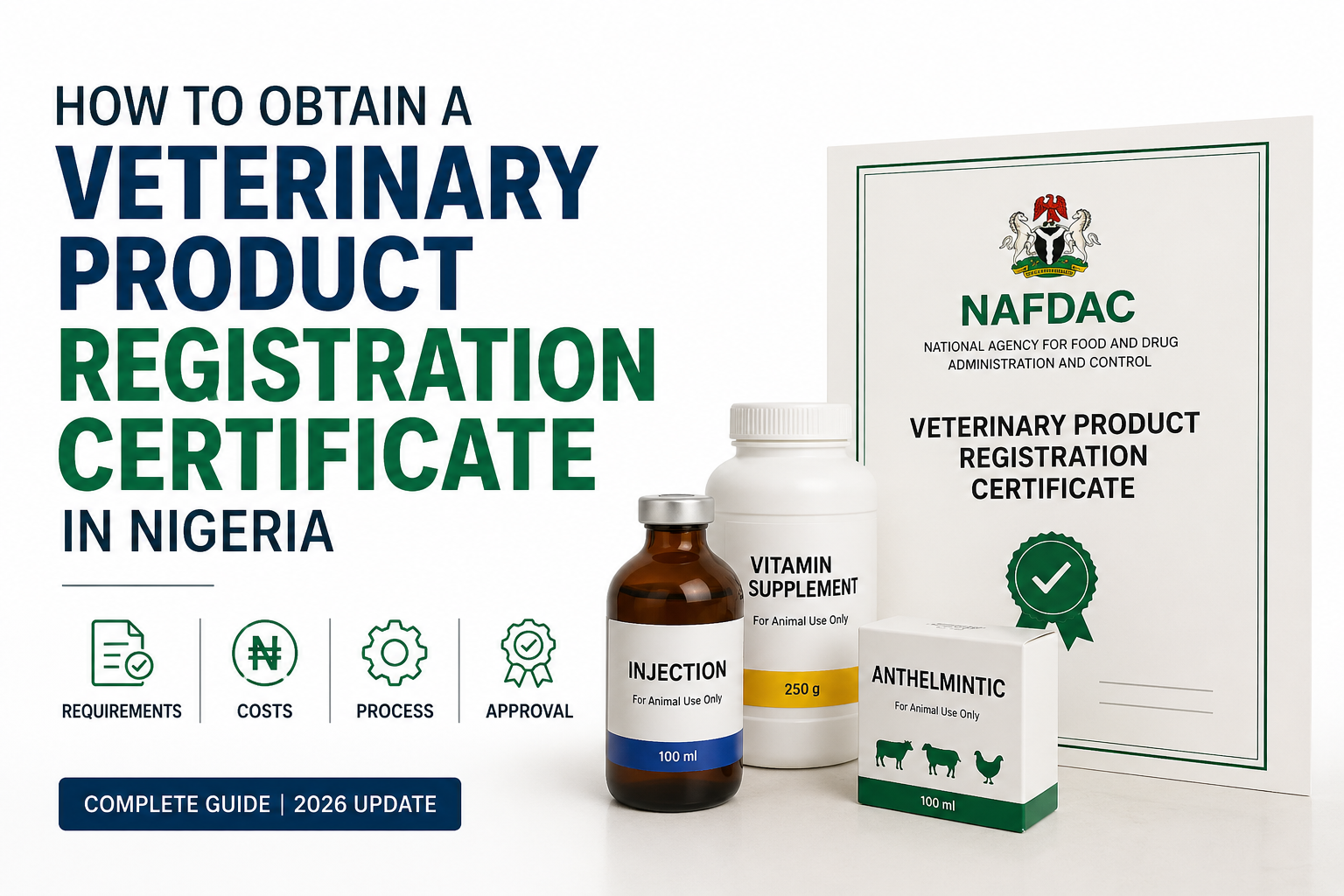
If you plan to manufacture, import, distribute, advertise, or sell veterinary medicines, animal feed, vaccines, supplements, pesticides for livestock use, or other animal health products in Nigeria, obtaining a Veterinary Product Registration Certificate is not optional, it is mandatory.
In Nigeria, veterinary products are regulated by the National Agency for Food and Drug Administration and Control (NAFDAC) through its Veterinary Medicine and Allied Products (VMAP) Directorate. No regulated veterinary product should lawfully enter the Nigerian market without registration, approval, or applicable permit from NAFDAC.
This detailed guide explains:
- What a Veterinary Product Registration Certificate is
- Products that require registration
- Official requirements
- Costs and fees
- Step-by-step registration process
- Timelines
- Common mistakes that delay approval
- Renewal process
- FAQs
If you are serious about launching veterinary products in Nigeria, this is the guide to bookmark.
Table of Contents
- What Is a Veterinary Product Registration Certificate?
- Who Issues It in Nigeria?
- Products Covered by NAFDAC VMAP
- Why Registration Is Mandatory
- Requirements for Registration
- Cost of Veterinary Product Registration in Nigeria
- Step-by-Step Application Process
- Timeline for Approval
- Imported vs Locally Manufactured Products
- Common Reasons Applications Fail
- Renewal of Certificate
- FAQs
- Final Compliance Advice
1. What Is a Veterinary Product Registration Certificate?
A Veterinary Product Registration Certificate is the formal approval issued by NAFDAC authorising a veterinary product to be legally manufactured, imported, marketed, distributed, advertised, or sold in Nigeria after regulatory review.
The certificate confirms that the product has met applicable standards relating to:
- Safety
- Quality
- Efficacy
- Labeling compliance
- Manufacturing standards
- Product documentation
Without this certificate, the product may be seized, refused importation, or sanctioned.
2. Who Issues Veterinary Product Registration in Nigeria?
The responsible authority is:
National Agency for Food and Drug Administration and Control (NAFDAC)
Specifically through:
Veterinary Medicine and Allied Products (VMAP) Directorate
VMAP regulates veterinary medicines and allied products to protect both animal and public health using a One Health approach.
3. Products That Require Registration
According to NAFDAC veterinary regulatory scope, the following categories may require registration, listing, or permit depending on product type:
Veterinary Medicines
- Antibiotics for animals
- Dewormers
- Anti-infectives
- Injectable animal drugs
- Pain relief products
Vaccines & Biologicals
- Poultry vaccines
- Livestock vaccines
- Companion animal vaccines
Feed & Feed Additives
- Animal feed
- Fish feed
- Premixes
- Concentrates
- Nutritional additives
Allied Products
- Veterinary disinfectants
- Pest control products for livestock facilities
- Animal supplements
4. Why Registration Is Mandatory
NAFDAC requires registration because unregulated veterinary products can cause:
- Drug residues in meat, eggs, milk
- Antibiotic resistance
- Livestock mortality
- Consumer health risks
- Fake/counterfeit medicine circulation
This is why NAFDAC also maintains lists of banned veterinary drugs for food-producing animals.
5. Requirements for Veterinary Product Registration in Nigeria
Requirements vary depending on imported or local product type, but generally include:
A. Corporate Documents
| Requirement | Local Company | Foreign Applicant |
|---|---|---|
| CAC Incorporation Certificate | Yes | Through Nigerian representative |
| Registered Address | Yes | Yes |
| Tax/Business Records | Often required | Through local agent |
B. Product Documents
- Product formulation/composition
- Certificate of Analysis
- Product specifications
- Manufacturing process details
- Stability data (where applicable)
- Label/artwork
C. Regulatory Documents
- Power of Attorney (foreign manufacturer to Nigerian agent)
- Free Sale Certificate / Certificate of Pharmaceutical Product (where applicable)
- GMP evidence
- Manufacturer License
D. Samples
Physical product samples may be requested for laboratory review.
E. Premises/Professional Requirements (drug products)
Some veterinary drug classes may require licensed technical supervision depending on category.
6. Cost of Veterinary Product Registration in Nigeria
Important Note
NAFDAC fees vary based on:
- Imported vs local
- Product category
- Drug vs feed vs vaccine
- Inspection requirements
- Laboratory analysis
- Number of SKUs/variants
Therefore exact fees should be confirmed from the latest NAFDAC schedule before filing.
Typical Cost Components
| Cost Head | Payable To |
|---|---|
| Application Fee | NAFDAC |
| Processing Fee | NAFDAC |
| Laboratory Analysis Fee | NAFDAC |
| GMP Inspection Fee | NAFDAC |
| Retention/Renewal Fee | NAFDAC |
| Consultant/Regulatory Fee | Optional Professional |
Realistic Budget Range
For many applicants, complete regulatory spend can range from hundreds of thousands to several millions of Naira, especially for imported products requiring inspection.
Always request updated official invoice through the NAFDAC portal.
7. Step-by-Step Process to Obtain Veterinary Product Registration Certificate
Step 1: Confirm Product Classification
Determine whether the product is:
- Veterinary drug
- Feed
- Vaccine
- Agro-veterinary product
- Supplement
Wrong classification causes delays.
Step 2: Create Account on NAFDAC Portal
Applications are processed electronically through NAFDAC’s automated platform (NAPAMS).
Portal allows:
- New applicant registration
- Product application
- Tracking progress
Step 3: Prepare Documentation
Compile:
- Company documents
- Manufacturing documents
- Labels
- COA
- Product dossier
- Agency authorisations
Step 4: Pay Applicable Fees
Generate invoice and pay approved fees through designated channels.
Step 5: Submit Application
Upload documents and submit product application.
Separate application may be required for each product/SKU.
Step 6: Screening / Vetting
NAFDAC reviews submission for completeness.
If defective, applicant receives query.
Step 7: Facility Inspection (Where Applicable)
For some products, NAFDAC may inspect:
- Local manufacturing site
- Foreign manufacturing facility
- Warehouse/storage premises
Step 8: Laboratory Analysis
Samples may be tested to verify:
- Identity
- Purity
- Strength
- Safety
Step 9: Final Approval
If satisfactory, certificate is issued.
Step 10: Market Compliance
After approval:
- Use approved labels only
- Avoid misleading claims
- Maintain pharmacovigilance/reporting obligations
8. How Long Does It Take?
| Stage | Estimated Time |
|---|---|
| Documentation Prep | 1–4 weeks |
| Filing & Screening | 2–6 weeks |
| Inspection (if needed) | Variable |
| Lab Analysis | Variable |
| Final Approval | Case dependent |
Total process can take weeks to several months, depending on product complexity and applicant readiness.
9. Imported vs Local Veterinary Products
| Factor | Imported Product | Local Product |
|---|---|---|
| Foreign Manufacturer Docs | Required | Not required |
| Power of Attorney | Usually required | No |
| Overseas GMP Issues | Possible | No |
| Local Factory Inspection | No/limited | Yes |
| Faster if Docs Ready | Sometimes | Sometimes |
10. Common Reasons Applications Fail
1. Wrong Product Category
Feed filed as medicine, supplement filed as drug, etc.
2. Incomplete Dossier
Missing formulation data or technical specs.
3. Bad Labeling
Unapproved claims, poor dosage instructions, absent batch details.
4. Trademark Problems
Brand conflict issues.
5. Manufacturer Compliance Gaps
No valid GMP evidence.
6. Poor Sample Quality
Failed lab results.
7. Using Unqualified Agents
Many delays happen because applicants use people who only “know portal.”
11. Renewal of Veterinary Product Registration Certificate
Certificates are not forever.
NAFDAC provides renewal pathways for several regulated products, including drugs and veterinary categories depending on type.
Renewal often requires:
- Existing certificate details
- Updated labels
- Evidence of continued compliance
- Payment of renewal fees
Always begin renewal early before expiry.
12. Frequently Asked Questions (People Also Ask)
Is veterinary product registration compulsory in Nigeria?
Yes. If regulated by NAFDAC, approval is required before lawful sale or importation.
Can I import animal drugs without registration?
Usually no, except under special permit categories.
Can foreigners apply directly?
Often through a Nigerian representative/company.
Does animal feed need approval?
Many feed categories require registration or applicable regulatory authorisation.
How much is the certificate fee?
Depends on product class.
Can one certificate cover many products?
Usually each distinct product/variant requires separate treatment.
Can I sell online without certificate?
No. Online sale does not exempt regulatory compliance.
13. Common Misconceptions
“It is just for big pharmaceutical companies.”
False. Small feed brands and veterinary startups may also need approval.
“Once imported, I can sell first and register later.”
Dangerous assumption. Goods may be detained or seized.
“My foreign approval covers Nigeria.”
Foreign approvals help credibility but do not replace NAFDAC authorisation.
“Certificate means no future inspections.”
NAFDAC can still inspect, monitor, or sanction non-compliance.
Final Strategic Advice
Obtaining a Veterinary Product Registration Certificate in Nigeria is not merely filling a form. It is a regulatory market-entry process involving classification, documentation, quality systems, labeling law, inspection readiness, and product review.
If handled properly, registration becomes a competitive advantage:
- Easier import clearance
- Stronger distributor trust
- Better market access
- Legal protection
- Brand credibility
If handled poorly, it becomes months of delays, queries, storage losses, and rejected stock.
For serious investors in Nigeria’s livestock, poultry, aquaculture, pet care, and veterinary markets, doing it correctly from day one is the cheapest option.
Need a PDF copy of this guide?
Download the professionally formatted PDF version of this article for offline reading, sharing with colleagues, or future reference.
📄 Download PDF: How to Obtain a Veterinary Product Registration Certificate in Nigeria (2026 Complete Guide)_PDF
