Need a PDF copy of this guide?
Download the professionally formatted PDF version of this article for offline reading, sharing with colleagues, or future reference.
📄 Download PDF: How to Obtain Healthcare Facility Accreditation Certificate in Nigeria_PDF
If you operate a hospital, clinic, diagnostic centre, maternity home, dental centre, physiotherapy practice, or specialist medical facility in Nigeria, one of the most commercially valuable approvals you may need is a Healthcare Facility Accreditation Certificate.
Why? Because many corporate patients, government programmes, enrollees, insurers, HMOs, and institutional clients prefer or require treatment from accredited healthcare providers.
In Nigeria, one of the most recognised federal accreditation pathways for healthcare providers is through the National Health Insurance Authority (NHIA), formerly NHIS. The NHIA accredits healthcare facilities for participation in national health insurance schemes and programmes.
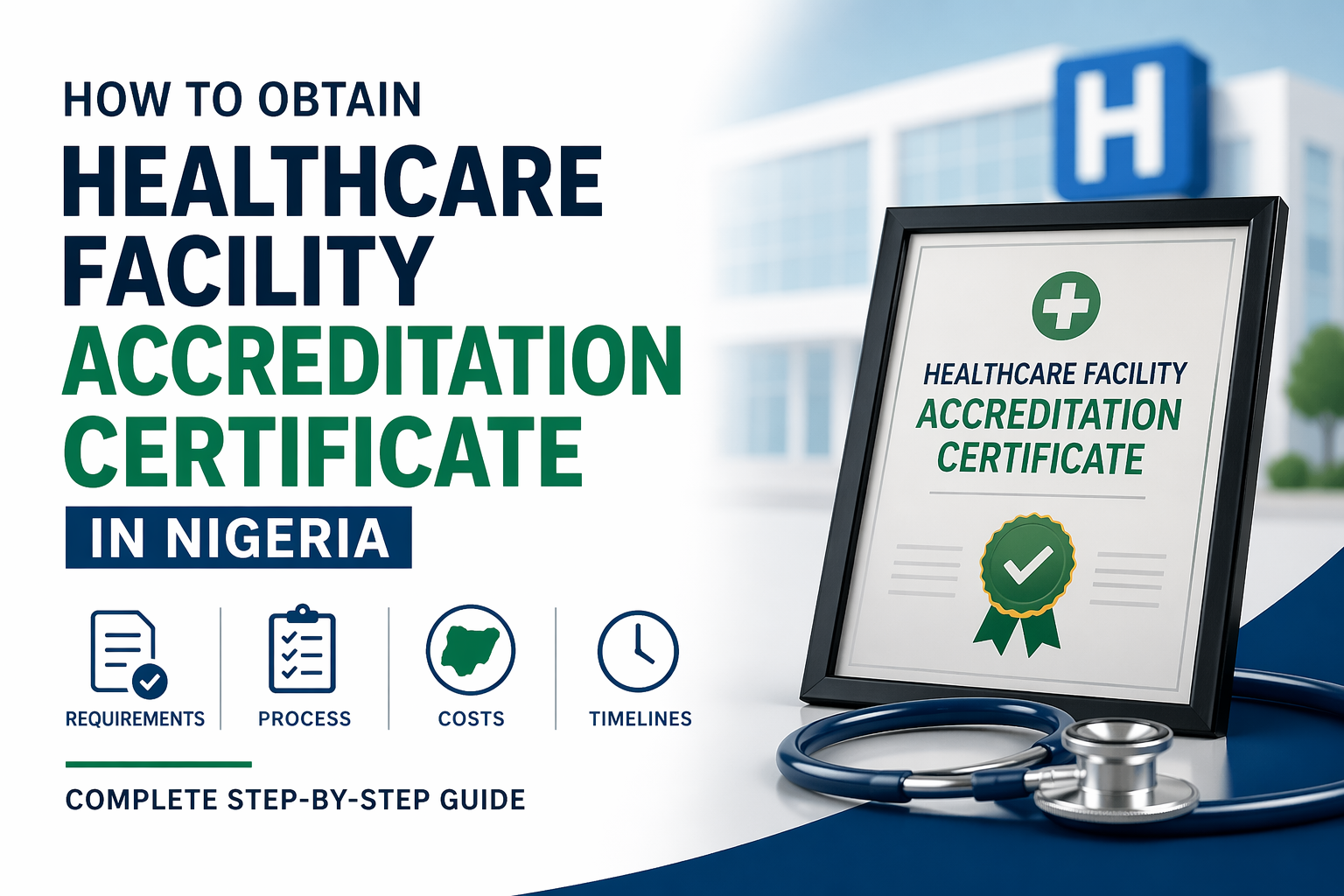
This guide explains how to obtain Healthcare Facility Accreditation Certificate in Nigeria, including:
- Official regulators involved
- Step-by-step process
- Requirements
- Inspection procedure
- Costs and hidden expenses
- Timelines
- Common reasons applications fail
- Frequently asked questions
If done correctly, accreditation can increase patient trust, revenue opportunities, HMO partnerships, and long-term business value.
Table of Contents
- What is a Healthcare Facility Accreditation Certificate in Nigeria?
- Which Government Agency Issues It?
- Who Needs Accreditation?
- Types of Healthcare Facilities Eligible
- Benefits of Accreditation
- Step-by-Step Application Process
- Documents Required
- Inspection & Assessment Process
- Costs Involved
- Processing Timeline
- Common Reasons Applications Fail
- How to Improve Approval Chances
- Frequently Asked Questions
- Final Thoughts
What is a Healthcare Facility Accreditation Certificate in Nigeria?
A Healthcare Facility Accreditation Certificate is an official approval showing that a hospital or medical facility has met the required operational, staffing, infrastructure, and service delivery standards for participation in regulated healthcare programmes.
In practical terms, it proves that your facility is fit to deliver approved medical services under the relevant scheme.
For many private facilities, the most commercially relevant accreditation in Nigeria is NHIA Healthcare Provider Accreditation.
The NHIA maintains lists of accredited healthcare providers and HMOs nationwide.
Which Government Agency Issues It?
Depending on your objective, different agencies may be relevant:
| Purpose | Main Regulator |
|---|---|
| Participation in National Health Insurance | National Health Insurance Authority (NHIA) |
| Hospital licensing at state level | State Ministry of Health |
| Diagnostic radiation approvals | NNRA / relevant federal regulators |
| Drug/pharmacy approvals | Pharmacists Council / NAFDAC |
| Laboratory standards | MLSCN / relevant authorities |
For this article, we focus on the NHIA Healthcare Facility Accreditation Certificate, because it is the most searched and commercially important accreditation route.
Who Needs Healthcare Facility Accreditation?
You may need accreditation if you run:
- General hospital
- Specialist hospital
- Primary healthcare centre
- Private clinic
- Maternity home
- Dental clinic
- Eye clinic
- Physiotherapy centre
- Diagnostic centre
- Medical laboratory (subject to scope)
- Corporate staff clinic
Why Healthcare Facilities Seek Accreditation
1. Access to HMO & Insurance Patients
Many enrollees can only use NHIA-accredited providers.
2. Increased Revenue Streams
Insurance patients create recurring monthly patient flow.
3. Better Reputation
Accreditation signals regulatory seriousness.
4. Eligibility for Partnerships
Corporate retainerships often prefer accredited hospitals.
5. Expansion Value
Future investors and buyers look favourably on accredited operations.
Legal Basis for NHIA Accreditation
The National Health Insurance Authority operates under the NHIA Act 2022, which replaced the former NHIS framework. The Act provides for accreditation and regulation of healthcare providers and quality assurance mechanisms.
Step-by-Step Process: How to Obtain Healthcare Facility Accreditation Certificate in Nigeria
Step 1: Incorporate Your Business Properly
Your hospital or clinic should usually operate through a registered legal entity with CAC documents.
Typical structures:
- Limited Liability Company
- Incorporated Trustees (mission/NGO hospitals)
- Government institution
Step 2: Obtain State Operational License
Before NHIA accreditation, many facilities need valid state licensing/registration to show lawful operation.
Step 3: Prepare Facility Readiness
Your premises, staffing, equipment, departments, records, and sanitation systems should be ready before submission.
Step 4: Submit Application to NHIA
NHIA publishes stepwise procedures for HCF accreditation. Applications are submitted with required documentation for review.
Step 5: Document Verification
Officials assess:
- Ownership records
- Licences
- Staff qualifications
- Equipment list
- Scope of services
- Compliance records
Step 6: Physical Inspection / Accreditation Visit
Inspectors may assess:
- Consultation rooms
- Pharmacy
- Waiting areas
- Wards
- Infection control systems
- Water & power supply
- Records system
- Emergency response capacity
Step 7: Scoring / Compliance Review
Facilities that meet minimum thresholds proceed.
Step 8: Issuance of Accreditation Approval
Successful facilities are listed as accredited providers.
Step 9: Continuous Monitoring & Renewal
Accreditation may require periodic compliance review.
Documents Required for Healthcare Facility Accreditation in Nigeria
While requirements vary by facility type and level, common documents include:
| Document | Usually Required |
|---|---|
| CAC Incorporation Documents | Yes |
| Tax Identification Number | Yes |
| State Hospital License | Yes |
| Medical Director Credentials | Yes |
| Staff Practicing Licenses | Yes |
| List of Equipment | Yes |
| Floor Plan / Premises Details | Often |
| Utility Readiness Evidence | Often |
| Infection Control Policy | Often |
| Waste Disposal Arrangement | Often |
| Bank Details | Sometimes |
| Application Letter | Yes |
Always confirm current checklist before filing.
Minimum Operational Standards Usually Reviewed
Clinical Personnel
- Doctors
- Nurses
- Pharmacists
- Lab scientists/technicians
- Records officers
- Support staff
Infrastructure
- Reception
- Consulting rooms
- Toilets
- Power backup
- Water supply
- Clean environment
Equipment
Depends on scope of practice.
Administration
- Patient records
- Registers
- Billing controls
- Complaint management
Cost of Obtaining Healthcare Facility Accreditation Certificate in Nigeria
Official Fees
Official charges can change depending on:
- Facility category
- Size
- Location
- Inspection needs
- Updated NHIA circulars
Because fee schedules may change, always verify current rates directly before payment.
Hidden Real Costs Most Owners Ignore
| Cost Area | Typical Impact |
|---|---|
| Facility upgrades | High |
| Licensing backlog | Medium |
| Missing staff licenses | High |
| Fire safety corrections | Medium |
| Water/power improvements | Medium |
| Compliance consultancy | Medium |
| Delays from incomplete file | High |
Many hospitals underestimate these costs.
Processing Timeline
| Stage | Estimated Time |
|---|---|
| Documentation Prep | 1–4 weeks |
| Submission Review | 2–6 weeks |
| Inspection Scheduling | 2–8 weeks |
| Rectification (if needed) | Variable |
| Final Approval | Depends on compliance |
Total realistic timeline: 1 to 4 months depending on readiness.
Why Many Applications Fail
1. Applying Before Facility is Ready
Some clinics apply while still under construction.
2. Unlicensed Staff
Expired MDCN, NMCN, PCN, MLSCN or other professional licenses create red flags.
3. Poor Record Keeping
No patient registers or proper files.
4. Inadequate Power & Water
Critical for medical operations.
5. Wrong Scope Claims
Applying as secondary-level facility when only primary-level capacity exists.
6. Poor Hygiene / Infection Control
Inspectors notice quickly.
7. Incomplete Documentation
The most common avoidable problem.
How to Improve Approval Chances
Conduct a Mock Audit First
Review your facility like inspectors would.
Verify Staff Licenses
Renew before filing.
Upgrade Weak Departments
Especially pharmacy, records, sanitation.
Use Correct Facility Category
Don’t overstate capacity.
Submit Professionally Organized Application
Presentation matters.
Common Misconceptions
“Once I register with CAC, I can get accredited immediately.”
False. Corporate registration alone is not enough.
“Small clinics cannot qualify.”
False. Smaller facilities may qualify depending on category and readiness.
“Accreditation lasts forever.”
False. Compliance can be reviewed periodically.
“Any building can become a hospital.”
False. Premises suitability matters.
Frequently Asked Questions (People Also Ask)
Is Healthcare Facility Accreditation compulsory in Nigeria?
Depends on the service you want to offer. For NHIA participation, accreditation is essential.
Can a new hospital apply?
Yes, if operationally ready and properly licensed.
How much is NHIA accreditation fee?
Fees may vary and may be updated administratively. Confirm current schedule before filing.
How long does it take?
Usually 1–4 months depending on readiness.
Can a diagnostic centre apply?
Possibly, depending on scope and programme category.
Can accreditation be revoked?
Yes, where standards are breached.
Is NHIA the same as NHIS?
NHIA replaced NHIS under the 2022 Act.
Strategic Advice for Hospital Owners
Do not treat accreditation as a mere paperwork exercise.
It is a business growth instrument.
Facilities that prepare properly often gain:
- More patients
- Insurance traffic
- Better reputation
- Higher valuation
- Stronger partnerships
Facilities that rush the process often face delays, repeat inspections, and wasted funds.
Final Thoughts
If you want to know how to obtain Healthcare Facility Accreditation Certificate in Nigeria, the real answer is simple:
Compliance first, paperwork second.
Most delays happen because facilities focus on forms rather than operational readiness.
The smartest route is to first assess your hospital, identify weak points, structure documentation properly, then submit a regulator-ready application.
That approach saves time, reduces rejection risk, and improves approval chances significantly.
Need a PDF copy of this guide?
Download the professionally formatted PDF version of this article for offline reading, sharing with colleagues, or future reference.
📄 Download PDF: How to Obtain Healthcare Facility Accreditation Certificate in Nigeria_PDF
