
Table of Contents
-
Overview of Waste Management Permits in Nigeria
-
Regulatory Authorities Responsible for Waste Management Licensing
-
Laws Governing Waste Management Permits
-
Types of Waste Management Permits in Nigeria
-
Who Needs a Waste Management Permit
-
Requirements for Waste Management Permit
-
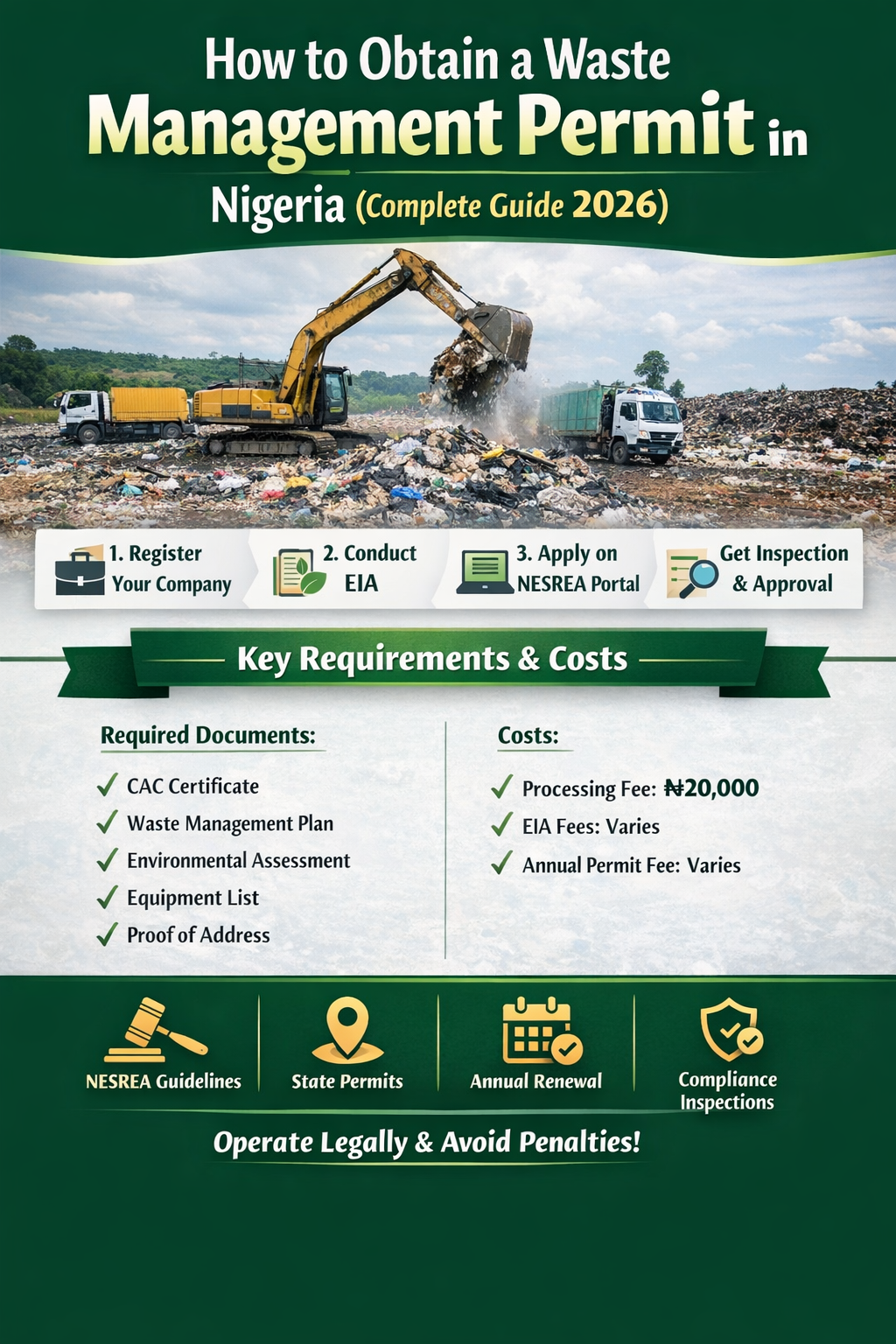
Step-by-Step Process to Obtain Waste Management Permit
-
Application Procedure on NESREA Portal
-
Inspection, Audit & Approval Process
-
Cost of Waste Management Permit in Nigeria
-
State Environmental Permits Requirements
-
Environmental Impact Assessment (EIA) Requirement
-
Renewal of Waste Management Permit
-
Compliance Obligations After Approval
-
Common Mistakes Applicants Make
-
FAQs (People Also Ask)
-
Common Misconceptions About Waste Management Permits
-
Conclusion
1. Overview of Waste Management Permits in Nigeria
Waste management permits are environmental approvals issued to companies whose activities may impact the environment through:
-
Waste collection
-
Waste transportation
-
Waste recycling
-
Waste disposal
-
Hazardous waste handling
-
Industrial waste generation
-
Medical waste disposal
-
E-waste recycling
Environmental permits ensure businesses operate in compliance with national environmental regulations.
The main federal regulator responsible for issuing environmental permits is:
-
National Environmental Standards and Regulations Enforcement Agency (NESREA)
-
Under the Federal Ministry of Environment.
2. Regulatory Authorities Responsible for Waste Management Licensing
| Authority | Role |
|---|---|
| NESREA | Federal environmental permits |
| Federal Ministry of Environment | EIA approvals |
| State Environmental Protection Agencies | State waste permits |
| Local Government Councils | Sanitation approvals |
| Special agencies (LAWMA, AEPB etc.) | State waste regulation |
NESREA enforces environmental laws and ensures industries comply with waste disposal standards.
State agencies may also require additional permits before operation.
3. Laws Governing Waste Management Permits in Nigeria
Waste management licensing is regulated by:
-
NESREA Act 2007
-
Environmental Impact Assessment Act
-
National Environmental (Sanitation & Waste Control) Regulations 2009
-
Harmful Waste Act
-
Pollution Abatement Regulations
These laws require companies handling waste to obtain environmental approval before operation.
4. Types of Waste Management Permits in Nigeria
NESREA issues different environmental permits depending on activity.
| Permit Type | Purpose |
|---|---|
| Waste & Toxic Substances Permit | Waste handling & disposal |
| Air Quality Permit | Emission control |
| Eco Permit | Environmental compliance |
| E-waste Permit | Electronic waste |
| Biodiversity Permit | Environmental protection |
NESREA categorizes environmental permits to avoid duplication.
Waste management companies typically require:
-
Waste & Toxic Substances Permit
-
Environmental Compliance Permit
-
EIA Approval (if required)
5. Who Needs a Waste Management Permit
You need a permit if you operate:
-
Waste collection company
-
Recycling plant
-
Scrap business
-
Landfill
-
Medical waste disposal
-
Hazardous waste handling
-
Industrial waste treatment
-
Waste transport company
Businesses handling waste must obtain NESREA approval before operation.
6. Requirements for Waste Management Permit in Nigeria
Company Documents
-
CAC Certificate
-
Memorandum & Articles
-
TIN
-
Company profile
Technical Documents
-
Waste management plan
-
Environmental management plan
-
Equipment list
-
Vehicle list
-
Staff qualification
Environmental Documents
-
Environmental Impact Assessment (if required)
-
Site layout
-
Safety plan
Other Requirements
-
Proof of office address
-
Consultant report
-
Payment receipt
Required documents are submitted during permit application.
7. Step-by-Step Process to Obtain Waste Management Permit
Step 1: Register Company
Register with CAC.
Step 2: Conduct Environmental Assessment
Required for high-impact waste projects.
Step 3: Enroll on NESREA Portal
Step 4: Submit Permit Application
Step 5: Pay Processing Fee
Step 6: Inspection
Step 7: Approval
Step 8: Permit Issued
NESREA processes permits through online application system.
8. Application Procedure on NESREA Portal
-
Visit permit portal
-
Enroll company
-
Get NESREA ID
-
Upload documents
-
Select permit
-
Submit form
-
Pay fee
Applications are acknowledged within working days.
9. Inspection & Audit
NESREA may conduct:
-
Facility inspection
-
Environmental audit
-
Safety check
Permits are issued only after compliance.
10. Cost of Waste Management Permit in Nigeria
| Item | Cost |
|---|---|
| Processing fee | ₦20,000 and Above |
| Annual permit fee | varies |
| Consultant fee | varies |
| EIA | varies |
Processing fee for waste permit is ₦20,000 for standard NESREA permits to over ₦2 million for major industrial waste disposal facilities.
Some recycling registrations cost about ₦50,000 annually and above.
11. State Waste Management Permit
You may also need:
| State | Agency |
|---|---|
| Lagos | LAWMA |
| Abuja | AEPB |
| Rivers | RIWAMA |
| Kano | KEPA |
State permits are required in addition to NESREA approval.
12. Environmental Impact Assessment (EIA)
Required for:
-
Landfills
-
Recycling plants
-
Hazardous waste
-
Industrial waste
EIA must be approved before permit.
13. Renewal of Waste Permit
Permit must be renewed yearly.
Requirements:
-
Inspection report
-
Payment receipt
-
Compliance report
14. Compliance Obligations
After approval:
-
Keep waste records
-
Submit audit report
-
Allow inspection
-
Follow disposal rules
NESREA monitors compliance.
15. Common Mistakes
-
Applying without EIA
-
Using wrong permit
-
No state approval
-
Incomplete documents
-
No inspection readiness
16. FAQs (People Also Ask)
Is waste management permit compulsory in Nigeria?
Yes, required for any business handling waste.
Who issues waste permits?
NESREA and state agencies.
How long does approval take?
2–8 weeks.
Can I operate without permit?
No, penalties apply.
Do recyclers need permit?
Yes.
Do hospitals need waste permit?
Yes for medical waste.
17. Common Misconceptions
Only big companies need permit?
All waste handlers need permit
NESREA alone is enough?
State permit also required
Permit once is forever?
Must renew yearly
Waste transport does not need permit?
It requires approval
18. Conclusion
Obtaining a Waste Management Permit in Nigeria is mandatory for any business involved in waste collection, disposal, recycling, or treatment. The process involves registration with NESREA, submission of environmental documents, inspection, payment of statutory fees, and approval from federal and state environmental authorities. Companies that fail to obtain the permit risk closure, penalties, and prosecution under environmental laws.
Following the steps in this guide ensures full regulatory compliance, faster approval, and smooth business operation in Nigeria.

