
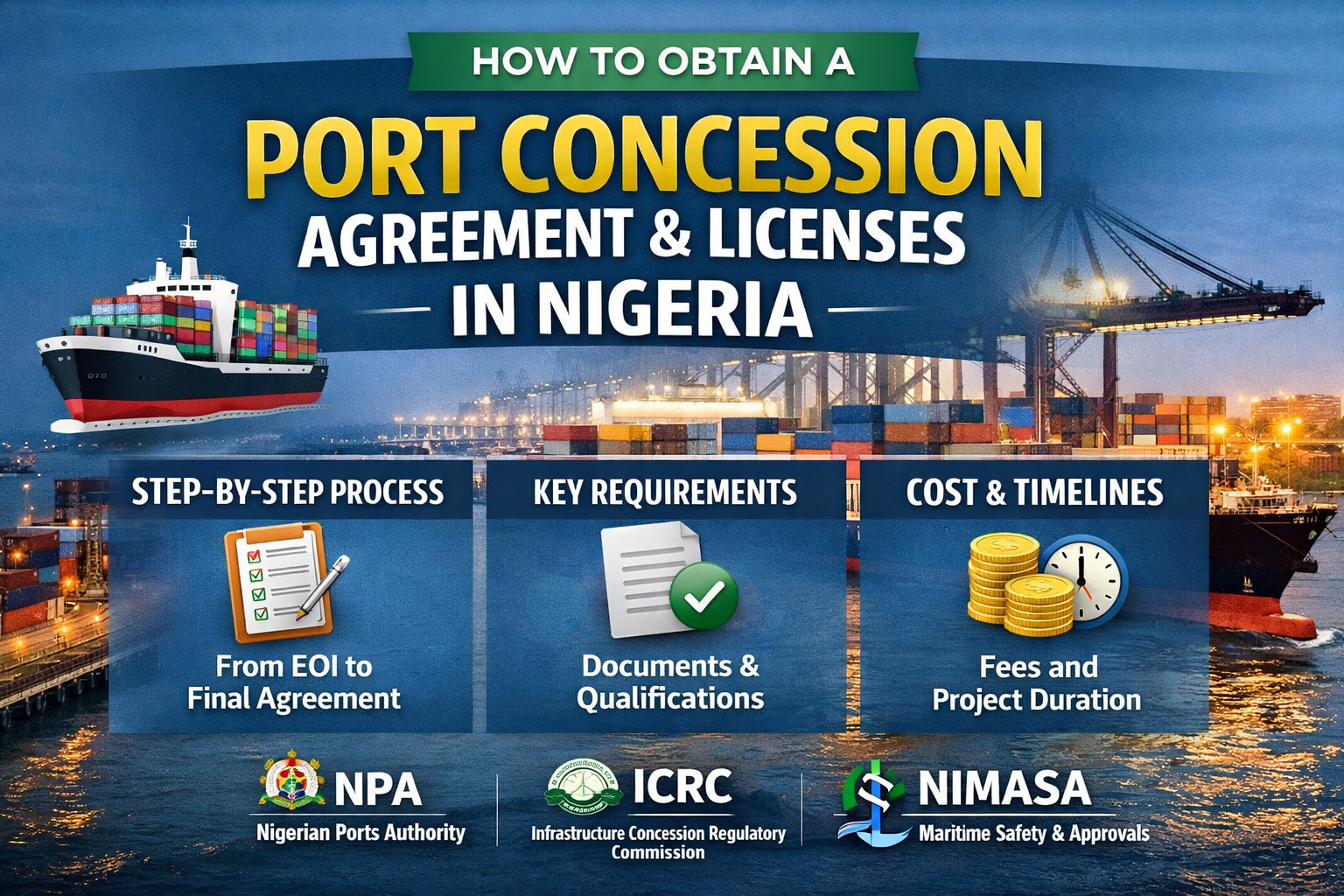
Need a PDF copy of this guide?
Download the professionally formatted PDF version of this article for offline reading, sharing with colleagues, or future reference.
📄 Download How to Obtain a Port Concession Agreement & Licenses in Nigeria_PDF (A Comprehensive Guide)
Introduction
Nigeria operates one of the largest maritime gateways in West and Central Africa. With strategic access to global trade routes and a growing domestic market, the country’s seaports remain critical infrastructure assets for commerce, energy, agriculture, and manufacturing.
For private investors and operators seeking to participate in Nigeria’s port ecosystem, the pathway typically involves securing a Port Concession Agreement and obtaining the required operational licenses from relevant maritime regulators.
This comprehensive guide provides a structured, professional overview of:
-
The legal and regulatory framework governing port concessions in Nigeria
-
The roles of key government agencies
-
Step-by-step procedures for obtaining a port concession agreement
-
Licensing requirements and regulatory approvals
-
Cost components and commercial considerations
-
Frequently asked questions and common misconceptions
This article is structured for investors, terminal operators, maritime service providers, infrastructure funds, and corporate advisors seeking clarity on how to obtain a Port Concession Agreement & Licenses in Nigeria.
1. Legal and Institutional Framework
Port concessions in Nigeria operate under a structured public-private partnership (PPP) framework involving multiple federal agencies.
1.1 Nigerian Ports Authority (NPA)
Nigerian Ports Authority
The NPA is the primary port landlord and concessioning authority for federal ports in Nigeria. It is responsible for:
-
Ownership and management of port infrastructure
-
Granting and administering port concession agreements
-
Publishing concession opportunities
-
Regulating port dues and tariff structures
-
Monitoring concessionaire compliance
Concession agreements for terminals, berths, and port facilities are executed by the NPA.
1.2 Infrastructure Concession Regulatory Commission (ICRC)
Infrastructure Concession Regulatory Commission
The ICRC provides oversight for Federal Government PPP projects, including port concessions. Its functions include:
-
Ensuring compliance with PPP regulations
-
Registering and maintaining custody of concession agreements
-
Monitoring contract performance
-
Providing regulatory guidance on PPP implementation
Port concession agreements fall within the PPP regulatory framework and are subject to ICRC oversight.
1.3 Nigerian Maritime Administration and Safety Agency (NIMASA)
Nigerian Maritime Administration and Safety Agency
NIMASA regulates maritime safety, shipping standards, and related licensing matters. Depending on the concession scope, operators may require:
-
Maritime service licenses
-
Vessel-related approvals
-
Cabotage compliance documentation
-
Safety and security certifications
2. What Is a Port Concession Agreement?
A Port Concession Agreement is a contractual arrangement through which the Federal Government, via the NPA, grants a private entity the right to finance, develop, operate, and manage specified port infrastructure for a defined period.
Key characteristics:
-
Government retains ownership of port land and core assets
-
The concessionaire receives operational and commercial rights
-
The concession is time-bound (commonly 10–25 years or more)
-
Performance benchmarks and financial obligations are defined
-
Revenue models may include lease fees, throughput fees, or revenue sharing
3. Types of Port Concessions and Licenses
Common categories include:
-
Container terminal concessions
-
Bulk cargo terminal concessions (dry or liquid)
-
Ro-ro or passenger terminal concessions
-
Private jetty and terminal licenses
-
Port service licenses (e.g., stevedoring, towage, terminal handling services)
Each concession type carries distinct operational and regulatory requirements.
4. Step-by-Step Process to Obtain a Port Concession Agreement in Nigeria
Step 1: Identification of Concession Opportunity
The NPA publishes concession opportunities or expressions of interest (EOIs). Investors monitor official publications and procurement notices.
Step 2: Expression of Interest (EOI) / Prequalification
Interested bidders submit prequalification documentation, typically including:
-
Corporate registration documents
-
Audited financial statements (usually 3 years)
-
Tax clearance certificates
-
Evidence of technical experience
-
Bank references
-
Board authorisation
Only prequalified bidders proceed to the next stage.
Step 3: Request for Proposal (RFP)
Shortlisted bidders receive the RFP, which includes:
-
Technical specifications
-
Draft concession agreement
-
Evaluation criteria
-
Financial model requirements
-
Bid security requirements
Step 4: Bid Submission
Bidders submit:
-
Technical proposal
-
Financial proposal
-
Bid bond
-
Supporting documentation
Evaluation is conducted based on compliance, technical strength, financial robustness, and commercial value to the government.
Step 5: Preferred Bidder Selection & Negotiation
The highest-ranked bidder is designated as the preferred bidder. Contract negotiations finalise:
-
Lease structure
-
Tariff framework
-
Performance benchmarks
-
Investment commitments
-
Risk allocation
Step 6: Execution of Concession Agreement
Upon agreement:
-
The concession contract is signed
-
Performance bond is issued
-
Documentation is submitted to the ICRC for registration and monitoring
Step 7: Regulatory Licensing & Mobilisation
Before commencing operations, the concessionaire must secure:
-
Operational permits
-
Maritime licenses (where applicable)
-
Environmental approvals
-
Safety certifications
This may involve engagement with NIMASA and environmental authorities.
5. Documentation Requirements Checklist
Corporate Documentation
-
Certificate of Incorporation
-
Memorandum & Articles of Association
-
Corporate Affairs Commission filings
-
Board Resolution authorising participation
Financial Documentation
-
Audited accounts (minimum three years)
-
Evidence of financial capacity
-
Bank comfort letters
-
Funding commitments
Technical Documentation
-
Project experience portfolio
-
Operational strategy
-
Equipment and asset plan
-
Key personnel CVs
Regulatory & Compliance Documentation
-
Environmental Impact Assessment (where required)
-
Health, Safety & Environmental (HSE) policies
-
Insurance coverage documentation
6. Cost Components and Financial Considerations
While costs vary depending on project scale and location, key financial components include:
| Cost Category | Description |
|---|---|
| Bid Security | Bank guarantee required during bidding |
| Performance Bond | Issued upon award of concession |
| Lease Payments | Annual or structured concession fees |
| Throughput Fees | Based on cargo volumes handled |
| Capital Investment | Equipment, infrastructure, modernisation |
| Regulatory Fees | Licensing and statutory compliance |
Tariff structures and port dues are governed by NPA regulations and incorporated into concession agreements.
7. Typical Timeline
A realistic timeline from opportunity announcement to operational commencement may range between:
-
9 to 18 months for established facilities
-
Longer for greenfield developments involving construction or dredging
Delays may arise from environmental approvals, financing arrangements, or contractual negotiations.
8. Post-Award Obligations
Concessionaires must:
-
Maintain performance standards
-
Submit periodic reports
-
Comply with tariff and regulatory rules
-
Meet investment milestones
-
Adhere to safety and maritime regulations
ICRC and NPA monitor compliance throughout the concession tenure.
9. Common Misconceptions
Misconception 1: A Concession Transfers Ownership of Port Land
Ownership remains with the Federal Government. The concessionaire only acquires operational rights.
Misconception 2: Financial Strength Alone Guarantees Award
Technical capacity, compliance history, and operational expertise are equally critical.
Misconception 3: Regulatory Approvals Are Automatic After Award
Licenses from NIMASA and other regulators must still be secured independently.
10. Frequently Asked Questions (People Also Ask)
Who grants port concession agreements in Nigeria?
The Nigerian Ports Authority grants concession agreements for federal ports.
How long does it take to secure a port concession?
Typically between 9–18 months, depending on project complexity.
Are port concessions subject to PPP laws?
Yes. They fall under the federal PPP framework and are overseen by the ICRC.
Is environmental approval required?
Yes, where development or dredging activities are involved.
Can foreign companies participate?
Yes. However, compliance with Nigerian laws, local content requirements, and corporate registration rules is mandatory.
11. Strategic Recommendations for Investors
-
Conduct thorough financial modeling before bidding
-
Engage maritime regulatory experts
-
Prepare robust local content strategies
-
Ensure complete documentation during prequalification
-
Secure financial backing early
Conclusion
Obtaining a Port Concession Agreement & Licenses in Nigeria requires strategic preparation, regulatory compliance, financial capacity, and technical expertise. The process is structured and competitive but offers significant long-term commercial opportunities for qualified operators.
Investors who approach the process with diligence, proper advisory support, and full regulatory compliance significantly increase their chances of success.
If your organisation requires professional advisory support for:
-
Concession bid preparation
-
Regulatory compliance strategy
-
Financial modeling
-
Documentation review
-
Contract negotiation support
Our team is available to provide structured guidance and end-to-end advisory services.
Contact us today to begin your port concession journey in Nigeria.
Need a PDF copy of this guide?
Download the professionally formatted PDF version of this article for offline reading, sharing with colleagues, or future reference.
📄 Download How to Obtain a Port Concession Agreement & Licenses in Nigeria_PDF (A Comprehensive Guide)

