
Introduction
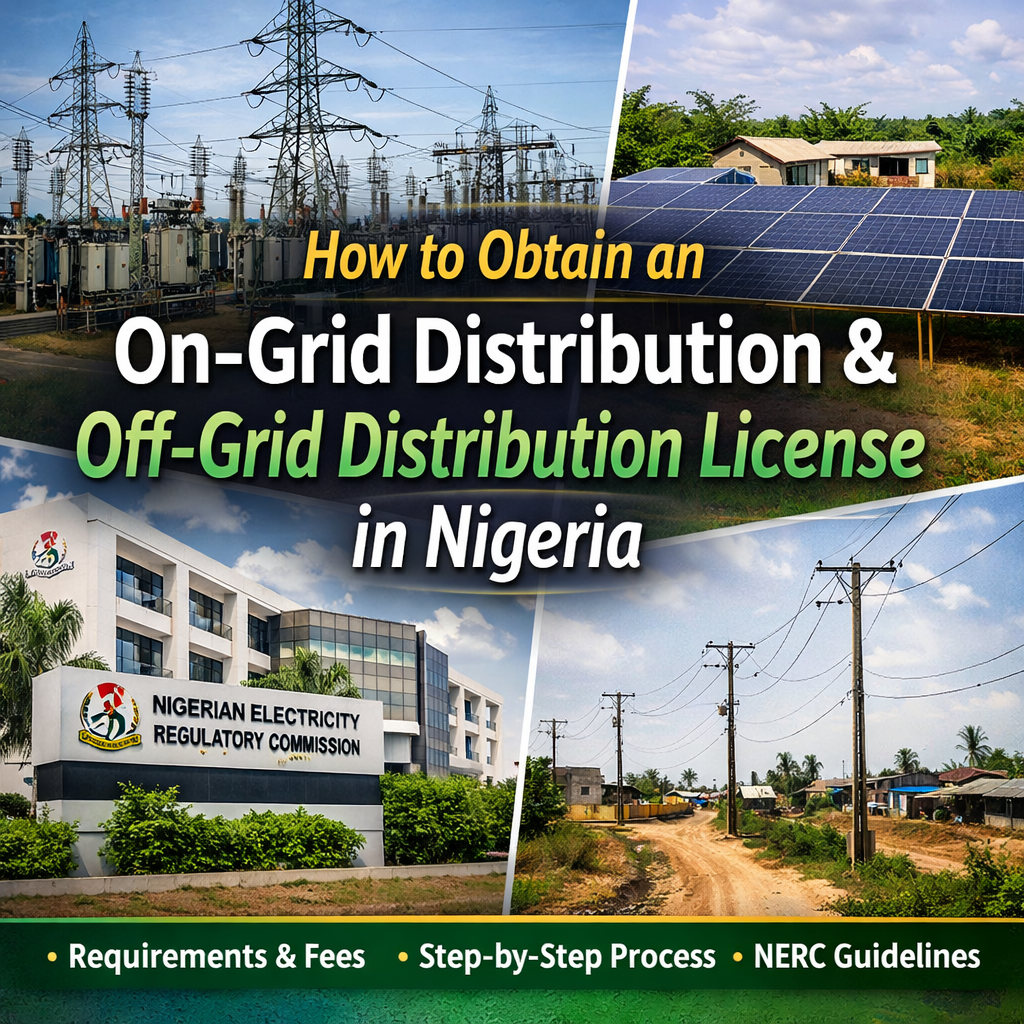
If you intend to operate an electricity distribution business in Nigeria; whether through a grid-connected distribution network or an off-grid mini-grid system, regulatory approval is mandatory.
The statutory authority responsible for issuing electricity distribution licenses and mini-grid permits in Nigeria is the Nigerian Electricity Regulatory Commission (NERC), established under the Electric Power Sector Reform Act (EPSRA).
This comprehensive guide explains, strictly based on official NERC regulations and published documents, how to obtain:
-
An On-Grid (Grid-Connected) Distribution License
-
An Off-Grid (Mini-Grid) Permit or Registration
It includes:
-
Clear step-by-step procedures
-
Official requirements
-
Processing fees and operating charges
-
Timelines
-
Frequently asked questions
-
Common misconceptions
All regulatory references are drawn directly from official NERC publications and licensing documents .
PART 1: ON-GRID DISTRIBUTION LICENCE IN NIGERIA
What Is an On-Grid Distribution License?
A Grid-Connected Distribution License authorises a company to:
-
Construct and operate electricity distribution infrastructure
-
Distribute and sell electricity within a defined geographical area
-
Connect customers to the national grid
This license is mandatory for entities operating within Nigeria’s interconnected transmission network.
Legal & Regulatory Basis
The authority for issuance of distribution licenses derives from:
-
The Electric Power Sector Reform Act (EPSRA)
-
NERC Licensing Regulations
-
NERC Application Forms for Licenses
Official Validity Period
According to NERC’s Schedule of Fees and Licensing Requirements:
-
Validity: 10 years
Step-by-Step Process to Obtain an On-Grid Distribution License
Step 1: Obtain and Complete the Official Application Form
Applicants must complete the NERC Application for License (Distribution – Grid Connected).
The form is available on NERC’s official website and must be submitted with all required supporting documentation .
Step 2: Prepare Corporate Documentation
Required corporate documents include:
-
Certificate of Incorporation (CAC)
-
Memorandum & Articles of Association
-
Particulars of Directors
-
Shareholding structure
-
Declaration of criminal convictions (if any)
These are mandatory under the NERC licensing form .
Step 3: Financial Requirements
Applicants must submit:
-
Audited financial statements for the last three (3) years (if available)
-
Bank references
-
Evidence of funding (equity, loans, grants)
-
Detailed 10-year business plan
-
Cash flow projections
NERC verifies financial and technical capability before granting approval .
Step 4: Technical Documentation
You must provide:
-
Detailed technical description of the distribution network
-
Single line diagrams
-
Load forecasts
-
Substation plans
-
Feasibility study
-
Operational & maintenance plan
Technical competence is a core licensing requirement .
Step 5: Environmental & Land Documentation
Applicants must include:
-
Environmental Impact Assessment (EIA) approval (where applicable)
-
Evidence of land rights or access
-
Site maps
These are required under NERC’s licensing documentation guidelines .
Step 6: Submission Format
NERC requires:
-
Three (3) hard copies
-
One (1) soft copy
Applications must be properly indexed and paginated .
Step 7: Payment of Official Fees
Official Fee Structure (As Published by NERC)
| Item | Amount |
|---|---|
| Processing Fee | ₦1,000,000 |
| Licence Fee | US$75,000 (or Naira equivalent) |
| Annual Operating Fee | ₦500,000 + 1.5% of licensee’s charges/kWh (net of generation & transmission cost) |
Source: NERC Schedule of Fees
Step 8: Regulatory Review & Timeline
NERC states that it aims to notify applicants of its decision within:
Six (6) months from acknowledgment of application .
During review, NERC may:
-
Request clarifications
-
Conduct due diligence
-
Invite public comments
PART 2: OFF-GRID DISTRIBUTION (MINI-GRID) LICENSING IN NIGERIA
Off-grid electricity projects fall under NERC’s Mini-Grid Regulations.
There are two categories:
-
Mini-Grid Registration (≤100 kW)
-
Mini-Grid Permit (>100 kW)
Regulatory source: NERC Mini-Grid Regulations
Key Threshold
| Capacity | Requirement |
|---|---|
| ≤100 kW | Registration |
| >100 kW | Permit (Mandatory) |
Source: NERC Mini-Grid Regulations
Step-by-Step Process for Mini-Grid Registration (≤100 kW)
Step 1: Complete Registration Form (Schedule 2)
Contained within the Mini-Grid Regulations .
Step 2: Provide Supporting Documentation
-
Corporate documents
-
Technical description
-
Installed capacity details
-
Site maps
-
Community agreement (where applicable)
Step 3: Submit to NERC
Submission is done through NERC’s mini-grid portal or as directed by the Commission .
Step-by-Step Process for Mini-Grid Permit (>100 kW)
Step 1: Complete Permit Application (Schedule 3)
Contained in NERC Mini-Grid Regulations .
Step 2: Tariff Filing
NERC requires use of the approved tariff methodology. The Commission adopted the AFUR mini-grid tariff tool for filings .
Step 3: Technical & Commercial Documentation
Required documents include:
-
Feasibility study
-
Load assessment
-
Distribution design
-
O&M plan
-
Business plan
-
Tariff model output
-
Environmental considerations
Step 4: Regulatory Review
NERC evaluates:
-
Technical soundness
-
Financial viability
-
Consumer protection compliance
Mini-Grid Regulatory Protections
Permit holders enjoy regulatory protections in case:
-
The distribution company’s grid extends into the mini-grid area
-
Asset acquisition or compensation is triggered
These protections are provided under the Mini-Grid Regulations .
Frequently Asked Questions (People Also Ask)
How long does it take to get a Distribution License in Nigeria?
NERC’s statutory review target is six months from acknowledgment of application .
Is NERC approval mandatory for mini-grids?
Yes. Systems above 100 kW require a permit. Systems at or below 100 kW must register .
How much does an On-Grid Distribution License cost?
-
₦1,000,000 processing fee
-
US$75,000 license fee
-
Annual ₦500,000 + 1.5% operating charge .
Can foreign investors apply?
Yes. NERC application forms provide for disclosure of foreign shareholders and require proof of financial capacity .
Common Misconceptions
“Small mini-grids don’t need NERC approval.”
False. Registration is mandatory for ≤100 kW systems .
“Company incorporation is enough.”
Incorrect. Technical, financial, environmental and operational capability must be demonstrated .
“Fees are the only cost.”
Beyond NERC fees, applicants must budget for feasibility studies, EIA approvals, engineering design, and professional advisory services.
Final Compliance Checklist
For On-Grid Distribution License
-
Completed NERC application form
-
3 hard copies + 1 soft copy
-
Audited accounts
-
10-year business plan
-
Technical documentation
-
EIA approval
-
Payment of ₦1,000,000 processing fee
For Mini-Grid Permit/Registration
-
Determine capacity (≤100 kW or >100 kW)
-
Complete Schedule 2 or 3
-
Submit tariff model (for permits)
-
Provide technical & commercial documentation
Conclusion
Obtaining an On-Grid Distribution License or Off-Grid Mini-Grid Permit/Registration in Nigeria requires strict compliance with the official requirements of the Nigerian Electricity Regulatory Commission.
The process is documentation-intensive and highly technical, with clear statutory timelines and defined fee structures. However, with proper preparation, financial strength, technical capacity, and regulatory compliance, approval is achievable.
For serious investors and energy developers, understanding these regulatory pathways is not optional, it is foundational to operating legally and sustainably within Nigeria’s electricity sector.

